


Reading time: 4 min
A 60% dividend hike and ambitious plans to double output by 2030 sit alongside a year of missed production targets, severe weather disruptions and rising costs across the company’s Ontario operations.
Record Numbers, Awkward Details

Alamos Gold reported fourth-quarter and full-year 2025 results on February 18, delivering a set of financial records that owe more to the gold price than to operational excellence. Annual revenue hit $1.8 billion, up 34% from 2024, and free cash flow reached $352 million — both company highs. The Toronto-listed miner realised an average gold price of $3,372 per ounce for the year and $3,998 per ounce in the fourth quarter alone, the latter reflecting spot gold’s surge past $5,000 in recent months. Those prices papered over a production shortfall: Alamos poured 545,400 ounces in 2025, a 4% decline from the prior year and below revised guidance, after severe winter weather and operational setbacks at its Canadian mines dragged output lower in the second half.
The market, however, chose to look forward. Shares rose 4.7% on the day to $62.68, just below the 52-week high, after CEO John McCluskey announced a 60% dividend increase — from $0.025 to $0.04 per share quarterly — and laid out a five-year growth roadmap targeting approximately one million ounces annually by 2030. Alamos returned $81 million to shareholders in 2025 through dividends and buybacks, nearly double the $41 million distributed the previous year.
Island Gold: The Bet That Has to Work
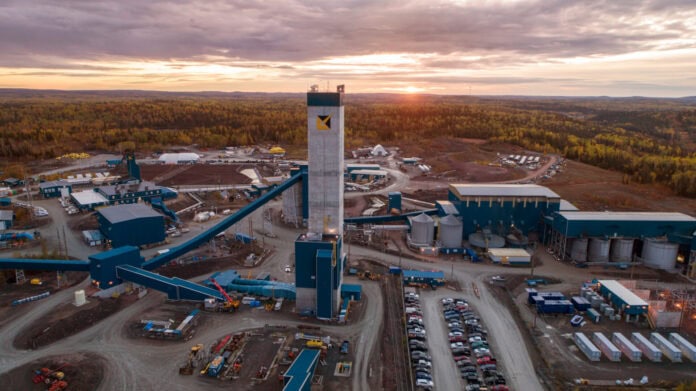
The centrepiece of Alamos’ expansion strategy is the Island Gold District in northern Ontario, which combines the underground Island Gold mine with the open-pit Magino operation acquired through the Argonaut Gold merger in 2024. The district produced 250,400 ounces in 2025 and generated $205 million in mine-site free cash flow after absorbing all Phase 3+ Shaft Expansion capital and exploration costs. Alamos is now expanding the district’s milling capacity to 20,000 tonnes per day, with underground contributing 3,000 tonnes and open-pit mining the balance. Once the expansion completes in 2028, the company expects the district to average 534,000 ounces annually for its first ten years at all-in sustaining costs of $1,025 per ounce — more than double current output at roughly 30% lower unit costs. At a conservative $3,200 per ounce gold assumption, the operation carries an after-tax net present value of $8.2 billion and would generate over $800 million a year in free cash flow on its own.
Mineral reserves across the company grew 32% in 2025 to 15.9 million ounces, with Island Gold accounting for nearly four million ounces of the increase. The Phase 3+ shaft is on track for completion in Q4 2026, followed by the PDA project in 2027, the broader district expansion in 2028, and the Lynn Lake project by 2029. McCluskey stressed that all growth sits within Canada and will be funded internally. The balance sheet supports that: cash ended the year at $623 million, up 90% from 2024, with debt reduced to $200 million, leaving net cash of $423 million and total liquidity of approximately $1.2 billion.
Turkish Exit, Canadian Focus
Alamos completed the sale of its three Turkish development projects to Tümad Madencilik for $470 million in October 2025, receiving $160 million upfront with $310 million due over the next two years. It also divested the non-core Quartz Mountain asset in Oregon. Both sales sharpened the portfolio toward Canadian jurisdictional safety — a theme that resonates with institutional investors wary of permitting risk in a trade environment distorted by tariff escalation.
When Gold Does the Heavy Lifting
Alamos’ Q4 adjusted earnings of $0.54 per share and revenue of $575 million both missed analyst expectations, yet the stock still rallied. The explanation is straightforward: with spot gold above $5,000 and Societe Generale targeting $6,000 by year-end, even an operationally mediocre gold miner generates enormous cash flow at these prices. Guidance for 2026 calls for 570,000 to 650,000 ounces at AISC of $1,500 to $1,600, implying free cash flow margins unthinkable two years ago. The company still carries 100,000 ounces of legacy hedges inherited from Argonaut Gold through the first half of 2027, but has already eliminated 230,000 of the original 330,000 hedged ounces ahead of schedule.
For investors tracking gold miners alongside broader equity rallies and persistent central bank buying, Alamos offers a specific bet: that a mid-tier Canadian producer can double output in five years without diluting shareholders or taking on significant debt. Whether Island Gold delivers on its $8.2 billion NPV promise — or whether $5,000 gold is simply doing the heavy lifting — will become clearer once the shaft is finished and expansion ramps through 2028. Until then, the dividend cheque just got 60% larger.