


Reading time: 4 min
Brent crude surged 2.4 percent on Thursday to $72.01 per barrel — its highest since the June 2025 twelve-day war — while WTI gained 2.7 percent to $66.78. Both benchmarks posted their strongest weekly close in six months, with Brent rallying roughly 7 percent from Tuesday to Friday. Goldman Sachs estimates about $6 per barrel of geopolitical risk premium is now embedded in the price. The question for physical traders is not whether that premium is justified. It is whether $6 is enough.
The Supply at Stake
Iran produces approximately 3 million barrels per day of crude, with exports averaging roughly 1.7 million bpd — about 90 percent flowing to China through the Strait of Hormuz. But Iran’s own barrels are only the start. The strait is 21 miles wide at its narrowest, its shipping lanes fall entirely within Iranian and Omani territorial waters, and roughly 20 million bpd transit the corridor — one fifth of global supply. Saudi Arabia alone ships about 5.5 million bpd through the chokepoint. Almost half of India’s crude imports and 60 percent of its gas pass through it.
The paradox is OPEC’s spare capacity — normally the market’s shock absorber. Energy Intelligence calculated adjusted spare capacity at 5.8 million bpd as of mid-2025, historically high levels bolstered by years of output restraint. The Big Four — Saudi Arabia, UAE, Iraq and Kuwait — control virtually all of it, having cut roughly 2.5 million bpd below their 2022 peak. But approximately 70 percent of that spare sits in countries whose exports transit the Strait of Hormuz. A closure scenario does not just knock out Iranian supply. It strands the barrels that are supposed to replace it.
The Military Buildup
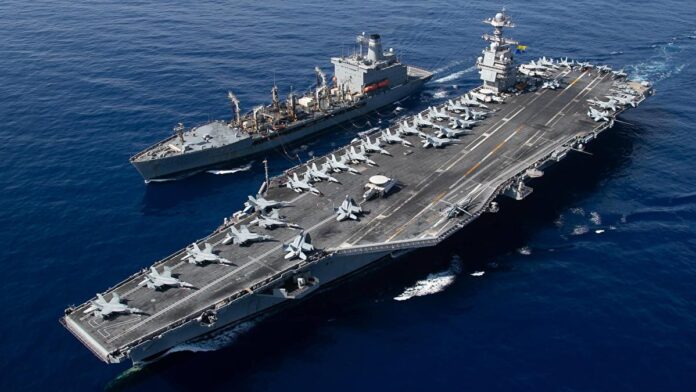
The Pentagon deployed at least 78 fighter and attack aircraft to Central Command bases between Monday and Wednesday, more than doubling its Gulf presence. The USS Gerald R. Ford is heading to join the Lincoln carrier group — the largest US deployment to the region since 2003. Iran responded with live-fire drills in Hormuz on February 17, temporarily closing sections of the waterway, then held joint exercises with Russia in the Gulf of Oman. Its parliament authorised the strait’s closure last year. Trump set a ten-day nuclear deadline Thursday and said Friday he was considering a limited strike; former ambassador Daniel Shapiro told CNBC the operational window opens this weekend.
What the Forward Curve Is Pricing
Goldman’s $6 risk premium implies the market assigns roughly a 25 percent probability to a major Middle Eastern conflict, according to energy analysts cited by Fortune. Barclays expects any strike to be time-limited and targeted at nuclear and ballistic missile sites, noting that with midterm elections this year and the administration’s trade and affordability agenda as priorities, Washington has limited tolerance for sustained high prices.
But the limited-strike scenario still carries supply risk that the premium may underweight. Global inventories sit well below five-year averages — a cushion that has quietly thinned while attention focused on the demand-side narrative. The EIA recently revised its OPEC capacity definitions, acknowledging that effective spare capacity — what can be brought online within 90 days and sustained — is meaningfully lower than nameplate figures suggest. Saudi Arabia last truly opened the taps during the 2014-2016 price war; a decade of underinvestment and mature-field decline has occurred since. Tortoise Capital’s Rob Thummel put the extreme case bluntly: a prolonged Hormuz disruption sends oil above $100. Each day without a deal narrows Trump’s timeline and widens the tail risk.
The Demand Side Isn’t Helping
OPEC+ paused output hikes for Q1 2026 after releasing roughly 2.9 million bpd since April 2025, and the Big Four’s rate of increase has been slowing. US horizontal rig counts dropped from 450 in April 2025 to roughly 366 — a decline that, at mid-$60s WTI, shows no sign of reversing. OPEC expects demand for its crude to rise by 600,000 bpd in both 2026 and 2027, while projecting US tight oil output will fall — implying a tighter physical market than current industrial supply chains already contending with overcapacity can easily absorb.
Where It Stands
By Monday both benchmarks pulled back modestly as US-Iran talks were set to resume in Switzerland. Brent held near $71, WTI near $67. The market’s base case remains diplomacy or a limited strike that avoids the strait — the pattern of last summer’s twelve-day war, when prices spiked and fell back quickly. The difference is the scale of the buildup, the explicit deadline, and the fact that Iran has rehearsed — live, in the strait, this month — the exact scenario the market says is unlikely. At $6 per barrel, the risk premium prices in a one-in-four chance of major conflict. Whether that is the right number depends on whether ten days leaves room for the kind of off-ramp that has always appeared before.
Sources: CNBC, Al Jazeera, Fortune, OilPrice