


Reading time: 6 min
Operation Epic Fury is four days old and the financial damage is outpacing the military timetable. VLCC tanker rates hit an all-time high, five major marine insurers pulled war-risk cover from the Persian Gulf, Brent surged past $82 intraday before settling near $78, and the Stoxx 600 is down 5.2 percent in two sessions. The Strait of Hormuz isn’t formally blockaded. It doesn’t need to be.
Forget the White House’s four-to-five-week timeline for a moment. The more consequential clock is the one ticking on protection and indemnity insurance for commercial vessels transiting the Strait of Hormuz, which gets revoked entirely on March 5, according to shipping data aggregated by analysts tracking the crisis. Without P&I cover, no shipowner sends a tanker through regardless of what any navy says about safe passage. The insurance market, not the IRGC, is what actually closed the strait.
What Happened on the Ground
The joint U.S.-Israeli campaign launched on February 28 has killed at least 787 people in Iran, according to the Iranian Red Crescent, as reported by Al Jazeera’s live tracker on March 3. That figure includes Supreme Leader Ali Khamenei, whose wife was confirmed dead from injuries sustained in the initial strike. Six U.S. service members have been killed. Eleven people have died in Israel, with additional casualties reported in the UAE, Kuwait, and Bahrain, per NBC News.
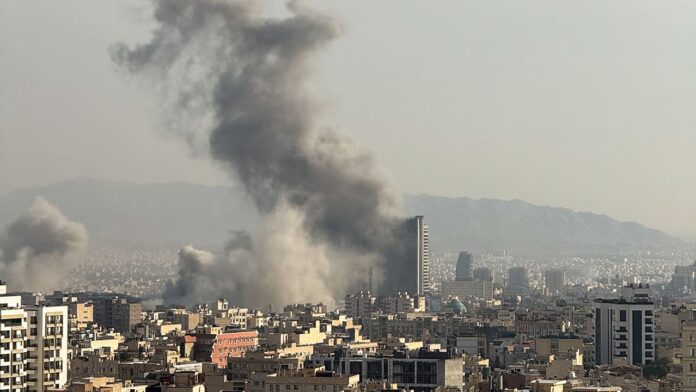
The target list tells you the scope. Israel’s air force dropped more than 1,200 munitions across 24 of Iran’s 31 provinces over the past day alone, according to Al Jazeera. The IAEA confirmed that the Natanz nuclear enrichment facility suffered significant damage from strikes on March 1 and 2, with satellite imagery from Vantor corroborating the assessment. On Tuesday morning, Israeli jets hit the Islamic Republic of Iran Broadcasting complex in central Tehran and damaged the Golestan Palace, a UNESCO World Heritage Site. The Assembly of Experts was bombed while in session to elect Khamenei’s successor.
Iran hasn’t absorbed this passively. The IRGC launched attacks on 27 bases hosting U.S. troops across the region, struck Israeli military targets in Tel Aviv, and hit the U.S. Embassy in Riyadh with two drones on Monday, according to Saudi authorities via CNBC. Qatar shut down LNG production after drones struck key facilities. Kuwait’s air defences intercepted multiple ballistic missiles at Ali al-Salem Air Base, though three U.S. fighter jets were accidentally downed by Kuwaiti forces, with all crew surviving, per NBC Washington. Jordan intercepted 49 drones and ballistic missiles entering its airspace.
The Market Damage
This is where it gets expensive for everyone, not just the combatants.
The benchmark freight rate for Very Large Crude Carriers shipping 2 million barrels from the Middle East to China hit $423,736 per day on Monday, an all-time record, according to LSEG data cited by CNBC. That’s a 94 percent jump from Friday’s close. Five major marine war-risk insurers pulled coverage from the Persian Gulf in under 48 hours: the American Club, Norway’s Gard and Skuld, Britain’s NorthStandard, and the London P&I Club. Without insurance, tankers don’t move. Full stop.
CMA CGM slapped an Emergency Conflict Surcharge on Monday: $2,000 per 20-foot container, $3,000 per 40-foot, $4,000 per refrigerated unit. The surcharge applies to cargo flowing to or from Iraq, Gulf states, Jordan, Egypt, Djibouti, Sudan, Eritrea, and Yemen, per The National. Maersk suspended all special cargo acceptance in and out of the UAE. Hapag-Lloyd followed with its own levies. Roughly 150 tankers and LNG carriers have dropped anchor in open Gulf waters with nowhere to go, according to Reuters ship-tracking estimates reported by Al Jazeera.
Brent crude opened the week by surging 13 percent to touch $82.37 before profit-taking pulled it back to settle around $78, per Investing.com data. On Tuesday it was swinging between $76 and $82, still its widest intraday range in years. The run-up that took Brent past $71 on Trump’s initial Iran deadline now looks like a warmup act. Barclays told clients Saturday that Brent could hit $100 if the security situation spirals further. UBS went further, flagging $120 in a material disruption scenario. JPMorgan’s Natasha Kaneva warned that a war lasting beyond three weeks would exhaust Gulf storage capacity as barrels pile up with no export route, forcing production shutdowns.
European equities absorbed the shock across both sessions. The Stoxx 600 fell 1.7 percent on Monday, then extended losses to 3.5 percent by Tuesday late morning, per Bloomberg. The DAX dropped 4.1 percent. The Euro Stoxx 50 shed 3.8 percent. Banks, insurance, and mining shares led the selloff. Even defense stocks, which closed Monday in the green, turned negative on Tuesday. European natural gas futures surged more than 40 percent as Qatar’s production shutdown compounded the energy squeeze that Europe was already facing from its Russian LNG ban colliding with the Hormuz closure.
Wall Street’s reaction was comparatively muted. The Dow dropped 600 points intraday Monday before closing down just 73, and the S&P 500 finished essentially flat, per NPR. But American consumers will feel it soon enough. GasBuddy’s Patrick De Haan reported that the national average gasoline price jumped 12 cents on Monday, the largest single-day increase in four years. He estimated a further 10 to 30 cents per gallon in the coming days, with some individual stations seeing spikes as high as 85 cents.
The Political Signals
There’s no off-ramp visible. Not yet.
Trump told CNN that the “big wave” of the U.S. attack hasn’t happened, a statement Rubio echoed on Capitol Hill, promising the next phase would be “even more punishing.” Defense Secretary Pete Hegseth said the war would not be “endless” and that regime change was not the objective, though that sits awkwardly beside Trump’s own February 28 video statement urging IRGC members to surrender and telling Iranians to “take over your government.” Netanyahu, speaking to Fox News, framed the entire campaign as something that would bring democracy to Iran.
Senate Minority Leader Schumer was blunt after a classified briefing from Rubio, telling reporters it raised more questions than it answered, per CNBC. The State Department on Monday urged Americans in more than a dozen Middle Eastern countries to leave immediately. Over one million travelers are caught in transit chaos, with another 1,900 flights cancelled on Tuesday alone, according to aviation data firm Cirium, as CNBC reported.
OPEC+ moved on Sunday to raise production by a modest 206,000 barrels per day starting in April, per the Christian Science Monitor. That gesture won’t dent the supply gap if Hormuz stays shut. Saudi Arabia’s East-West Pipeline, the main bypass option, has roughly 2.4 million barrels per day of spare capacity, according to a pre-war analysis from CSIS. That covers less than half of Saudi exports, let alone the roughly 14 million barrels per day that transited the strait in 2025, per Kpler.
What Markets Need to Watch
Three things, all of them binary. First, the March 5 P&I insurance deadline. If coverage isn’t reinstated, the de facto closure becomes structural rather than tactical, and the pricing models everyone is using for Brent, TTF, and container freight all break. Second, the Houthi situation. The National reported that Yemen’s militia is preparing to close the Bab Al Mandeb strait. That would mean two of the world’s three critical energy chokepoints shut at the same time. Third, Iran’s retaliatory targeting. Tehran has so far struck military bases and embassies. If it pivots to Saudi or Emirati energy infrastructure, Brent doesn’t stop at $100. Bank of America’s Francisco Blanch told CNBC that a hard-line Iranian response targeting neighbouring energy facilities could push European natural gas above 60 euros per megawatt hour.
Four days in, the market is still pricing a short war. The White House is saying four to five weeks. Those two assumptions cannot both be right.