


Reading time: 5 min
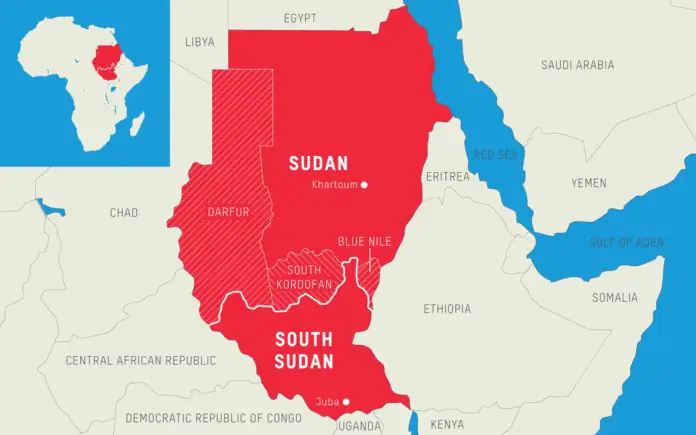
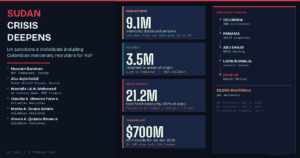
Britain sanctioned six individuals on February 5 for fuelling Sudan’s civil war, targeting RSF and SAF commanders alongside a transnational Colombian mercenary recruitment network linked to Abu Dhabi. The measures add names to a growing sanctions ledger but do little for the 3.5 million Sudanese who have returned to destroyed cities with no electricity, hospitals, or functioning public services — while famine conditions grip Al Fasher and Kadugli and 21.2 million people face acute hunger.
Who Was Sanctioned — and Why It Matters
Foreign Secretary Yvette Cooper announced the designations following her visit to the Sudan-Chad border, where she met refugees including women and girls subjected to sexual violence by warring factions. The six targets span both sides of the conflict and, critically, the mercenary pipeline feeding it.
Hussein Barsham, an RSF field commander, faces sanctions for mass atrocities including ethnic violence, forced displacement, and attacks on civilians in Darfur. Abu Aqla Mohamed Keikil, a former RSF commander who defected to lead the Sudan Shield Forces under the SAF, is linked to attacks against Kanabi farming communities in Gezira state. Mustafa Ibrahim Abdel Nabi Mohamed, director of the UK-sanctioned al-Khaleej Bank, is suspected of serving as financial adviser to RSF leader Hemedti and facilitating illicit financing of the paramilitary’s military campaign.
The remaining three — Claudia Viviana Oliveros Forero, Mateo Andres Duque Botero, and Alvaro Andres Quijano Becerra — are accused of recruiting former Colombian military personnel to train and fight for the RSF. This is the most internationally significant element of the package: it formally links UK sanctions architecture to a mercenary pipeline that has funnelled an estimated 380 former Colombian soldiers into Darfur since September 2024.
The Colombian Pipeline
An AFP investigation in December 2025 exposed how the network operates. Colombian veterans were recruited via WhatsApp under the guise of security work in the United Arab Emirates, only to be deployed to RSF frontlines in western Sudan via transit through Libya and Somalia. The mercenaries — organized into a unit called the “Desert Wolves” — provide tactical expertise as snipers, artillerymen, and drone pilots, earning $2,500 to $4,000 per month, roughly six times a Colombian military pension.
Geolocation data from battlefield footage places Colombian fighters at the scene of the RSF’s October 2025 takeover of El Fasher, a siege marked by mass killings and sexual violence that displaced over 100,000 people. An Abu Dhabi-based firm, Global Security Services Group (GSSG), was identified as the financial node managing mercenary compensation through a Panama-registered entity. The UAE has repeatedly denied involvement. The United States sanctioned four Colombian nationals and their companies on December 9, 2025, weeks before the UK action. Colombia’s government formally apologized to Sudan for its citizens’ involvement.
Return Without Recovery
Nearly three years after fighting erupted in April 2023 between the Sudanese Armed Forces and the Rapid Support Forces, Sudan remains the world’s largest displacement crisis. More than 15 million people have been forced from their homes since the conflict began — at the crisis peak, one in every seven internally displaced persons globally was Sudanese.
Yet an overlooked counter-trend is accelerating. According to IOM data from February 9, some 3.5 million Sudanese have returned to areas of origin — over 1.3 million to Khartoum state alone, following the army’s recapture of the capital, Sennar, and Gezira. The total displaced population has fallen 21 percent from its January 2025 peak of 11.5 million, to approximately 9.1 million internally displaced. But 83 percent of returnees came from internal displacement rather than abroad, and 52 percent of those returning are children.
These are not returns to stability. UNICEF reports that over 70 percent of health facilities remain nonfunctional. Water infrastructure has been destroyed or looted. In Khartoum, electricity grids, universities, hospitals, and water networks have sustained heavy damage. Markets function sporadically, public administration remains fragmented, and local security is volatile. IOM Director General Amy Pope warned that without sustained support, return risks becoming another cycle of hardship rather than recovery.
Famine Spreading
The humanitarian dimension dwarfs the sanctions agenda. The IPC confirmed famine conditions in Al Fasher (North Darfur) and Kadugli (South Kordofan) as of September 2025, with similar conditions suspected in Dilling but unconfirmable due to access restrictions. On February 5, the IPC issued a new alert: famine-level acute malnutrition had been detected in two additional North Darfur localities, Um Baru and Kernoi. The risk of famine persists across 20 additional areas in Greater Darfur and Greater Kordofan.
An estimated 21.2 million people — 45 percent of Sudan’s population — face high levels of acute food insecurity. Nearly 4.2 million cases of acute malnutrition are projected for 2026, including over 800,000 cases of severe acute malnutrition among children. The World Food Programme requires $700 million for operations from January to June 2026 alone. The broader pattern of international institutions struggling to match rhetoric with resources is nowhere more visible than in Sudan: the $4.16 billion humanitarian plan was just 28 percent funded as of late 2025, while barely 40 percent of required funding was secured for the full year.
Sanctions vs. Reality
The UK will make Sudan a priority during its UN Security Council presidency in February, pressing for humanitarian access, accountability, and coordinated international pressure on both warring parties. In April, Britain and Germany will co-host an international conference marking the conflict’s third anniversary. London has contributed £146 million in humanitarian aid, including £21 million added in December 2025.
These are not trivial measures. The Colombian mercenary designations, in particular, represent a meaningful expansion of the sanctions framework beyond the conflict’s immediate principals to the transnational financial networks sustaining it. The January 7 US State Department determination that the RSF committed genocide against the Masalit people in West Darfur adds legal gravity.
But armed actors in Sudan operate through regional patronage networks, illicit gold trade routes, and alternative financial channels largely beyond the reach of Western banking restrictions. For the families returning to devastated neighborhoods, sanctions remain invisible abstractions. Their immediate concern is whether electricity will return, whether hospitals will reopen, whether their children can attend school. Without enforcement mechanisms tied to ceasefire compliance, humanitarian access guarantees, and civilian monitoring systems, the gap between diplomatic activity and ground reality will continue to widen.
Sources: Middle East Eye