


Reading time: 6 min
India’s National Stock Exchange issued a request for proposals to investment banks on Wednesday, formally launching what could be a $2.5 billion listing — the culmination of a decade-long regulatory battle that at one point saw the exchange pay ₹1,388 crore just to settle the governance scandal blocking its path to public markets. The move lands in the middle of an Asia Pacific IPO boom that saw $90 billion in proceeds last year, with Manila simultaneously slashing float requirements to pull mega-caps onto its own bourse.
The Casino Goes Public
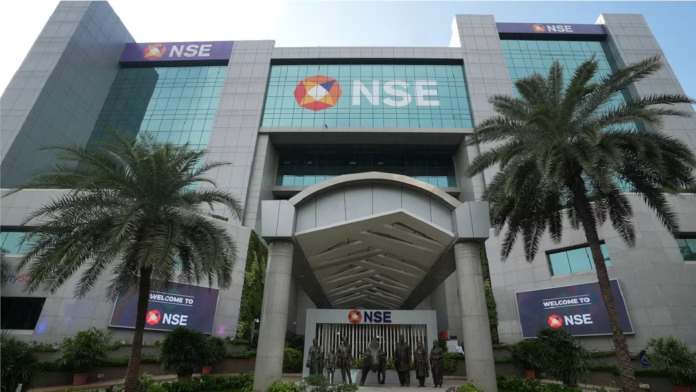
NSE operates the world’s busiest derivatives market by contract volume, holds a 93% share of India’s equity cash market, and oversees securities with a combined market capitalisation exceeding ₹460 lakh crore. It facilitates roughly 65 IPOs per quarter. It has never had one of its own. That changes in 2026.
Bloomberg reported Wednesday that NSE has appointed Rothschild & Co. as independent adviser to oversee the listing process. The exchange plans to select lead bankers by mid-March, with a draft red herring prospectus filing targeted for late March or early April. The IPO will be structured as a pure offer for sale — no fresh capital raised — with existing shareholders divesting 4–4.5% of their equity. At unlisted market prices of roughly ₹2,150 per share, that implies a deal size of approximately ₹23,000 crore ($2.5 billion) and a total valuation near ₹5.3 lakh crore. Bloomberg data puts that figure at the world’s fourth-most valuable exchange among listed peers.
The selling shareholders read like a who’s who of Indian institutional capital. Life Insurance Corporation holds 10.72%, Singapore’s Temasek about 4.5%, SBI Capital Markets 4.5%, and State Bank of India 3.2%. Stock Holding Corporation of India, the Canada Pension Plan Board and Morgan Stanley are also on the register. All 184,000 shareholders will be given the option to participate. NSE has no promoter — it is structured as a Market Infrastructure Institution — which means the board is composed entirely of institutional holders and independent directors.
Ten Years of Co-Location
NSE first filed draft offer documents in 2016, seeking to raise around ₹10,000 crore. It never got to market. SEBI investigations into the so-called co-location scandal — in which certain brokers allegedly received preferential access to the exchange’s trading systems — froze the listing process for the better part of a decade. A parallel dark fibre case compounded the regulatory overhang. NSE ultimately filed two settlement applications and offered to pay ₹1,388 crore, which SEBI accepted. The no-objection certificate arrived on January 30, 2026.
The exchange has not been idle financially. Q3 FY26 consolidated profit after tax came in at ₹2,408 crore — down 37% year-on-year due to one-off provisions including the co-location settlement charge, but up 15% sequentially. Revenue from transaction charges rose 9% quarter-on-quarter to ₹3,033 crore. Standalone PAT margin hit 59%. For nine months through December 2025, NSE contributed ₹41,842 crore to India’s exchequer in securities transaction tax alone. This is not a company that needs fresh capital in a volatile macro environment. The entire offering is a liquidity event for long-standing shareholders who have waited a decade for an exit.
Manila Rewrites the Float Rules
The NSE listing would arrive in the middle of the most active Asia Pacific IPO market in years. And regulators across the region are responding by competing for deal flow. On February 24, the Philippine Securities and Exchange Commission signed Memorandum Circular No. 11, Series of 2026, introducing a tiered minimum public ownership framework that could reshape that country’s dormant listings market.
Under the old rules, every company going public in Manila had to float at least 20% of its shares regardless of size. Under the new system, companies with an expected market capitalisation above ₱50 billion need only a 15% public float, with flexibility to go as low as 12% for exceptionally large listings above ₱150 billion. Smaller firms retain higher requirements — up to 33% for companies valued under ₱500 million. The circular takes effect immediately, though the Philippine Stock Exchange has a transitional period to update its listing rules.
The target is obvious. GCash parent Mynt and digital bank Maya have both been weighing IPOs, with Maya targeting a US-first dual listing in the second half of 2026. Chinabank Capital managing director Juan Paolo Colet said the new rules make it easier for both fintechs to list domestically. Analysts also flagged Land Bank of the Philippines, where the government could retain a larger stake under the lower float threshold. The Philippine benchmark PSEi is up 8.56% from its 12-year low but still lags regional peers, and SEC Chairman Francis Lim has been explicit that the reform is about competitiveness — Manila’s flat 20% rule was increasingly out of step with Hong Kong’s tiered system adopted in August 2025 and India’s structurally flexible approach.
$90 Billion and Counting
The macro backdrop supports both moves. Asia Pacific IPO proceeds surged to $90.4 billion in 2025, up 73% year-on-year, according to Dealogic data compiled by J.P. Morgan. Seven of the world’s ten largest IPOs took place in the region. Total APAC equity capital market volumes hit $334 billion — 34% of the global total — with Hong Kong rebounding sharply and India now commanding a 20% share of all regional ECM activity, up from an average 9% between 2019 and 2023.
J.P. Morgan’s Asia Pacific CEO Sjoerd Leenart told CNBC in January that activity across the region was “unbelievable.” Goldman Sachs’ APAC ex-Japan president Kevin Sneader described markets as having learned to operate through geopolitical volatility rather than waiting for it to pass. The pipeline for 2026 includes Reliance Jio, which could become India’s largest-ever IPO, SBI Funds Management targeting up to $1.2 billion, SoftBank’s PayPay in Japan, and SK Hynix exploring a New York secondary listing.
Even smaller stories illustrate the breadth. Sedemac Mechatronics — a Pune-based deeptech company founded in 2007 by IIT Bombay associate professor Shashikanth Suryanarayanan and three of his students — opens its ₹1,087 crore IPO on March 4, less than a week after NSE’s banker pitch launched. Suryanarayanan holds a 16.2% stake he is not selling. The company, which designs electronic control units for two-wheelers and industrial engines, posted an eightfold profit jump in FY25 to ₹47 crore on revenue of ₹658 crore. An IIT professor’s lab project from 2007 reaching public markets at a ₹1,352-per-share price band is the kind of story that keeps IPO pipelines full.
What the NSE Listing Actually Tests
The NSE IPO is the headline, but the real test is structural. India’s primary market has been one of the strongest in the world for two consecutive years, even as the secondary market has sold off — the Nifty is down roughly 10% from January 2025 highs, foreign institutional investors pulled a record ₹1.6 lakh crore from Indian equities in 2025, and mid-cap indices have fallen 25% from their peaks. The question is whether a $2.5 billion secondary offering from the institution that underpins the entire system can find demand in a market where FIIs are still net sellers.
If it can, it validates the thesis that India’s capital markets have matured enough to absorb institutional-scale liquidity events regardless of the cycle. If it can’t — or if the pricing has to come in materially below grey-market levels — it tells you something about the gap between India’s IPO narrative and its actual absorption capacity. Either way, the exchange that spent a decade watching everyone else ring the bell is about to find out what its own shares are worth. Listing is expected by late 2026.
Sources: Business Standard, Business Today, BusinessWorld, J.P. Morgan, CNBC