

Reading time: 5 min
South Korea imports 64.7% of its helium from Qatar. Qatar’s main helium facility has been offline since March 2, when an Iranian drone struck the Ras Laffan industrial complex. The Strait of Hormuz is effectively closed to shipping. Samsung and SK Hynix have roughly six months of stockpiles. The AI chip trade has a supply chain problem that has nothing to do with crude oil, and markets are only beginning to price it.
What Helium Has to Do With Your Next GPU
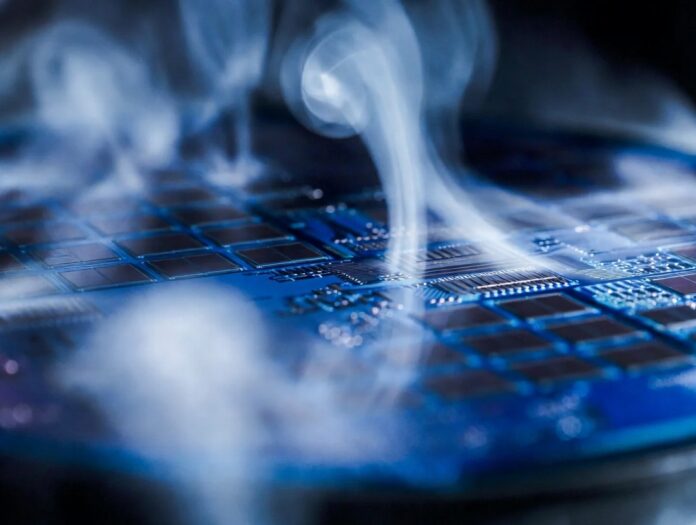
Helium is not optional in semiconductor manufacturing. It is used throughout the wafer cooling process – specifically to transfer heat away during lithography and deposition steps where any thermal variance degrades yields. There is no practical substitute at scale. Qatar produces over a third of global helium supply, according to USGS data cited by CNBC, and South Korea sources 64.7% of its national helium imports from Qatar, per the Korea International Trade Association. With QatarEnergy’s Ras Laffan Industrial City offline since March 2 – the Financial Times reported the facility will not restart production until the conflict ends – a meaningful share of global helium supply has simply stopped.
Phil Kornbluth, president of Kornbluth Helium Consulting, told CNBC it is “getting hard to imagine” the world avoids a minimum two-to-three month shutdown of helium production, followed by a four-to-six month period before supply chains return to normal. More than 25% of global helium supply would be taken off the market by an extended Hormuz closure, Kornbluth said. Industry sources cited by Businesskorea confirmed that Samsung and SK Hynix hold combined stockpiles of approximately six months. That is not a comfortable buffer in a prolonged conflict. It is a deadline.
Bromine Is the Other One Nobody Is Talking About
Helium is getting the headlines. Bromine is quieter but arguably more concentrated. South Korea sources 97.5% of its bromine imports from Israel, according to the Korea International Trade Association. Bromine is a core material in flame retardants used in chip packaging and printed circuit boards, and a key part of the broader semiconductor manufacturing process. Israel has sustained repeated Iranian missile strikes since the conflict began. The concentration of global semiconductor equipment companies in the Tel Aviv region – a major hub for measurement and inspection tools supplied to Samsung and SK Hynix fabs – adds a further variable that has received almost no coverage outside Korean trade press.
“A prolonged regional conflict could potentially disrupt chipmakers’ manufacturing operations regarding sourcing materials like helium and bromine,” Ray Wang, memory analyst at SemiAnalysis, told CNBC. “For now, the impact appears to be limited. However, a prolonged conflict could eventually lead to disruptions or require adjustments in the sourcing of key materials.” Samsung has applied helium recycling systems to some production lines, and industry officials say both companies are diversifying toward Canada, Australia, and alternative suppliers. But with stockpiles finite and alternative sourcing running months behind demand, Samsung’s memory operations are running against a clock that started March 2.
The Energy Multiplier on AI Demand
There is a second channel that runs through energy rather than materials. The chips Samsung and SK Hynix are selling at record prices – HBM3E, LPDDR5X, the full stack of memory the AI buildout requires – go into data centers that are three to five times more power-hungry than conventional server farms, according to Morningstar equity analyst Jing Jie Yu. The hyperscalers building those data centers – Microsoft, Amazon, Google – are committing to hundreds of billions in capex that was underwritten by a specific assumption about energy costs. Sustained oil above $90, with electricity prices tracking upward in every major economy, compresses the economics of that buildout. If data center expansion slows, the marginal buyer of high-bandwidth memory contracts.
South Korea’s net oil import bill runs to approximately 2.7% of GDP, according to Nomura, making it among the most exposed economies in the world to the current energy shock. The KOSPI crash earlier this month was partly mechanical – a margin call cascade after retail leverage hit a record – but the underlying exposure is structural. Samsung and SK Hynix together constitute roughly 50% of the KOSPI’s market cap, per Morningstar data. When oil moves, Korea’s benchmark moves through both the current account and the chip demand channel simultaneously.
Thursday’s Session and What It Tells You
On Thursday, the KOSPI fell 0.48% to close at 5,583, with Samsung down 0.74% and SK Hynix down 0.89%, even as the Kosdaq small-cap index gained 1.02%, according to CNBC and Trading Economics. The split is telling. Retail and domestic-focused names recovered. The two stocks most exposed to both the energy cost channel and the helium supply chain did not. The Nikkei 225 fell 1.39%, closing at 54,262, with SoftBank down 3.6% and Advantest down 1.6% – while defense names Mitsubishi Heavy and Kawasaki Heavy gained 3.6% and 3.8% respectively, per Trading Economics. The market is beginning to separate winners from losers inside the previous consensus trade.
Nikkei Asia reported Thursday morning that the Hormuz closure is casting a shadow over Asia’s chip supply chain, with both South Korea and Taiwan struggling to secure alternative helium and LNG supplies at the required scale. Taiwan sources significant helium volumes through the same Qatar-Hormuz corridor. TSMC said it does not expect a significant short-term impact on its operations. Seagate told Bloomberg on Thursday that short-term supply chain impact remains limited – a statement that is accurate for hard drives but sidesteps the specific helium and bromine exposure concentrated in memory manufacturing.
Six Months Is Not Forever
Korean equities lost roughly 20% in the first two days of the war on oil shock and margin call mechanics. They have partially recovered since on Trump’s repeated suggestions of a quick resolution. But the helium clock does not wait for diplomatic signals. If the conflict extends past August – six months from the March 2 Ras Laffan shutdown – Samsung and SK Hynix move from inventory drawdown into active supply rationing. At that point the question is not whether chip costs rise. The question is which downstream buyers get allocation and at what price. The Strait does not only move crude. Markets took two weeks to price fertilizers. They may take longer to price helium. That lag is the trade.