


Reading time: 7 min
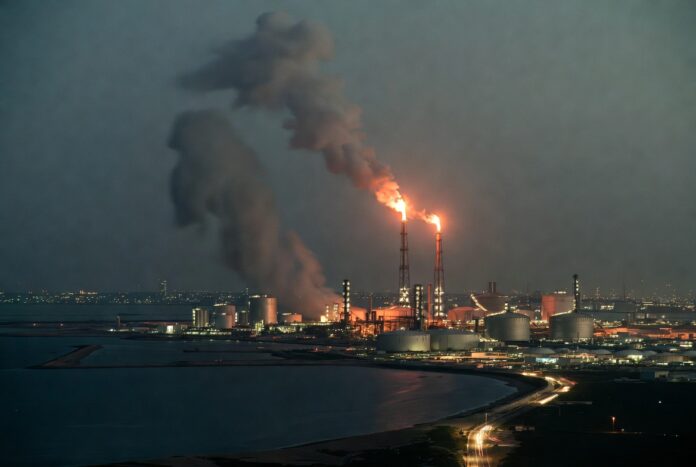
Iranian missiles struck Ras Laffan Industrial City on Wednesday, causing what QatarEnergy described as “extensive damage” to two of Qatar’s fourteen LNG production trains and one of its two gas-to-liquids facilities. CEO Saad al-Kaabi told Reuters that 12.8 million tonnes per year of LNG capacity, roughly 17 percent of Qatar’s export capability, has been sidelined for three to five years. The estimated cost of the damage is $26 billion. Brent crude briefly touched $119 per barrel on Thursday morning before settling near $112.
Ras Laffan, located 80 kilometres northeast of Doha, is the largest liquefied natural gas production facility on earth. Before the war, it accounted for approximately 20 percent of global LNG supply, per Kpler. It was also, until three weeks ago, the foundation of Qatar’s entire economic model. Al-Kaabi told Reuters that the disruption would cost approximately $20 billion in lost annual revenue and that the damage has “set the region back 10 to 20 years.”
The Sequence of Escalation
The chain of events began when Israel struck Iran’s South Pars natural gas field on Wednesday, a facility that provides 80 percent of Iran’s domestic gas supply, per the Center on Global Energy Policy at Columbia University. South Pars is also shared with Qatar via the same geological formation beneath the Persian Gulf. President Trump stated publicly that the United States “knew nothing” about the Israeli strike. He subsequently warned on Truth Social that if Iran “unwisely decides to attack” Qatar, the United States would “massively blow up the entirety of the South Pars Gas Field.”
Iran attacked anyway. The Revolutionary Guard Corps had warned in advance that it would target energy infrastructure in Qatar, Saudi Arabia, and the United Arab Emirates. Missiles struck Ras Laffan, causing three fires, per Qatar’s Ministry of Interior. QatarEnergy confirmed in a subsequent statement that several additional LNG facilities had also been hit, “causing sizeable fires and extensive further damage.” Saudi Arabia’s Ministry of Defence reported intercepting four ballistic missiles aimed at Riyadh and two at its eastern region. Abu Dhabi shut its Habshan gas facilities after debris from an intercepted strike caused damage, per Bloomberg. An Iranian projectile struck near Australia’s military headquarters in the UAE, per Prime Minister Anthony Albanese.
Qatar’s Foreign Ministry declared Iran’s military and security attaches persona non grata, giving them 24 hours to leave the country. Prime Minister Sheikh Mohammed bin Abdulrahman Al Thani condemned the attack, stating that it had “significant repercussions for global energy supplies” and rejecting Iran’s claim that its targets were American interests. “The clear proof of this is the attack that targeted a natural gas facility in the State of Qatar,” he said.
The Damage Assessment
This was not the first strike on Ras Laffan. On March 2, just days into the war, Iranian drones hit the facility and a nearby water treatment plant in Mesaieed Industrial City, prompting QatarEnergy to suspend all LNG production. The March 18 missile attack was qualitatively different. Bloomberg, citing people with knowledge of the matter, reported that two of the plant’s fourteen LNG trains and the Pearl gas-to-liquids facility sustained direct damage. Al-Kaabi’s assessment, per Reuters, is that repairs will take three to five years and that 12.8 million tonnes per year of LNG output has been lost. The affected facilities cost approximately $26 billion to build. ExxonMobil, per al-Kaabi, holds a 34 percent stake in LNG train S4 and a 30 percent stake in train S6.
The damage extends well beyond LNG. Al-Kaabi told Reuters that Qatar’s condensate exports would drop by approximately 24 percent, liquefied petroleum gas by 13 percent, helium by 14 percent, and naphtha and sulphur by 6 percent each. The helium loss is particularly consequential: the gas is essential for semiconductor manufacturing, MRI scanners, and scientific research, and Qatar is a major global supplier. QatarEnergy has declared force majeure on long-term LNG contracts with buyers in Italy, Belgium, South Korea, and China, potentially for up to five years.
To put that number in context: Qatar’s total LNG export capacity was approximately 77 million tonnes per year before the war. The loss of 12.8 million tonnes represents roughly one-sixth of the country’s export capability. QatarEnergy had been in the process of commissioning 47 million tonnes of new capacity between 2026 and 2028 as part of the North Field expansion, a project now complicated by the closure of the Strait of Hormuz and active hostilities at the production site itself.
Tom Marzec-Manser, director of gas and LNG at Wood Mackenzie, told Al Jazeera that because of the extensive damage, “even when the Iran conflict ends and if the Strait of Hormuz reopens, Qatari LNG production will not fully resume within a few weeks as previously expected.” The assumption that had underpinned most energy market forecasts, that Qatar’s output would snap back once hostilities ceased, is no longer operative.
Who Is Exposed
The most immediately vulnerable markets are in Asia. India sources between 42 and 52 percent of its LNG imports from Qatar, per the Center for a New American Security. Indian companies began implementing 10 to 30 percent cuts to industrial gas supplies even before the March 18 strike. India’s external affairs ministry told CNBC that it was in discussions with Iran to route 22 ships through the Strait of Hormuz, with two having already reached Indian ports.
South Korea and Japan are heavily import-dependent for energy raw materials. The Bank of Japan, in its monetary policy statement on Thursday, cited the Middle East conflict directly as a factor in its decision to hold rates at 0.75 percent, noting that “crude oil prices have risen significantly” and that “future developments warrant attention.”
Europe’s direct exposure to Qatari LNG is smaller than Asia’s but more consequential than the headline share suggests. Qatar supplied approximately 6 to 8 percent of EU LNG imports in 2025, per Eurostat. The United States accounted for nearly 60 percent, and Norway provides roughly 30 percent of pipeline gas. However, as Euronews reported, the displacement effect is where the real risk lies: when Asian buyers scramble for replacement cargoes on the spot market, they bid against European importers, driving up prices across the board regardless of direct sourcing. EU gas storage sits at approximately 30 percent, per Gas Infrastructure Europe, well below the 54 percent seasonal average. Italy and Belgium are the most exposed EU members, with Qatar accounting for roughly 30 percent and 8 percent of their respective LNG imports. Belgium’s storage levels, at approximately 25.5 percent, compound the vulnerability.
The European Commission convened emergency coordination groups on Wednesday. EU Energy Commissioner Dan Jorgensen highlighted continued deliveries from the United States and Norwegian pipeline gas as stabilising factors. The Commission’s message was that there are no immediate shortages. The TTF benchmark for European natural gas, however, told a different story: it traded 11 to 17 percent higher on Thursday and has doubled since the start of the month.
The Broader Energy War
Brent crude briefly spiked above $119 per barrel on Thursday morning before pulling back to approximately $112, still a 4.5 percent daily gain, per CNBC. WTI touched $100.04. The Strait of Hormuz, through which approximately 20 percent of global oil and a comparable share of LNG had transited before the war, remains effectively closed to commercial tanker traffic. The cumulative effect of the Hormuz closure, the Ras Laffan damage, Saudi refinery strikes, and Kuwaiti facility attacks is producing what Gulf Oil senior energy adviser Tom Kloza described as an “all bets are off” scenario.
Qatar’s energy minister al-Kaabi had warned on March 6 that if the conflict continued, other Gulf producers might be forced to halt exports and declare force majeure, and that “this will bring down economies of the world.” Three weeks later, the scenario he described is materialising. Seb Kennedy, founder of Energy Flux, an independent gas and LNG analytics platform, told Middle East Eye that the effects “will be profound and long lasting, and will probably eclipse in depth and scope the impact of Russia’s 2022 invasion of Ukraine.” Wood Mackenzie’s Marzec-Manser made a structural point that distinguishes this crisis from previous oil shocks: unlike crude, there is no spare capacity in global LNG production. Every operational plant is already producing at maximum output. There is no redundancy to absorb the loss.
The policy response from Washington, thus far, has been to suspend the Jones Act for 60 days to ease domestic fuel transport and to coordinate strategic petroleum reserve releases. Neither addresses the structural loss of 12.8 million tonnes of annual LNG capacity that will not return until 2029 at the earliest. For energy-importing economies in Asia and Europe, the March 18 strike on Ras Laffan is not a price event. It is a supply event. The distinction matters because price shocks can be hedged. Physical shortages cannot.
For a complete timeline of how the Iran war reshaped global markets, see our reference page.