

Reading time: 5 min
The S&P 500 slipped 0.41% on Wednesday as rising oil prices, elevated Treasury yields and Iran uncertainty overwhelmed another blockbuster Nvidia quarter and a historic SpaceX IPO filing targeting a raise of roughly $80 billion.
A Market That Refused to Pick a Direction
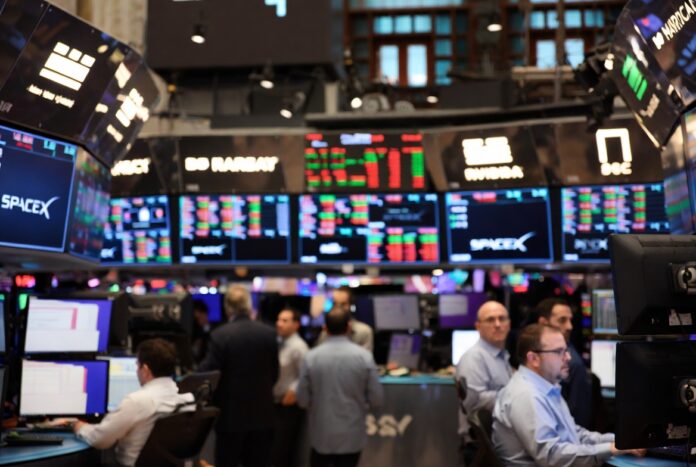
Wall Street closed May 21 in a state of analytical gridlock. The Nasdaq Composite dropped 0.72%, dragged lower by technology stocks that should, by any conventional reading, have been celebrating. The Dow Jones Industrial Average finished essentially flat. The Russell 2000 briefly rallied on a report, later called into question by multiple analysts, that the United States and Iran were approaching a draft resolution. As TheStreet’s live blog noted on May 21, this is a story the market has heard many times before.
Two massive corporate events landed within hours of each other, each carrying implications that will shape capital allocation for the rest of 2026. Nvidia reported fiscal first-quarter earnings that beat every meaningful estimate. SpaceX filed an IPO prospectus that could become the largest public offering in history. Neither was enough to pull the broader market higher.
Nvidia: $81.6 Billion and a Fourth Straight Post-Earnings Drop
Jensen Huang’s chipmaker reported revenue of $81.62 billion for the quarter ended April 2026, above consensus estimates of $79.2 billion, according to Kiplinger’s live earnings coverage published on May 20. Adjusted earnings per share came in at $1.87 versus the $1.78 Wall Street had pencilled in. Data centre revenue, the segment that matters most to AI infrastructure investors, nearly doubled year-over-year to $75.2 billion, as CNBC reported on May 21. The company announced an $80 billion share buyback programme and raised its quarterly dividend to 25 cents per share.
Nvidia shares still closed Thursday down 1.8%, marking the fourth consecutive post-earnings pullback. Expectations have grown so elevated that even a meaningful beat fails to unlock upside. John Belton, portfolio manager at Gabelli Funds, told Kiplinger that Nvidia now trades at a sub-20 price-to-earnings ratio, roughly a market multiple, with the potential to return a trillion dollars in free cash over the next four to five years. The valuation case is there. The sentiment is not.
Analysts cited by Reuters noted that Nvidia’s forward guidance excluded China-related sales, injecting uncertainty into an otherwise clean beat-and-raise quarter. The company’s $20 billion Groq acquihire, structured as an asset and licensing deal in December 2025 to sidestep antitrust scrutiny, as Axios reported at the time, adds inference capacity but also complexity, at a moment when investors are questioning how long hyperscaler capital expenditure can hold its current pace.
SpaceX: Ticker SPCX and a $1.5 Trillion Question
Hours after Nvidia’s numbers dropped, SpaceX published its IPO prospectus. The company will list on the Nasdaq under the ticker SPCX, with Goldman Sachs leading the underwriting syndicate alongside Morgan Stanley, Bank of America, Citigroup and JPMorgan Chase, CNBC reported on May 20. Following the February merger with xAI, Elon Musk’s artificial intelligence venture, SpaceX carried a private valuation of $1.25 trillion. The IPO is reportedly targeting a valuation above $1.5 trillion and a raise of roughly $80 billion, a sum that would comfortably surpass Saudi Aramco’s $26 billion record from 2019.
The prospectus offered several data points investors had long awaited. Total expenditures reached $20.7 billion, driven largely by xAI’s data centre expansion. SpaceX disclosed holdings of 18,712 bitcoin as of March 31, with a cost basis of $661 million and a fair value at that time of $1.293 billion, a figure that has since risen toward $1.45 billion given bitcoin’s recent movements around the $77,000 level. Musk retains 85% of voting power. The company identifies a total addressable market of $28.5 trillion, most of it outside existing business lines.
The Wall Street Journal separately reported that OpenAI may confidentially file for its own IPO as soon as this week. Combined with Cerebras Systems’ $5.55 billion Nasdaq debut on May 14, which priced at $185 per share, above its raised range, and more than doubled on its first trading day, mid-2026 could see the most consequential wave of technology listings since the dot-com era.
Oil, Yields and the Iran Variable
The macro backdrop made it nearly impossible for equity bulls to capitalise on the corporate news. Brent crude traded near $102 per barrel, reflecting ongoing supply-side anxiety tied to the Iran conflict and Strait of Hormuz disruption risk. At that level, crude oil prices exert direct inflationary pressure on consumer spending, transport costs and corporate margins.
Treasury yields remained elevated. The 10-year yield had hit its highest level in over a year earlier in the week, a move that triggered consecutive S&P 500 and Nasdaq declines on Monday and Tuesday. The bond market is pricing in a Federal Reserve with little room to cut rates while oil sits above $100. Weekly jobless claims, released Thursday morning by the Labor Department, came in at 209,000, below the 213,000 economists surveyed by FactSet had expected, reinforcing a labour market that analysts describe as low-hire, low-fire. The unemployment rate remains near 4.3%, with employers adding a surprising 115,000 jobs in April despite conflict-driven uncertainty.
President Trump’s warning that the “clock is ticking” on Iran, combined with the briefly encouraging but unsubstantiated resolution report, added another layer of intraday volatility that ultimately resolved nowhere.
The Collision That Defines This Market
A record IPO pipeline, an AI sector delivering revenue growth that would have been unimaginable two years ago, oil above $100 and Treasury yields that refuse to retreat, these forces are pulling in opposite directions with roughly equal strength. The result is a market where sector rotation matters more than index-level direction, and where the best corporate earnings quarter in semiconductor history can coexist with a session that closes in the red.