

Reading time: 5 min
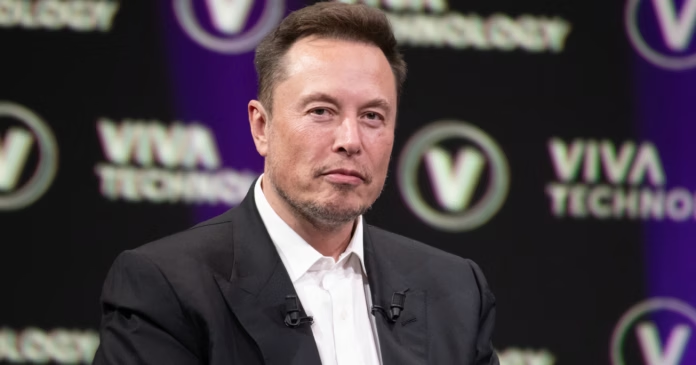
A San Francisco jury found Elon Musk liable for misleading Twitter investors during the 2022 acquisition. Estimated damages sit between $2.1 billion and $2.6 billion. His net worth is $661 billion, per the Bloomberg Billionaires Index. The number that matters isn’t the fine. It’s the ruling.
The verdict came Friday afternoon after several days of deliberation in a trial that started March 2. The jury in the Northern District of California concluded that Musk intentionally misled Twitter shareholders with two tweets in May 2022, including the now infamous post declaring the deal “temporarily on hold” over concerns about bots and fake accounts. The jury rejected two of the four fraud claims and found that Musk did not engage in a broader “scheme” to defraud investors, per Bloomberg Law. But on the core question of whether his public statements contained false or misleading information that harmed shareholders, the answer was yes.
The class action, Pampena v. Musk, was filed in October 2022 on behalf of investors who sold Twitter shares between mid-May and early October of that year. Twitter’s stock fell below $33 during the limbo period, roughly 40% below Musk’s original offer of $54.20 per share. Shareholders who sold during that window missed the eventual payout when Musk completed the acquisition at the original price. The jury calculated per-day damages of between $3 and $8 per share over a five-month class period, per NPR and OPB.
The Tweets That Cost Billions
At trial, the argument came down to a narrow set of public statements. On May 13, 2022, Musk tweeted that the Twitter deal was “temporarily on hold” pending details on spam and fake accounts. Plaintiffs argued this was not an innocent observation but a calculated move to drive down the stock price, either to renegotiate the deal at a lower valuation or to create an exit ramp. Musk testified that the tweet was not an attempt to cancel the deal. “At no point did I say the deal was canceled,” he told the jury, per Fortune. He also acknowledged the post was a mistake. “It may not be my wisest tweet,” he said. “I don’t know if I would call it my stupidest. But if it led to this trial it probably qualifies as such.”
Joseph Cotchett, an attorney for the plaintiffs, framed the verdict in broader terms after leaving the courthouse. “This case is much bigger than Twitter,” he told CNBC. “It goes right to the heart of Wall Street and what’s been going on in recent years. It’s a great example of what you cannot do to the average investor.” The investors he’s describing are not hedge funds. They’re pension funds, 401(k) holders, teachers, and nurses who held Twitter stock in managed portfolios and watched the value collapse while Musk debated publicly whether he even wanted the company.
The Financial Sting Is Minimal. The Legal Exposure Is Not.
Quinn Emanuel, Musk’s legal team, signaled an appeal is coming before the courtroom had cleared. “We view today’s verdict, where the jury found both for and against the plaintiffs and found no fraud scheme, as a bump in the road,” the firm said in a statement. “And we look forward to vindication on appeal.” Even if the full $2.6 billion damages estimate holds, which it may not after claims processing, the figure represents roughly 0.4% of Musk’s current net worth as measured by the Bloomberg Billionaires Index. A rounding error for the defendant. A landmark for the plaintiffs.
What matters more than the dollar figure is the precedent. Musk is separately in talks to settle an SEC lawsuit accusing him of failing to properly disclose his initial purchases of Twitter stock in early 2022, per a court filing this week. That case covers different conduct but the same acquisition. A pattern of adverse findings around the Twitter deal, even partial ones, makes future enforcement actions easier to pursue and harder to dismiss as politically motivated. Markets are already under pressure from war-driven selling, and the last thing institutional holders of Tesla, SpaceX-adjacent instruments, or xAI exposure need is a headline cycle about securities fraud liability attached to the person at the center of all three.
The Company No Longer Exists. The Verdict Does.
Consider the chain of events. Musk bought Twitter for $44 billion in October 2022, renamed it X, merged it with his AI company xAI, and then folded the combined entity into SpaceX. The company that shareholders were defrauded over no longer exists as a standalone entity. It’s been absorbed into a private aerospace and defense contractor that holds government contracts and classified clearances. The jury’s verdict applies to conduct from 2022. But the structural question it raises is whether a public market participant can use misleading statements to acquire a company, take it private, and then embed it so deeply into a government-adjacent corporate structure that accountability becomes a rounding error.
For now, the answer from the San Francisco courthouse is that the tweets were misleading, the shareholders were harmed, and damages will be calculated. Musk’s legal team will appeal. Claims administration will take roughly 90 days to set up, per CNBC, and months more before any investor sees a payout. The broader market had its own problems on Friday, with the S&P 500 falling 1.51% and the Dow hitting its 2026 low. This verdict landed in a week where everything was falling. It’ll get louder once the war headlines quiet down. Securities fraud liability doesn’t expire when the news cycle moves on.