Reading time: 6 min
The University of Michigan’s final March reading dropped to 53.3, placing household sentiment in the bottom 1st percentile of the survey’s 48-year history and below the threshold recorded at the onset of all six recessions captured by the index.
That number, released on March 27 by the University of Michigan’s Surveys of Consumers, is not a rounding error. It represents a 5.8% decline from February’s 56.6 and undershoots the consensus forecast of 54.0 by a wide margin, per Reuters polling. Two-thirds of the survey’s respondents were interviewed after the United States began military operations against Iran on February 28, and the deterioration between early and late responses was stark enough to rewrite the headline figure.
What the Numbers Actually Show
The damage runs deeper than the headline. The expectations component, which measures how households view the next twelve months, cratered to 51.7 from 54.1 in the preliminary release and 56.6 in February. That is a four-month low and an 8.7% monthly decline, the steepest drop in the sub-index since the aftermath of the 2025 government shutdown. Current conditions, which had briefly touched a five-month high of 57.8 in the preliminary reading, reversed to 55.8 in the final report. Survey director Joanne Hsu noted that the short-run economic outlook plunged 14% over the full survey period, while year-ahead expectations for personal finances fell 10%, with declines cutting across all age groups and both political parties.
The inflation data embedded in the survey is arguably more consequential for policy. Year-ahead inflation expectations jumped to 3.8% from 3.4% in February, the largest single-month increase since April 2025, per the University of Michigan. That figure well exceeds anything recorded in 2024 and sits far above the 2.3% to 3.0% band that prevailed in the two pre-pandemic years. Hsu added that year-ahead gasoline price expectations climbed to their highest level since June 2022, when consumer prices were peaking in the wake of Russia’s invasion of Ukraine. Longer-term five-to-ten-year expectations, the measure the Federal Reserve monitors most closely, edged down a tenth of a point to 3.2%, offering a thin sliver of comfort to policymakers who fear a broader unanchoring of the inflation outlook.
The Gasoline Transmission Mechanism
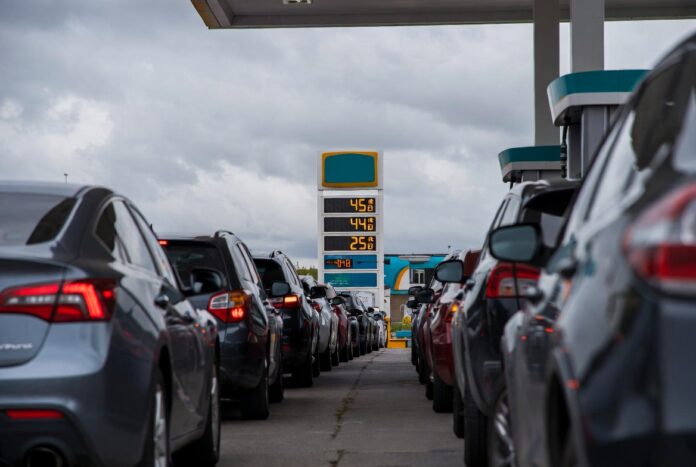
The channel through which the Iran conflict is reaching American households is printed on the pump. The national average price of regular gasoline stood at $4.10 per gallon for the week ending March 23, according to Energy Information Administration data. That compares with less than $3.00 as recently as late February, a period during which prices had remained below that threshold for thirteen consecutive weeks, the longest such stretch since 2021. Crude oil breached $100 per barrel on multiple occasions in early March. The EIA’s short-term energy outlook now projects gasoline will average $3.34 per gallon for the full year, a significant upward revision from the $2.91 forecast issued in February before the conflict began.
Consumers with middle and higher incomes, as well as those holding equity portfolios, reported the sharpest declines in confidence, according to Hsu. The damage is not confined to lower-income households already stretched by food and shelter costs. It is broadening into the cohorts that account for a disproportionate share of discretionary spending. U.S. equities have fallen roughly 6% in March, compounding the gasoline shock with a negative wealth effect that the preliminary survey had not fully captured.
The Macro Backdrop Is Not Helping
The sentiment collapse did not arrive in isolation. The Bureau of Economic Analysis reported on March 13 that fourth-quarter GDP grew at an annualized rate of just 0.7%, revised sharply downward from the advance estimate of 1.4%. Real consumer spending in the quarter was marked down to 2.0% from 2.4%. The February employment report showed a net loss of 92,000 jobs, with unemployment ticking up to 4.4%. Excluding the healthcare sector, the economy has shed roughly 202,000 positions since January 2025. That is not a recession, but it is not the foundation on which robust consumer spending is built.
The Federal Reserve, meeting on March 18, held the federal funds rate steady at 3.50% to 3.75%. The updated dot plot signalled one reduction in 2026 and another in 2027, though seven of nineteen FOMC participants indicated they expected no cuts at all this year. Governor Stephen Miran dissented in favour of a quarter-point reduction. Chair Powell told reporters the implications of the Middle East conflict for the domestic economy remained “too soon to know.” The median FOMC projection for core PCE inflation in 2026 was revised upward to 2.7%, per the Federal Reserve Bank of St. Louis. Before the conflict, markets had been pricing in two rate cuts. That expectation has since been compressed to one.
The Recession Question
Mark Zandi, chief economist at Moody’s Analytics, told CNBC on March 25 that recession risks were “uncomfortably high and on the rise.” A NerdWallet survey conducted in March found that 65% of American respondents now expect a recession within twelve months, up six percentage points from February. The word “stagflation,” which Powell explicitly rejected during his post-meeting press conference, noting that the term originated in the 1970s when unemployment was in double digits, has nonetheless re-entered the vocabulary of strategists and editorial boards. Bloomberg Opinion published a piece on March 24 under the headline that the U.S. economy is “recession-free but feels miserable,” a formulation that captures the dissonance between aggregate output, which remains positive, and the lived experience of households contending with persistent price pressures on one side and a labour market that, outside of a single sector, has stopped creating jobs on the other.
It is worth pausing on the historical context. At 53.3, the index sits 36.5% below the survey’s long-run mean of 84.0, according to Advisor Perspectives’ analysis of the full dataset back to 1978, and rests below the level recorded at the start of every recession during its existence. That is not a forecast. Sentiment surveys are poor at predicting turning points. But it is a data point the Federal Reserve cannot dismiss when it arrives alongside an inflation expectations print that has jumped more in a single month than at any time in nearly a year.
What Comes Next
The critical variable is duration. If the Iran conflict proves short-lived and the Strait of Hormuz reopens to commercial traffic in April, as the EIA’s baseline scenario assumes, gasoline prices should moderate and the sentiment shock could prove transitory. If it does not, the 3.8% year-ahead inflation expectation risks becoming entrenched, and the Fed will face a decision it has spent two years trying to avoid: whether to tighten into a weakening economy or tolerate above-target inflation to protect a fragile labour market. The April preliminary Michigan release, due on April 10, will offer the first signal. A stabilisation above 55 would suggest a confidence floor. A further drop toward 50 would place the index within range of the November 2025 trough of 51.0, the second-lowest reading in the survey’s history. The American consumer has not stopped spending, but the American consumer has stopped believing that things are about to get better. For an economy in which household expenditure accounts for two-thirds of GDP, that distinction matters more than one month’s survey might suggest.