


Reading time: 12 min
On May 1, 2026, the United Arab Emirates formally ended its 59-year membership in OPEC, freeing itself from production quotas that had held its output 30 percent below installed capacity and removing itself from the only cartel arrangement that gave Iran’s Hormuz blockade any residual economic logic. On May 4, an Iranian drone struck the Fujairah Oil Industry Zone, setting the facility ablaze and wounding three Indian nationals. Two additional drones struck the ADNOC-affiliated tanker Barakah as it attempted to transit the strait. The UAE’s Ministry of Defence reported engaging 12 ballistic missiles, three cruise missiles, and four unmanned aerial vehicles in a single afternoon. The sequence is not coincidental. It is strategic. Understanding why requires understanding what Fujairah actually is and what the UAE’s departure from OPEC means for the only leverage Iran has left.
What Fujairah Is, and Why It Changes Everything
The port of Fujairah sits on the eastern coast of the UAE, on the Gulf of Oman, entirely outside the Strait of Hormuz. It is the terminus of the Abu Dhabi Crude Oil Pipeline, known as ADCOP or the Habshan-Fujairah pipeline. The pipeline is 406 kilometres long, 48 inches in diameter, and runs from onshore oil fields in Habshan, Abu Dhabi, directly to the Gulf of Oman coast. It was commissioned in June 2012 and built for precisely this scenario: to get UAE crude oil to export markets without passing through Hormuz at any point. Its designed capacity is 1.5 million barrels per day, expandable to 1.8 million barrels per day. According to the International Energy Agency, the UAE exports approximately 1.1 million barrels per day of domestic crude via the ADCOP route in normal operations, leaving up to 700,000 barrels per day of additional spare capacity that could be rerouted in a closure scenario.
That spare capacity became, from February 28 onward, the UAE’s most valuable geopolitical asset. When Iran effectively closed the Strait of Hormuz and IRGC drones, missiles, and small boat attacks began targeting commercial vessels, shipping traffic through the strait plunged by more than 95 percent, the UAE was the only major Gulf producer that could still get meaningful crude volumes to export markets. Saudi Arabia has the larger East-West Pipeline to Yanbu on the Red Sea, but its bypass capacity is capped. Iraq’s 3.4 million barrels per day of pre-war exports went almost entirely through Basra and the strait with no meaningful inland alternative. Kuwait Petroleum Corporation declared force majeure in March and had to extend it on April 20, stating it could not meet contractual obligations even if Hormuz reopened. Qatar’s entire LNG export capacity at Ras Laffan, 77 million tonnes annually and the largest in the world, is geographically stranded behind the strait with no alternative route to global markets.
Naveen Das, senior oil analyst at Kpler, told CNBC in March that the ADCOP pipeline was running at 71 percent utilisation, roughly 1.07 million barrels per day, leaving around 440,000 barrels per day of spare capacity with ADNOC able to temporarily push throughput to 1.8 million barrels per day if required. The IEA estimates that UAE pipeline export loadings at Fujairah had already climbed to 1.62 million barrels per day in March, up from 1.17 million in February, according to Kpler analyst Johannes Rauball’s data cited by Reuters. In a Gulf where Saudi Arabia, Iraq, and Kuwait were largely unable to export, the UAE became the only pipeline to the world market that was meaningfully open. And then on May 1 it left OPEC, removing the last institutional constraint on how much of that pipeline capacity it could use.
Why the UAE Left, and Why Iran Noticed
The UAE’s frustrations with OPEC predate the war by years, but the conflict sharpened them into a decision that could no longer be deferred. Under OPEC+ quota arrangements, the UAE had been producing approximately 3.4 million barrels per day against an installed capacity of 4.85 million barrels per day, operating 30 percent below what its infrastructure could physically sustain, according to data from The National and JINSA’s strategic analysis. ADNOC had set a target of 5 million barrels per day of capacity by 2027, backed by $150 billion in upstream investment between 2023 and 2027. The Saudi preference within OPEC for price defence over volume, maintaining higher per-barrel revenue at the cost of market share, directly contradicted the UAE’s calculation. The UAE holds 111 billion barrels of proven reserves and a fiscal breakeven oil price roughly half of Saudi Arabia’s $90-per-barrel threshold, according to ORF Middle East analysis. With peak oil demand projected around 2030, Abu Dhabi wanted to convert its reserves into revenue before the window narrowed.
Energy Minister Suhail Mohamed al-Mazrouei announced the withdrawal on April 28 without consulting Saudi Arabia or any other OPEC member, per his own confirmation to Reuters. “This is a policy decision. It has been done after a careful look at current and future policies related to level of production,” he said. The formal exit took effect May 1. Rystad Energy’s head of geopolitical analysis Jorge Leon described the consequence for the cartel plainly: “Losing a member with 4.8 million barrels per day of capacity, and the ambition to produce more, takes a real tool out of the group’s hands.” JINSA’s strategic analysis argued that al-Mazrouei timed the announcement to precede an OPEC ministerial meeting scheduled for late April, maximising its disruptive signal to the organisation. UAE President Mohammed bin Zayed did not attend a Gulf security summit in Jeddah convened the same day, sending his foreign minister instead. At a gathering called to demonstrate Gulf unity after the most severe regional crisis since 1990, the absence of the most directly affected head of state was, as JINSA noted, a deliberate statement.
The immediate market consequence is a UAE now free to produce and export at whatever rate its infrastructure allows, without quota constraint, without cartel obligation, and with a pipeline to Fujairah that Iran cannot stop by closing the strait. What Iran can do is try to destroy the pipeline’s endpoint.
The Fujairah Attack: What Actually Happened
Monday’s strikes on the UAE were the first since the ceasefire agreed on April 8 and represented a deliberate escalation timed to coincide with the US military’s attempt to escort two American-flagged merchant vessels through the strait. The UAE’s Ministry of Defence confirmed engagement of 12 ballistic missiles, three cruise missiles, and four unmanned aerial vehicles, totalling 19 separate threats intercepted or tracked in a single afternoon, per official statements from the UAE’s Fujairah Media Office and Ministry of Defence.
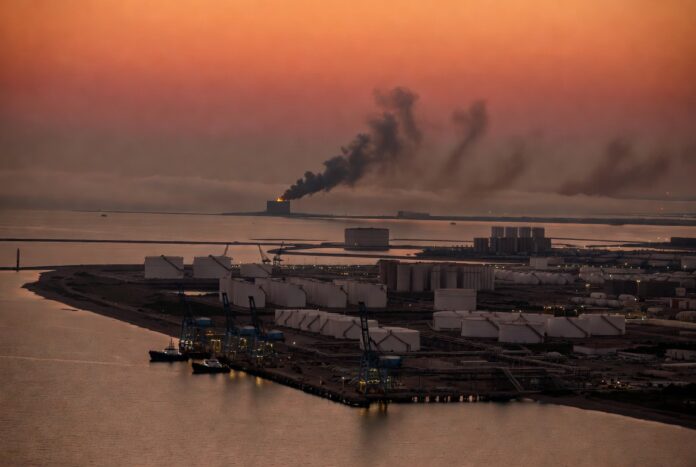
The Fujairah Oil Industry Zone, one of the Middle East’s largest oil storage and export complexes, took a direct drone hit, triggering a fire that civil defence teams were deployed to contain. Three Indian nationals sustained moderate injuries and were hospitalised. Separately, an Iranian drone attacked the ADNOC tanker Barakah as it transited Hormuz, though the vessel was unladen at the time of the strike and no casualties were reported, per ADNOC’s maritime energy logistics unit statement cited by Pakistan Today. UAE presidential adviser Anwar Gargash described the Barakah attack as “maritime piracy.” The UAE Foreign Ministry condemned the strike as a “flagrant violation” of UN Security Council Resolution 2817 on freedom of maritime navigation and called Iran’s use of the strait “economic blackmail.”
Iranian state-linked media simultaneously claimed that a US warship had been struck. US Central Command refuted the report, per Al-Monitor. Iran’s IRGC Navy released a map designating areas of the strait under Iranian military control, warning that any US forces approaching would be targeted. US Defence Secretary Pete Hegseth stated on Tuesday that the ceasefire remained in place despite the attacks and confirmed that two US commercial vessels had transited the strait safely with military escort. Markets processed the contradiction by selling oil: Brent slipped below $112 per barrel on Tuesday before stabilising, retreating from Monday’s gains on ceasefire ambiguity. As of Wednesday morning May 6, Brent futures were trading near $113.83 and WTI at $102.51, per Investing.com data, as Reuters reported that Iran had sent a second peace proposal to mediators in Pakistan.
What the Attack Reveals About Iran’s Strategy
The Hormuz blockade has been Iran’s primary economic weapon since February 28. By preventing Gulf producers from exporting, Tehran was simultaneously extracting leverage and demonstrating its ability to impose costs on US-aligned economies globally, from Asian refiners facing supply shortfalls to European fertiliser markets facing urea cutoffs. The strategy worked in the early weeks because the blockade was total and bypass routes were underdeveloped.
The UAE’s Fujairah pipeline disrupted that totality. Iranian drone strikes on Fujairah port infrastructure occurred on March 3, March 14, and March 16, according to The Conversation’s pipeline analysis by academic researcher David B. Roberts, setting storage tanks on fire and temporarily suspending loadings each time. Each attack was followed by recovery. The ADCOP pipeline resumed operations and Fujairah exports rose anyway, reaching 1.62 million barrels per day in March despite the three strikes, per Kpler data. Pankaj Srivastava of Rystad Energy told CNBC in March that the pipeline gave the UAE a critical asymmetry: crude could leave through Fujairah, but refined products from the Ruwais refinery, which processes 922,000 barrels per day, still depended on Hormuz tanker routes. The combination of Fujairah crude exports continuing while Ruwais shut down was simultaneously proof of concept and demonstration of limit.
The May 4 attack, arriving three days after the UAE left OPEC and three days after the US began escorting vessels through the strait, was Iran’s answer to both developments simultaneously. A UAE unconstrained by quotas, exporting through Fujairah at near-full ADCOP capacity, while the US Navy reopens the strait to American-flagged vessels, erodes the two pillars of Iran’s Hormuz leverage at the same time. Attacking Fujairah directly is the only kinetic response available to Tehran short of renegotiating the ceasefire terms, which, as of Wednesday, it appeared to be attempting through the Pakistani mediation channel.
OPEC Without the UAE: A Cartel That Cannot Enforce Its Own Logic
The OPEC+ meeting on May 3, the first convened without the UAE, produced an agreement to raise June production quotas by 188,000 barrels per day, slightly below May’s 206,000 barrel increase, per CNBC reporting on the statement issued by the seven remaining countries: Algeria, Iraq, Kazakhstan, Kuwait, Oman, Russia, and Saudi Arabia. The statement made no mention of the UAE’s departure. Saudi Arabia’s new quota of 10.291 million barrels per day sits far above its actual March production of 7.76 million barrels per day, per OPEC’s own data reported by Al Jazeera. The increase is, by any market measure, symbolic. OPEC members cannot get meaningful volumes of oil through the strait regardless of what their quota says.
Amrita Sen, founder and chief economist at Energy Aspects, told CNBC on May 5 that she expects $80 to $90 per barrel to be the new price floor going forward. She added that higher-for-longer energy prices will reverberate into LNG, chemicals, and fertilisers for months and warned investors of “extremely misplaced euphoria,” calling equity market indifference to the energy squeeze a precursor to what she described as “a potentially pretty big recession.” The IEA, in its April analysis, estimated that the combined Saudi and UAE bypass pipeline capacity could handle 3.5 to 5.5 million barrels per day, a fraction of the 20 million barrels per day that transited Hormuz before the war. The World Bank’s April 28 Commodity Markets Outlook projected overall commodity prices rising 16 percent in 2026 and described a scenario under which Brent averages $115 per barrel for the year if critical infrastructure damage persists, which Monday’s strikes on Fujairah suggest remains entirely plausible.
The broader commodity picture being reshaped by these events extends well beyond crude oil. Base metals including copper have already reached record highs in 2026, driven in part by supply chain disruption routed through the same maritime corridors now under attack. The Hormuz closure strands roughly a third of global urea and a third of global helium alongside the crude, amplifying the fertiliser and food inflation consequences already documented for agricultural markets from Brazil to Egypt. And for the trade architecture supposed to stabilise these relationships, the energy shock has rendered bilateral trade frameworks negotiated before February 28 economically obsolete, since the energy cost assumptions embedded in those agreements were calibrated for a world in which Hormuz was open.
The Pipeline as Both Target and Testimony
The paradox of the Fujairah attacks is that Iran’s repeated targeting of the terminal has not closed the ADCOP pipeline. It has demonstrated that the pipeline works. Exports rose in March despite three strikes. The system recovered each time. And now, with the UAE freed from OPEC quotas, ADNOC has both the capacity and the political mandate to push throughput higher than it has ever run. Simon Kaye, Global Director of Reinsurance at NorthStandard, told CNN that commercial shipping confidence is “really the center of gravity” of the Hormuz crisis, meaning Iran needs only to continue presenting a perception of risk to keep merchant traffic at minimal levels. The same logic applies to Fujairah. Iran does not need to destroy the pipeline. It needs only to make insurers and operators believe the infrastructure is unsafe to operate at full capacity.
Whether that calculation holds depends partly on what the Brent forward curve does over the coming weeks and partly on whether the Pakistani mediation channel produces a deal before the next attack on Fujairah. As of May 6, Brent was trading near $113, WTI below $102, gold at $4,582 per ounce on dollar softness, and three Indian nationals in Fujairah hospitals were the most concrete evidence available that Iran’s answer to the UAE’s strategic pivot was not diplomatic. For commodity traders watching the prediction markets that have tracked this conflict since before the first missile landed, the OPEC exit and the Fujairah attack are the same event, just described in two different languages.