Reading time: 7 min
Brazil recorded a record first-quarter trade surplus of $14.2 billion in 2026 as Brent crude surged to an intraday peak of $128 a barrel during March’s fighting before rebounding to $119 after a brief ceasefire, while Buenos Aires residents waited in doubled-length bus queues and taxi drivers in Quito said fuel prices had become too high to justify working a full shift. The same conflict. Opposite consequences. The Iran war has drawn a fault line across Latin America that no amount of ceasefire diplomacy is erasing quickly.
The Numbers Behind the Divide
Brazil is the world’s sixth-largest oil exporter at approximately 3.7 million barrels per day. According to Brazil’s Ministry of Finance, each sustained $100 barrel of Brent crude adds close to one percent of GDP in government revenue. With Brent surging from $72 to an intraday peak of $128 during March’s fighting — the largest single-month gain in the contract’s history, according to the Rio Times — before retreating to roughly $93 on the Pakistan-brokered ceasefire of April 8 and then rebounding to $119.34 on April 29 as escalation fears returned, the price environment across the first quarter was extraordinarily volatile but cumulatively positive for net exporters. Total first-quarter exports reached $82.3 billion, a historical record, and the trade surplus of $14.2 billion represented a 47.6 percent increase year-on-year, according to data compiled by the Rio Times from Brazilian trade ministry figures. The Ibovespa closed the first quarter up 16.35 percent, attracting R$48 billion in foreign inflows, and the real strengthened to approximately 5.15 per US dollar, its strongest position against the dollar in roughly two years.
Venezuela, post-Maduro and under US-managed oil sales since January, has seen crude exports rise to a seven-year high of 1.16 million barrels per day in April, according to shipping data tracked by Bloomberg. The export recovery, while structurally incomplete, positions Venezuela as one of the few economies in the hemisphere to gain from the Hormuz disruption, albeit under terms set largely by Washington. Francisco Monaldi, director of the Latin America Energy Program at Rice University’s Baker Institute, told Marketplace on April 16 that Venezuela was “sending some oil to US refiners that really want this sort of heavy oil” and also helping India plug supply gaps created by the closure of the strait, though he cautioned that the country remains far from adding meaningful additional barrels to global markets.
Colombia sits at what analysts at the Rio Times described as an “awkward midpoint.” Crude accounts for roughly 25 percent of Colombian exports, and each additional dollar per barrel generates approximately $100 million in tax revenue. That creates a headline revenue boost, but the country simultaneously imports refined fuels whose prices are now elevated, passing costs directly to consumers and transport operators.
Where the Pain Is Sharpest
For Argentina, the conflict arrived at the worst possible moment. President Javier Milei had staked his political credibility on a disinflation program that brought annual inflation from 211 percent in 2023 to approximately 30 percent by late 2025. The Relevamiento de Expectativas de Mercado, the central bank’s monthly survey of professional forecasters, showed the median full-year inflation projection jumping to 29.1 percent in March 2026, a 3.1 percentage point revision upward from the previous month’s survey. Rodrigo Park, chief economist at Santander Argentina, told Bloomberg in April that Santander had raised its full-year estimate to 26 percent from 16 percent previously, adding that fuel-price transmission was now an explicit variable in the bank’s models. Monthly consumer prices accelerated to 3.4 percent in March, the highest reading in a year. Milei, who had told audiences in March that inflation “may start with zero” in August, conceded the result was a bad one.
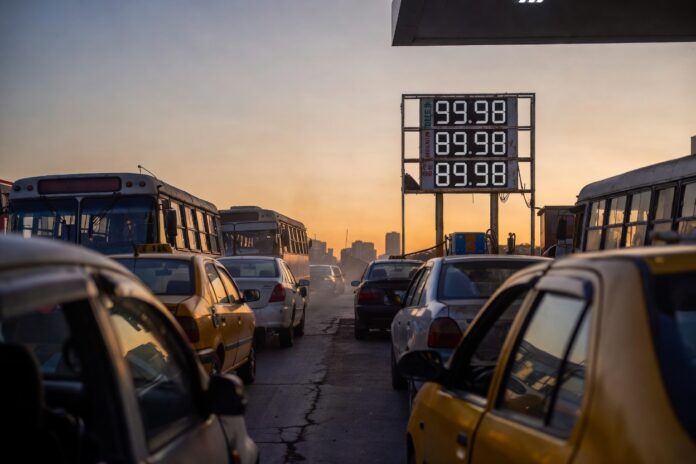
The mechanism is not hard to trace. Although Argentina is a net energy exporter through its Vaca Muerta shale formations, domestic fuel prices are partially tied to international benchmarks, and transport costs rise regardless of export revenues. Buenos Aires commuters reported journey times nearly doubling in April after authorities cut bus services in response to higher diesel costs, according to CNN’s reporting from the city. Decree 302/2026, signed by Milei, Economy Minister Luis Caputo, and Cabinet Chief Manuel Adorni on April 30, partially unfroze fuel taxes from May 1 with a 0.5 percent increase on gasoline and diesel, deferring the larger accumulated backlog to June. The decree illustrates, in precise form, the trap: fuel tax normalization is necessary for fiscal balance, but every percentage point of tax increase feeds directly into the inflation index the government is trying to suppress.
The pattern repeats across Central America and the Caribbean. The ceasefire between the United States and Iran was announced on April 8, but as CNN’s reporting from the region in May confirmed, shipping through the Strait of Hormuz remains far below pre-war volumes. Rerouting around the Cape of Good Hope adds 10 to 14 days to trade lanes, sustaining freight cost premiums that smaller, fuel-importing economies in the region cannot easily absorb. The IMF’s spring baseline projects growth of 2 to 3 percent for Central America and the Caribbean in 2026, contingent on a short conflict. Ecuador’s Confederation of Heavy Transport warned in late March that the sector could effectively shut down if the government did not act on diesel prices, according to CNN’s correspondent in Quito, and taxi drivers there described a business model that had become mathematically difficult to sustain.
The Fertilizer Problem Underneath the Oil Story
The energy shock has a second layer that matters disproportionately to agricultural exporters. The Strait of Hormuz is the transit route for more than 30 percent of global urea, produced from Gulf natural gas. For Brazil, the world’s largest fertilizer importer, this creates a structural exposure that the oil windfall only partially offsets. Before the war, 41 percent of Brazil’s urea imports transited Hormuz, with 36 percent originating directly from Iran, Qatar, and Saudi Arabia, according to data cited by the Rio Times. A potential phosphate deficit of one to three million tons threatens the 2026-2027 planting season, and fertilizer costs represent 27 to 34 percent of operational expenses across soybean, corn, and wheat production, according to the same source. Brasilia attempted to manage this with a package of measures on March 12 that included eliminating federal diesel taxes and subsidizing diesel at R$0.32 per liter through December 2026, but annual inflation still reached 4.14 percent in March, above target, with fuel as the primary driver. The Central Bank’s March cut of just 25 basis points, to 14.75 percent, signaled that the rate-cut cycle may now be shorter than anticipated.
What the Division Means for Regional Policy
The geopolitical rent from elevated oil has sharpened pre-existing divergences in monetary policy capacity across the hemisphere. The World Economic Forum noted in March that economists in countries as far from the battlefield as Chile were already scaling back expectations for rate cuts as oil prices rose. Brazil’s central bank faces the opposite concern: whether windfall-driven growth overheats an economy already above-target on inflation. For the oil importers, the risk is stagflation, a combination of decelerating growth and accelerating prices that leaves central banks with no good options.
The ceasefire may hold. Hormuz traffic may normalize. The fertilizer pipeline may reopen. But the transmission lags from an energy shock of this magnitude typically run six to twelve months, which means the inflationary legacy of the Iran conflict will still be visible in Latin American consumer price data well into 2027. As a comprehensive analysis published by the World Economic Forum in March noted, what began as a battlefield shock hardened into a geoeconomic one. For the governments on the wrong side of the commodity ledger, that hardening is not a metaphor. The copper market, which had already reached record highs earlier this year amid a broader commodity supercycle driven by electrification demand, now contends with disrupted supply chains that add another layer of uncertainty to the region’s industrial outlook. For the governments in Washington, meanwhile, the architecture of the conflict, as the World Economic Forum observed, has exposed a fundamental contradiction: the United States has imposed enormous costs on many of the same economies it relies on as trading and strategic partners — a tension that will shape trade negotiations across the Americas long after the shooting stops.