


Reading time: 5 min
The IISS’s “Boomtime at Bohai” report reveals Beijing launched 10 nuclear-powered submarines displacing 79,000 tonnes between 2021 and 2025, exceeding US output in both hulls and tonnage while Washington’s shipyards struggle to deliver even 1.2 boats per year.
The Numbers Behind the Reversal
China’s nuclear submarine production has undergone a transformation that the International Institute for Strategic Studies describes in stark quantitative terms. Between 2021 and 2025, the People’s Liberation Army Navy (PLAN) launched 10 nuclear-powered submarines with a combined displacement of approximately 79,000 tonnes, according to the IISS report published on February 16. During the same period, the United States launched seven boats displacing 55,500 tonnes. The comparison represents a dramatic inversion from the 2016–2020 cycle, when China managed only three launches totaling 23,000 tonnes against the US Navy’s seven boats at 55,500 tonnes. IISS senior fellows Henry Boyd and Tom Waldyn based their assessment on commercially available satellite imagery of the Bohai Shipbuilding Heavy Industry Co. (BSHIC) facility in Huludao, northern China — the sole yard responsible for constructing the PLAN’s nuclear-powered fleet. A second production hall built at the site between 2019 and 2022 has enabled China to reach what analysts describe as a “1+2” output rhythm, matching the production cadence that US planners aspire to but have consistently failed to sustain.
What Beijing Is Building
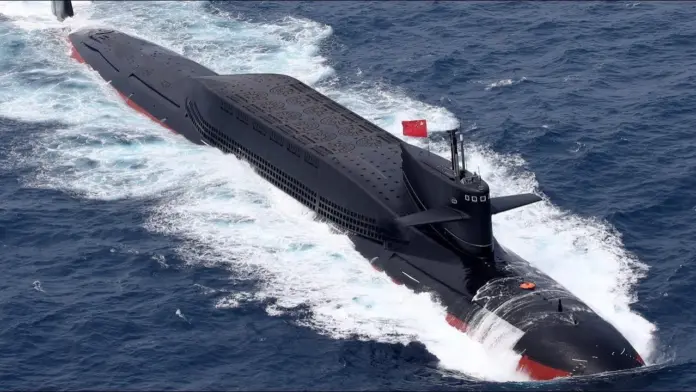
The IISS assessment identifies three distinct submarine programs driving the expansion. Most strategically significant are the seventh and eighth Type 094 (Jin-class) nuclear-armed ballistic missile submarines (SSBNs), which strengthen Beijing’s sea-based nuclear deterrent and complete the third leg of its nuclear triad alongside land-based intercontinental ballistic missiles and strategic bombers. Commercial satellite imagery from early 2026 showed six Type 094s distributed across four locations: the BSHIC shipyard, the 1st Submarine Base at Jianggezhuang, the Xiaopingdao test facility and the 2nd Submarine Base at Yalong Bay on Hainan Island. In parallel, BSHIC has produced at least nine Type 093B (Shang III) nuclear-powered guided-missile submarines (SSGNs) since 2022, an upgraded variant of the earlier Type 093A fitted with vertical launch systems for guided missiles. A next-generation SSGN, reportedly designated Type 09V, was also launched this month. Looking further ahead, the Type 096 SSBN — expected to carry the longer-range JL-3 submarine-launched ballistic missile — is anticipated to begin production at Bohai later this decade and enter service in the late 2020s or early 2030s.
The Quality Gap Still Favors Washington
Raw launch numbers, however, do not tell the full story. The IISS report is careful to note that both the Type 093 and Type 094 hulls remain noisier than their Western counterparts, making them easier to detect and track. A 2009 US Office of Naval Intelligence assessment compared their acoustic signatures to late Cold War-era Soviet designs — a characterization that, while dated, is still widely cited in open-source analysis. This noise penalty has operational consequences: the Type 094 SSBNs are currently believed to patrol only within the relatively protected waters of the South China Sea, where other PLA assets can provide a defensive umbrella rather than operating freely in open ocean. US submarines, by contrast, are considered significantly quieter and more technologically sophisticated, maintaining advantages in stealth, sensor suites and combat systems. Yet the IISS acknowledges that qualitative assessments are inherently difficult to verify for Chinese platforms, and that each successive hull variant has incorporated incremental improvements.
America’s Industrial Base Under Strain
China’s production acceleration coincides with deepening problems in US naval shipbuilding. A Congressional Research Service report delivered to Congress in January 2026 found that American shipyards have delivered only 1.1 to 1.2 Virginia-class attack submarines per year since 2022, well below the target of two per year. The Columbia-class ballistic missile submarine program — the replacement for the aging Ohio-class boats that carry America’s sea-based nuclear deterrent — is running at least a year behind schedule, with the lead vessel USS District of Columbia now expected in 2028. The CRS projects that the US attack submarine fleet will hit a “valley” of just 47 boats by 2030 as older Los Angeles-class submarines retire faster than replacements arrive. Numbers are not expected to recover to 50 until 2032, assuming construction targets are met. Compounding the pressure, the AUKUS agreement commits Washington to selling three to five Virginia-class boats to Australia from the early 2030s, further straining a fleet that the CRS warns faces a period of heightened operational strain and potentially weakened conventional deterrence.
Strategic Implications for the Indo-Pacific
The submarine balance carries consequences that extend well beyond fleet inventories. Nuclear-powered submarines enable sustained, covert operations far from home ports — a capability that underpins both nuclear deterrence and conventional power projection. For Beijing, a larger SSBN fleet operating under the protective canopy of South China Sea anti-access systems strengthens the survivability of its second-strike nuclear capability, a factor that reshapes deterrence calculations for every power in the region. The industrial dimension of the competition mirrors broader patterns visible across China’s record-breaking semiconductor production, where state-directed manufacturing scale is outpacing Western capacity in strategically critical sectors. Meanwhile, allied responses are gathering pace: South Korea’s booming defense-industrial sector, fueled by the same semiconductor supercycle driving its equity markets to record highs, launched its own Jang Yeongsil submarine in October 2025 as part of an expanding regional undersea capability. The IISS report’s central conclusion is that China’s submarine buildup has crossed a threshold: it is no longer a shipyard expansion story but a structural shift in Indo-Pacific naval power. Whether Beijing can convert faster production into effective operational leverage depends on closing the quality gap — but every year that US output falls short of its own targets, the window for maintaining American undersea dominance narrows further.