


Reading time: 3 min
Vicuña Corp, the 50/50 joint venture between BHP and Lundin Mining, published a preliminary economic assessment on February 17 projecting $18.1 billion in capital expenditure to develop two adjacent copper-gold-silver deposits in Argentina’s San Juan province — the largest foreign direct investment in the country’s history. The catch: Argentina has not produced a single tonne of commercial copper since the Bajo de la Alumbrera mine closed in 2018.
The Resource
The district combines Josemaría, a copper porphyry entirely within Argentina, and Filo del Sol, a copper-gold-silver system straddling the Chilean border. Together: 13 million tonnes of measured and indicated copper, 25 million inferred, 32 million ounces of gold, 659 million ounces of silver. The PEA models 25 years of production averaging 395,000 tonnes of copper, 711,000 ounces of gold and 22.2 million ounces of silver annually — with the first decade running closer to 500,000 tonnes of copper, enough to rank among the world’s top five producers. At Cochilco’s revised copper forecast of $4.95 per pound, that translates to roughly $965 million a year in Argentine taxes and royalties.
$7 Billion First, Then Scale
Stage one absorbs $7.1 billion between 2027 and 2030: open-pit mine and concentrator at Josemaría, first copper concentrate by 2030. Stage two brings Filo del Sol’s oxide resources online via solvent extraction and electrowinning. Stage three expands the concentrator and develops deeper sulphides, pushing throughput to 293,000 tonnes per day with a desalination plant. Total life-of-mine capital including closure: $30.3 billion.
Vicuña invested roughly $400 million in 2025. Communications director Caterina Dzugala told Reuters the target is $800 million this year. An integrated technical report due Q1 2026 frames the final investment decision.
RIGI Makes or Breaks It
Vicuña filed for RIGI benefits in December 2025 under the Long-Term Strategic Export Projects designation, committing $2 billion within 24 months. The regime, approved September 2024 as part of Milei’s broader fiscal and tax reform package, offers long-term tax stability, reduced import tariffs and dollar revenue retention — directly addressing the currency controls that historically kept major miners out.
Economy Minister Caputo declared the project would not exist without RIGI. CEO Hochstein agreed. But RIGI’s track record is measured in applications, not operating mines. The regime has attracted a pipeline exceeding $33 billion — Glencore’s Alumbrera restart (H1 2028), the $9.5 billion El Pachón, the $4 billion Mara, McEwen Copper’s $2.7 billion Los Azules — all at various stages of permitting. None is producing copper.
The Hard Part
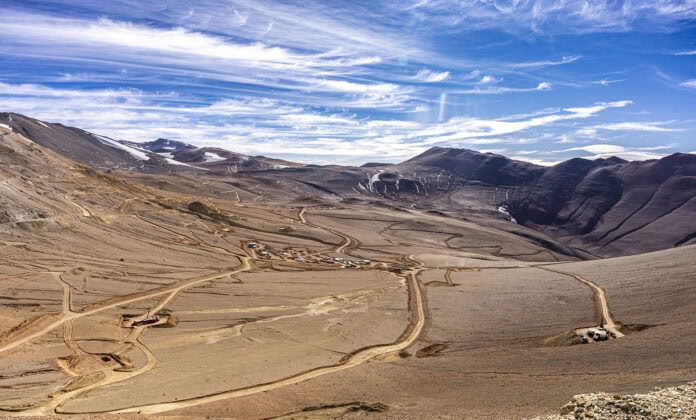
Unlike Chile and Peru, where the state builds roads and power lines to mining districts, Argentine miners typically finance their own infrastructure. Vicuña sits in the high Andes, 200-plus kilometres from the nearest city. Concentrate has to cross 1,200 to 1,500 kilometres of grain-oriented transport network to reach Atlantic ports. Filo del Sol’s binational footprint means two regulatory frameworks, two environmental permitting regimes. The Glacier Law adds legal uncertainty for high-altitude operations.
The market case is straightforward: a landslide at Indonesia’s Grasberg cut output 30–40 percent, Cobre Panama remains suspended since 2023, and electrification plus data centre construction are accelerating demand. Copper hit record highs this year. The Payne Institute describes Argentina as holding one of the three largest portfolios of undeveloped copper projects in the world — a position that gains strategic weight as trade policy reshapes global commodity flows.
The risks are just as tangible. Nine sovereign defaults and regular policy reversals across administrations are exactly what RIGI was designed to insulate against — but the regime has not been tested through a change of government. The PEA assumes copper above $3.25 per pound for viability, well below spot but a price that looked optimistic during the 2015–2020 trough. And six world-class projects advancing simultaneously in a country with minimal mining infrastructure means competition for labour, equipment and government bandwidth that could delay any one of them.
Vicuña’s geology manager calls Filo del Sol the greatest mineral discovery of the last 30 years. If the technical report confirms those numbers, BHP and Lundin will have locked in a generational asset at the moment the global metals industry is running short of alternatives.
Sources: Buenos Aires Times, Mining.com, The Rio Times