Reading time: 8 min
Brent crude rose above $116 on Monday morning after President Trump told the Financial Times that his “preference would be to take the oil in Iran” and that he is considering seizing Kharg Island, the export terminal that handles roughly 90 percent of Iran’s crude shipments. With that statement, the war shifted from a transit disruption to a resource seizure. And Brent, which has gained more than 55 percent in March alone, is now on track for its steepest monthly rise in the history of the benchmark.
The Record That Nobody Forecast
Brent opened 2026 below $75. Goldman Sachs had forecast a full-year average of $56. The World Bank projected commodity prices falling 7 percent. Every major outlook published in December 2025 assumed oversupply, weakening Chinese demand, and a manageable geopolitical risk premium. By the close of trading on March 28, Brent had settled above $112, according to LSEG data cited by CNBC. The 55 percent gain in a single calendar month exceeds the March 2022 Russia-Ukraine spike, the 2008 supercycle surge, and the 1990 Gulf War price shock. There is no precedent for it in the 38-year history of the ICE Brent futures contract.
The mechanics are straightforward. Gulf producers have lost roughly 6.7 million barrels per day of export capacity since the Strait of Hormuz was effectively closed in early March. The IEA released 400 million barrels of strategic reserves from 32 countries. The market ignored it because 400 million barrels at 6.7 million per day provides roughly 60 days of coverage, and the war is now in its fifth week with no ceasefire in sight. Saudi Arabia and the UAE have limited alternative pipeline capacity that can bypass Hormuz, but those pipelines handle a fraction of total Gulf output. The rest sits in storage or stays in the ground.
WTI crossed $100 per barrel on Monday for the first time during this conflict, trading at $101.30 according to Pintu News, driven by the same forces pushing Brent but with an additional dynamic: the Brent-WTI spread has widened beyond $14 at times, reflecting the fact that Brent directly prices the disrupted Gulf cargoes while WTI reflects domestically produced US crude that continues to flow normally. That spread is itself a measure of how severely the physical market is dislocated from the paper market.
Kharg Island: What “Take the Oil” Actually Means
Trump’s statement to the Financial Times was not a negotiating tactic. It was a statement of military intent backed by deployment. Several hundred US Special Operations forces have arrived in the region, joining thousands of Marines and Army paratroopers, according to NBC News. The USS Tripoli arrived on Saturday with a complement of 3,500 troops. Portions of the 82nd Airborne are on their way. The total US troop presence in the Middle East now exceeds 50,000, roughly 10,000 above the normal baseline, according to reports cited by CNN and the Washington Post.
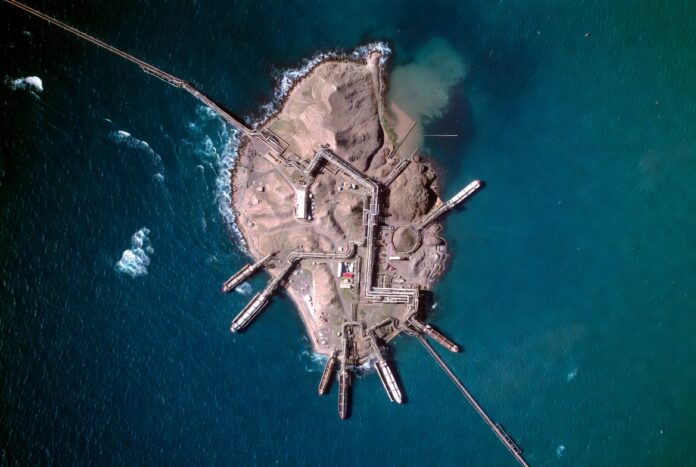
Kharg Island is a coral island roughly 25 kilometres off Iran’s southern coast in the Persian Gulf. It is the loading point for approximately 2.5 million barrels per day of Iranian crude exports, representing over 90 percent of Iran’s total oil shipments, according to the Times of Israel citing the Financial Times interview. The island has been a target before: Iraqi aircraft struck Kharg repeatedly during the Iran-Iraq War of 1980 to 1988, and the US struck it earlier in the current conflict. But there is a difference between bombing an island and occupying it.
Trump acknowledged the distinction. “Maybe we take Kharg Island, maybe we don’t. We have a lot of options,” he told the Financial Times. “It would also mean we had to be there for a while.” That last sentence is the one the oil market should read twice. Seizing Kharg is not a surgical strike. It is an occupation of a critical piece of energy infrastructure in contested waters, within range of Iranian shore-based missiles and drone systems. Military analysts quoted by CNN warned that Iranian forces could launch sustained attacks on any American presence on Kharg, with casualties accumulating over time.
For the oil market, the implications depend on which scenario unfolds. If the US seizes Kharg and successfully defends it, Iranian crude exports resume under American control, effectively adding 2.5 million barrels per day back to the market. That would be bearish for Brent in the medium term because it solves part of the supply problem. But in the short term, the military operation itself would generate extreme volatility as markets price the risk of failure, the risk of escalation across the Gulf, and the legal ambiguity of one sovereign state seizing another’s export infrastructure. If the US does not seize Kharg and the threat remains rhetorical, it adds another layer of uncertainty to a market already drowning in it.
The Second Front: Houthis and Kuwait
Trump’s Kharg Island comments arrived on the same weekend that two additional escalations widened the war’s footprint. Yemen’s Iran-backed Houthi militia fired missiles at Israel on Sunday, marking the group’s entry into the conflict as a combatant rather than a bystander, according to CNBC. The Houthis had already disrupted Red Sea shipping in 2023 and 2024 in solidarity with Hamas. Their entry into the Iran war raises the possibility of a two-front maritime disruption: Hormuz in the east and Bab el-Mandeb in the west.
Separately, Iran struck a service building at a power generation and water desalination plant in Kuwait on Sunday evening, killing one worker, according to CNBC. Kuwait has not been a belligerent in this conflict. The attack on civilian infrastructure in a non-combatant Gulf state represents a qualitative escalation: if Iran is willing to strike water and power facilities in countries that are not actively at war with it, then every piece of energy and utility infrastructure across the Gulf becomes a potential target. Saudi Aramco’s Abqaiq processing facility, the UAE’s Jebel Ali port, Qatar’s remaining LNG infrastructure: all of these are within range of the same weapons systems Iran used against Kuwait.
Brent’s move above $100 two weeks ago priced a Hormuz closure. The move above $116 on Monday, according to CNN and CNBC reporting, is pricing something broader: a regional conflict with no geographic boundaries and no clear endpoint. The market is no longer asking when the strait will reopen. It is asking whether the infrastructure that produces and ships Gulf oil will survive the war intact.
Twenty Tankers Is Still Not a Solution
Trump also disclosed that Iran had agreed to allow 20 oil tankers through the Strait of Hormuz starting Monday, which he described as “a sign of respect.” Pakistani deputy prime minister Ishaq Dar, whose country has been mediating between the US and Iran, first revealed the gesture on Saturday via social media, as reported by Al Jazeera. Last week it was 10 tankers. We wrote then that 10 tankers was a pricing experiment, not a ceasefire. Twenty is a larger experiment but the arithmetic hasn’t changed.
Under normal conditions, roughly 50 vessels per day transit Hormuz, according to the Energy Information Administration’s assessment of strait traffic. Twenty tankers over “the next few days” represents somewhere between 4 and 7 percent of normal weekly flow, depending on how many days the window stays open. At that rate, the physical market remains starved of Gulf crude. Refiners in Japan, South Korea, and India, the three largest importers of Gulf oil, cannot sustain operations on 5 percent of their normal supply. The 45 Japanese vessels stranded in the Gulf that Prime Minister Takaichi raised with the IEA three weeks ago are presumably still waiting.
The tanker gestures serve a political function, not a market function. They give Trump a talking point (“they’re negotiating in good faith”) and they give Iran leverage (the ability to selectively open and close the valve). But they don’t fill Asian refineries, they don’t bring insurance premiums down, and they don’t reopen the strait to commercial traffic. The gap between the paper market and the physical market that we identified two weeks ago has only widened.
What March 2026 Means for Energy Positioning
March 2026 is entering the record books alongside October 1973 and August 1990 as a month that redefined the relationship between geopolitics and oil prices. CNBC reported that the 55 percent March gain puts Brent on track for the steepest monthly rise on record. The difference is that those previous episodes were discrete supply shocks with identifiable endpoints. The 1973 embargo ended when OPEC lifted it. The 1990 Gulf War ended when Iraq was expelled from Kuwait. The 2026 Iran war has no comparable off-ramp because the dispute is not about a single act of aggression that can be reversed. It is about nuclear capability, maritime sovereignty, regional power projection, and now, explicitly, control of oil production infrastructure.
Trump’s statement about “taking the oil” moves the conversation from “when will Hormuz reopen” to “who controls the oil.” That is a different question with different pricing implications. If the market believed Hormuz would reopen within weeks, Brent at $116 would be a spike to sell. If the market comes to believe that the US intends to control Iranian oil output directly, the pricing framework shifts to one where Brent reflects a permanently restructured supply map with American military forces sitting on a producing asset in the Persian Gulf.
The April 6 deadline for strikes on Iranian energy infrastructure is one week away. The 15-point peace proposal remains unresolved. Iran’s foreign ministry says there are no direct talks. Trump says a deal “could be made fairly quickly” but also that the US has “about 3,000 targets left” after bombing 13,000. Brent is pricing all of these possibilities simultaneously, which is why it has produced the steepest monthly gain in the history of the contract. The market isn’t confused. It’s doing exactly what it’s supposed to do: reflecting the full range of outcomes in a situation where the full range includes everything from a ceasefire to an American occupation of Iran’s oil infrastructure.