


Reading time: 6 min
South Korea’s benchmark index crashed 12.1% on Wednesday — its steepest single-day fall ever recorded — as a record pile of leveraged retail bets met a geopolitical shock nobody had hedged for. The two-day rout is the worst since the 2008 financial crisis. Circuit breakers fired twice. Brokers pulled margin lending mid-session. And the won hit levels not seen since March 2009.
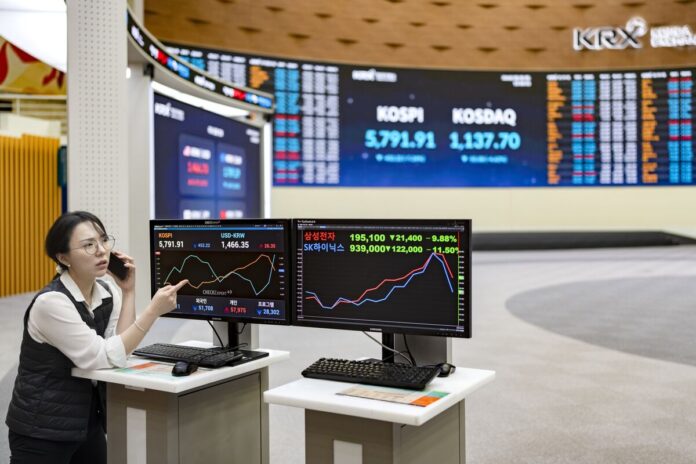
The numbers alone are brutal. The KOSPI closed at 5,093.54 on Wednesday — down 12.1%, according to Korea Exchange data. That came on top of Tuesday’s 7.2% plunge, which at the time already felt like a capitulation event. Together, the two sessions mark the worst back-to-back decline since October 2008. The tech-heavy Kosdaq fared worse still, crashing 14% and triggering its own circuit breaker. Of more than 800 stocks on the KOSPI, ten finished the day in green. Ten.
Nobody saw this coming. Not really. A week ago the index was printing fresh all-time highs near 6,350, per Investing.com data — propelled by a semiconductor supercycle that had turned Samsung Electronics and SK Hynix into the twin engines of what many called the world’s best-performing major stock market. The numbers were absurd: the KOSPI surged 76% in 2025 and tacked on another 50% in the first eight weeks of 2026, according to Seoul Economic Daily. Retail investors were borrowing everything they could get. Analysts kept raising already-bullish targets. Then the bombs started falling on Iran, oil spiked past $83, and the Strait of Hormuz — through which South Korea sources virtually all of its crude — became a war zone.
The Leverage Trap That Seoul Built
Geopolitics lit the fuse. The explosion, though, was structural — and it had been building for months. Outstanding margin loans hit 32.67 trillion won ($22.4 billion) by late February, the Korea Financial Investment Association reported. That was a record, but it was also the fifth or sixth time the record had been broken since the balance first crossed 30 trillion won in late December. Pile on securities-backed lending and total credit extension balances had ballooned past 52 trillion won by year-end 2025, per Seoul Economic Daily. Several brokerages, including NH Investment & Securities, had already exhausted their credit extension quotas and stopped issuing new margin loans weeks before the crash ever hit.
Here’s the part that should worry you. Credit trading wasn’t spread across the market. It was concentrated in the same handful of names driving the index: Samsung Electronics carried 1.948 trillion won in margin exposure, SK Hynix another 1.666 trillion won, according to Seoul Economic Daily data from late February. Those two stocks alone account for roughly half the KOSPI’s capitalisation, per Morningstar. When they fell — Samsung dropped 11.7%, Hynix 9.6%, Hyundai Motor a staggering 16.1% — there was nowhere to hide.
Retail investors had been putting down as little as 30 to 40% in margin deposits, riding the rally with borrowed conviction. Kim Dojoon, chief executive at Seoul-based Zian Investment Management, told Bloomberg the dynamic was now working in reverse: the positions that amplified gains on the way up are forcing liquidation on the way down. If Thursday brings another leg lower, he said, nobody will step in to catch a falling knife. Local brokers started halting margin provision during Wednesday’s session itself. The buy-the-dip reflex that propped up earlier dips? It faded through the afternoon. The KOSPI 200 Volatility Index — the market’s fear gauge — surged to its highest reading since 2008, per Bloomberg.
Foreign Money Ran First
The selling wasn’t just domestic. Foreign investors dumped more than 12 trillion won of Korean equities across Tuesday and Wednesday combined, Bloomberg reported. In Wednesday’s morning session alone, overseas funds offloaded over 1 trillion won. The won briefly breached 1,500 per dollar — its weakest since March 2009, according to The National — before partially recovering after the Bank of Korea issued a statement warning it would act against herd-like behaviour in the currency market.
BNY Mellon’s economists drew a straight line between the selloff and South Korea’s energy dependence on Gulf supply. Nomura flagged the country’s net oil imports at 2.7% of GDP, placing it among the economies most exposed to a sustained current account shock. That matters because the AI-driven rally had convinced everyone this was a technology story. It is. But Korea also happens to be an economy that imports every barrel of crude it consumes, overwhelmingly from the Middle East. When Samsung’s memory chip dominance collides with $83 Brent crude and a blocked Hormuz strait, the correlation structure of the entire market breaks apart. You can’t diversify away from geography.
Seoul Reaches for the Emergency Toolkit
The authorities didn’t wait. Financial Services Commission Chairman Lee Eog-weon convened an emergency meeting and confirmed the government stands ready to deploy its 100 trillion won-plus ($68 billion) market stabilisation programme if volatility persists, Seoul Economic Daily reported. Bank of Korea Governor Rhee Chang-yong ordered round-the-clock monitoring and set up a cross-agency response team spanning the FSC, the Ministry of Economy and Finance, and the Financial Supervisory Service. On the commercial side, Hana Financial Group rolled out a 12 trillion won support package for firms with Middle East exposure, per the Korea Herald, while Korea Exim Bank pledged 7 trillion won in targeted lending this year alone, including preferential rates for companies hit by energy disruptions, BusinessKorea confirmed.
What’s particularly striking is the rate outlook. Traders are now pricing two rate hikes by the Bank of Korea, according to Business Standard — a dramatic reversal from the easing path that was consensus just weeks ago. The logic isn’t complicated: if oil stays elevated, imported inflation will force the central bank’s hand no matter what the equity market does. That’s a headwind nobody was positioned for when they bought Samsung at 218,000 won on February 26.
What the Market Isn’t Telling You
Even after the carnage, the KOSPI remains up roughly 21% year-to-date, per Business Standard. The semiconductor thesis hasn’t evaporated. Global memory chip demand tied to AI data centres is real, and Samsung and SK Hynix aren’t losing market share — they’re losing their price premium to a geopolitical shock that lies entirely outside the earnings cycle. Defence and energy names bucked the selloff entirely: Hanwha Aerospace surged nearly 20% on Tuesday, per Trading Economics, while refiners like Korea Petroleum Industries and Daesung Energy gained around 30% on Wednesday, according to Business Standard.
Dave Mazza, chief executive at Roundhill Investments, argued this reads more like a positioning unwind than a Korea-specific fundamental break. That’s a reasonable call — for now. But it assumes the Hormuz disruption is temporary. If it drags on, the won keeps weakening, energy costs keep climbing, and the margin debt overhang that everybody ignored for months becomes the defining story of H1 2026. Foreign investors who bought the AI thesis weren’t buying an energy-import economy. They’re selling one now.
The lesson is blunt. South Korea built one of the most leveraged retail equity markets in the developed world on top of one of the most energy-exposed economies in the OECD. When those two facts collided, the result was a circuit breaker, a currency crisis, and the worst trading day the KOSPI has ever recorded. The stabilisation fund is a backstop, not a cure. Investors who rode the rally with borrowed money already know that.