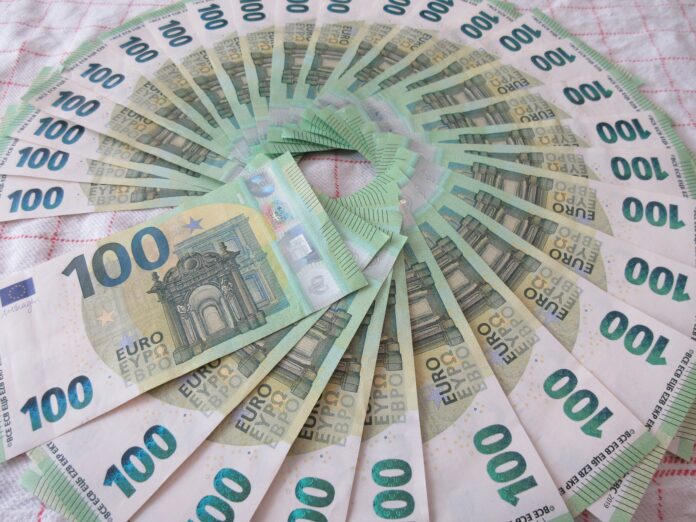
Four weeks ago the European Central Bank published its annual assessment of the euro’s international role, and the headline finding still has not received the attention it deserves. The report, released on 2 June 2026, concluded that the euro has gained ground as a global currency, but according to ECB Executive Board member Piero Cipollone, that gain came “largely by circumstance rather than by design.” Europe did not earn this position. It was handed to it by a sequence of external events. Four weeks on, with Hormuz payments shifting to renminbi and crypto, a US stablecoin push accelerating, and the ECB mid-tightening cycle, the question the report raised has become more urgent, not less.
The circumstances Cipollone refers to are not obscure. The dollar wobbled in April 2025 when US reciprocal tariffs triggered simultaneous declines in the S&P 500, the dollar index, and US long-term government bond prices. That combination, a falling currency alongside falling bonds, is the signature of a reserve currency under stress rather than a safe haven under pressure. Danish and Dutch pension funds began reducing their US government bond holdings, per the Centre for European Reform, citing political risk and concern about Federal Reserve independence. Euro-denominated international debt issuance reached record highs in 2025, per Dealogic data cited in the ECB report, with notable increases from US and emerging market issuers. The euro behaved like a safe haven during several risk-off episodes in 2025 and early 2026.
None of that was the result of European policy. It was the result of American policy choices that made dollar assets less attractive to a specific category of long-term institutional investor. Europe received the benefit passively. For the energy price backdrop that is running in parallel and shapes the whole macro picture, Brent crude remains elevated well above pre-war levels as the Hormuz situation continues to colour every commodity and currency conversation in 2026.
What the Hormuz Data Actually Shows
The most arresting data point in the ECB’s June 2026 report is not about the euro at all. It is about what happened to China’s Cross-Border Interbank Payment System when the war in the Middle East broke out on 28 February 2026. CIPS, the renminbi-denominated settlement infrastructure that China has been building since 2015, saw activity increase by more than one-third in the days surrounding the outbreak, according to ECB staff calculations. Customer-related cross-border payments by Chinese banks in renminbi reached a historical high of 1.4 trillion US dollars in March 2026, up roughly 30% from the previous month, per data cited in the same report.
The detail beneath that figure is the one that matters most: some ships transiting what remained passable of the Strait of Hormuz in March and April 2026 made payments in renminbi via CIPS, or in crypto-assets, to secure passage. This is not a footnote. This is the first documented instance of renminbi and crypto infrastructure being used as transactional currencies at a major geopolitical chokepoint, under conditions where the dollar-based correspondent banking system was either unavailable or considered too exposed. The ECB flagged it directly. It is unlikely to be the last time it happens.
The connection between Hormuz and European consumers runs through a separate but related channel. As this publication traced in May, the fertiliser and food price shock from the strait closure is still working through a 12 to 18 month transmission lag, and the grocery bill impact arrives in Q1 2027. The currency war and the commodity war share the same geography.
The renminbi’s share in global trade finance messages through Swift rose from 5.5% in 2024 to around 8% in March 2026, per ECB data, an increase of roughly six percentage points compared with pre-pandemic levels. The dollar’s share fell by more than two percentage points between 2024 and March 2026, broadly mirroring the renminbi’s rise. China also modified its CIPS rules on 1 February 2026 to enable settlements beyond the renminbi, positioning CIPS as a multicurrency platform. President Xi Jinping, on the same date, called publicly for the renminbi to become a global reserve currency, in what the ECB described as one of his clearest statements yet. The timing of the rule change and Xi’s statement, four weeks before the war began, looks prescient in retrospect.
The Dollar’s New Weapon
The ECB report dedicates specific attention to US dollar-pegged stablecoins, and the framing is not neutral. The current US administration has moved to encourage issuance and use of dollar-based stablecoins as an explicit instrument of dollar internationalisation. The total stablecoin market capitalisation exceeded 230 billion dollars by early 2026, the vast majority of it dollar-denominated. The ECB’s modelling suggests that strong stablecoin issuance moderates the dollar’s response to US monetary policy shocks by creating additional global demand for dollar assets, which reduces spillover effects on foreign economies. Put plainly: dollar stablecoins are a monetary policy tool that operates outside the Federal Reserve’s balance sheet and outside the traditional correspondent banking system.
If non-euro-pegged stablecoins were to become a significant means of payment within the euro area, the ECB’s own analysis concludes that fluctuations in stablecoin demand could effectively import foreign monetary conditions into the European domestic economy. The digital euro project exists in part as a response to this risk. It has not launched for retail use yet, though Cipollone confirmed in his 2 June blog post that the ECB will begin issuing tokenised central bank money for wholesale transaction settlement in September 2026, and the retail digital euro follows as a longer preparation. The stablecoins are already circulating at scale. The digital euro is still in preparation.
For the crypto-asset dimension of this currency competition, bitcoin and dollar stablecoins are now documented participants in real geopolitical payment flows, not theoretical instruments, which changes the risk calculus for European policymakers considering the digital euro timeline.
Three Pillars, One Weakness
The ECB’s framework for assessing the euro’s global potential rests on three pillars: economic resilience, legal and institutional integrity, and geopolitical credibility. The report is honest about the state of each one. Economic resilience is under strain: the Eurosystem’s June 2026 staff projections put eurozone GDP growth at 0.8% for 2026, revised down from 1.2% projected in autumn 2025, with the war in the Middle East identified as the primary cause. The European Commission’s Spring 2026 forecast puts EU-wide growth at 1.1%, also revised down 0.3 percentage points. Inflation is projected at 3.0% for the eurozone in 2026 and 3.1% EU-wide, above target well into 2027.
Legal and institutional integrity is the pillar where Europe’s position is strongest. MiCA is now fully in force. The euro area runs a current account surplus. On 14 February 2026 the ECB Governing Council voted to enhance EUREP, its repo facility for central banks, granting standing access to all non-euro area central banks globally, up to 50 billion euros per institution, against high-quality euro-denominated collateral. Onboarding begins in Q3 2026. The facility is explicitly designed so that central banks anywhere in the world can hold euro-denominated assets with confidence that liquidity will be available in stress scenarios, making those assets more attractive as reserve holdings. The Eurosystem’s Pontes initiative, set for Q3 2026, will connect TARGET payment infrastructure to distributed ledger technology platforms, enabling settlement of DLT-based wholesale transactions in central bank money. A connection between the Eurosystem’s fast payment system TIPS and India’s payments infrastructure is planned for 2027, with similar links being explored for Switzerland, Brazil, and the Nexus Global Payments platform.
Geopolitical credibility is the gap. The Euro Summit on 19 March 2026 produced a statement that the euro’s global position will depend on Europe’s economic and geopolitical strength. That is a description of the problem, not a solution to it. The Centre for European Reform identified the structural obstacle clearly in February: Europe lacks the consolidated capital markets, institutional coherence, and supply of safe assets that underpin a truly dominant currency. The Capital Markets Union is progressing slowly. Banking union remains incomplete. National sovereignty over securities supervision, insolvency law, and regional stock exchange infrastructure has not been surrendered. These are political obstacles, not technical ones, and the ECB cannot resolve them unilaterally.
What the Numbers Say About the Opening
Vanguard’s euro area outlook, published in early June, put the situation in the most direct institutional terms available from a major asset manager: the ECB is expected to deliver two “insurance hikes” in 2026, then reverse them in 2027 as the energy shock fades. That framing treats the current ECB tightening cycle as temporary and tactical, not structural. If Vanguard is right, the window in which Europe is receiving passive safe-haven flows from dollar uncertainty will close at roughly the same moment the ECB is reversing course. The window is narrow.
The renminbi faces its own constraints that limit how far it can go as a dollar alternative regardless of CIPS growth or Hormuz payments. Capital controls remain in place. China’s domestic bond market, though large, is not fully accessible to foreign institutional investors. The government’s track record on private property rights creates a category of political risk that long-term institutional allocators are not willing to absorb at scale. The Centre for European Reform makes this point directly. The renminbi will not replace the dollar. But it will take share from the euro if Europe does not act.
Geopolitical tensions continue to drive strong central bank demand for gold, per the ECB report, which it presents as evidence that the flight to safety dynamic is real and ongoing. Gold near all-time highs is consistent with that reading: central banks are adding to reserves in an asset that belongs to no currency system, which is itself a signal about confidence in existing reserve currency arrangements. The message encoded in gold prices is that no currency, not the dollar, not the euro, not the renminbi, has yet established sufficient trust to absorb the reallocation that geopolitical fragmentation is generating. That is the space the euro could occupy. It requires active policy, not passive accumulation of circumstances.
The ECB knows this. Cipollone said so on 2 June. The question is whether European finance ministers and heads of state read the same report with the same urgency. The Eurosystem can build the pipes. Only national governments can decide to use them.