Reading time: 11 min
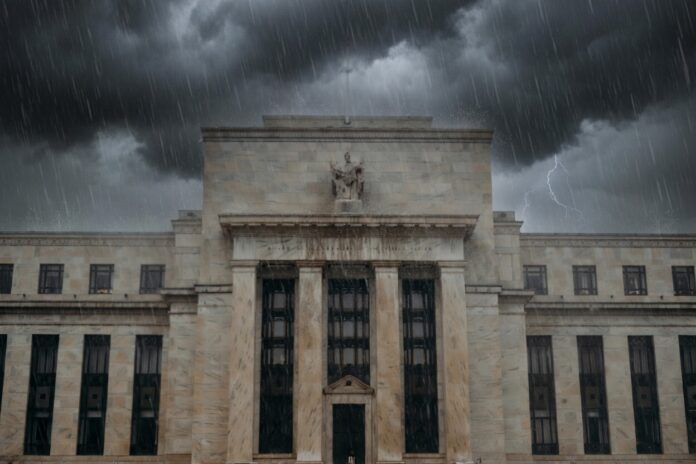
The US economy lost 92,000 jobs in February, nearly double what economists expected. Wages rose 3.8 percent year-over-year, the fastest pace in months. The OECD projects US inflation at 4.2 percent for 2026. Oil is up 55 percent in March alone. The Federal Reserve held rates at 3.50 to 3.75 percent at its March meeting and offered no guidance on what comes next. It cannot cut because inflation is accelerating. It cannot hike because the labour market is contracting. And the next jobs report lands on Good Friday, April 4, when markets are closed, one day before Trump’s Iran energy strike deadline expires on Sunday evening. Every piece of price discovery from that weekend will be compressed into Monday’s open.
The Numbers That Broke the Dual Mandate
The Bureau of Labor Statistics reported that the US economy shed 92,000 nonfarm payrolls in February 2026, the fifth monthly job loss in nine months. The consensus estimate had been a loss of roughly 50,000. The miss was driven by continued DOGE-related federal workforce reductions, a Kaiser Permanente strike that removed approximately 30,000 healthcare workers from payrolls, and broad weakness in leisure, hospitality, and retail hiring. The unemployment rate, last reported at 4.4 percent in December 2025 (the October figure was never calculated due to the government shutdown), has been drifting higher since mid-2025 when it stood at 4.1 percent.
On the other side of the Fed’s mandate, inflation is moving in the wrong direction. Core PCE, the Fed’s preferred measure, remained at 2.8 percent through late 2025, according to Bureau of Economic Analysis data. The New York Fed’s DSGE model, updated in March 2026, revised its Q1 2026 inflation nowcast upward by almost half a percentage point from its December projection, attributing the miss to cost-push shocks that “possibly capture the effects of tariffs.” Average hourly earnings growth of 3.8 percent, reported by the BLS in the February jobs report, is running well above the rate consistent with the Fed’s 2 percent inflation target. And oil prices, which feed into headline inflation through gasoline, diesel, heating oil, and transportation costs, have risen 55 percent in March alone following the closure of the Strait of Hormuz, according to CNBC. Brent touched $120 and crashed to $86 in a single session on a false ceasefire rumour, and closed above $100 for the first time since August 2022 two weeks into the war. The energy shock is not a one-day event. It is a sustained repricing of the global cost of fuel.
This is the configuration that monetary policy textbooks call a stagflation trap. Inflation is too high to cut rates. The labour market is too weak to raise them. The Fed is stuck. The CME FedWatch tool now shows greater than 50 percent probability of a rate hike at a future meeting, the first time hike expectations have exceeded cut expectations since the tightening cycle ended, according to reporting by Techi.com citing CME data. At the same time, LPL Financial’s chief economist noted that if the labour market deteriorates faster than expected, officials could cut rates as early as the April 29 decision. The two most likely outcomes, according to market pricing, are diametrically opposed. That is not a market expressing confidence. That is a market expressing confusion.
GDP Already Cracked Before the War Started
The Bureau of Economic Analysis reported that real GDP grew at an annualised rate of 0.7 percent in the fourth quarter of 2025, according to the second estimate released on March 25. That is a deceleration from 4.4 percent in Q3 and 3.8 percent in Q2. The 3.7 percentage-point drop between Q3 and Q4 is one of the sharpest single-quarter decelerations in recent history, and it occurred entirely before the Iran war began on February 28.
Part of the Q4 weakness was mechanical. Businesses had front-loaded imports in Q1 2025 to beat anticipated tariff increases, according to Purdue University’s Center for Commercial Agriculture. Imports surged 38 percent at an annualised rate in Q1, then collapsed 29 percent in Q2. The inventory cycle that accompanied this front-loading artificially inflated Q1 and Q3 GDP and then subtracted from Q4 as inventories were drawn down rather than replenished. The New York Fed’s DSGE model attributes the residual strength in Q3 and early 2026 primarily to AI-related investment, describing the shocks as “marginal efficiency of investment” forces that are now fading.
Deloitte’s Q1 2026 economic forecast, published March 27, projects full-year 2026 GDP growth of 2.2 percent, noting that “strong growth at the end of 2025 puts upward pressure on the growth rate” through base effects. Goldman Sachs, in its December 2025 outlook, forecast 2.6 percent growth for 2026. The New York Fed’s DSGE model is less optimistic, projecting just 1.0 percent for 2026, down from its December projection but revised upward from an even weaker earlier estimate. The model puts the probability of recession, defined as four-quarter growth falling below minus 1.0 percent, at 35.8 percent.
None of these forecasts fully incorporate the impact of oil at $115 per barrel. The Hormuz closure has removed 6.7 million barrels per day from the market, and the energy shock is feeding directly into consumer prices, transportation costs, and corporate margins. The Q1 2026 GDP print, when it is eventually published by the BEA, will be the first to reflect the full impact of the war on economic activity. If it comes in below 1 percent, the stagflation framing will shift from analyst commentary to official data.
The AI Factor: Growth Without Jobs
The traditional relationship between GDP growth and employment, in which economic expansion creates jobs and contraction destroys them, appears to be breaking down. A Resume.org survey found that 58 percent of US companies plan layoffs in 2026, and 37 percent expect to replace those roles with artificial intelligence by year-end. RSM Chief Economist Joe Brusuelas described the current environment as a “low-hire, more-fire” dynamic in which companies are not just cutting headcount in response to weak demand but are actively investing in AI infrastructure while shedding labour, even when revenue is stable.
This structural shift is visible in the data. The BLS has reported payroll gains averaging roughly 50,000 per month in the second half of 2025, well below the approximately 180,000 monthly average that prevailed before the tariff escalation. Goldman Sachs forecasts that payroll growth could double to 70,000 per month in 2026, but even that optimistic scenario implies employment growth that is less than half the pre-tariff pace. The unemployment rate, according to Purdue’s analysis, needs roughly 2.4 percent GDP growth to remain stable. At the New York Fed’s projected 1.0 percent growth rate, unemployment should rise. At Goldman’s projected 2.6 percent, it might hold. The range of outcomes is wide enough that the Fed cannot model its way to a confident policy decision.
The AI investment cycle is the reason GDP can grow while employment shrinks. Nvidia’s record GPU demand, the proliferation of enterprise AI tools, and rapid adoption of AI agents across customer service, coding, data analysis, and content production are enabling companies to increase output per worker without increasing the number of workers. The New York Fed’s DSGE model explicitly attributes recent GDP resilience to investment shocks that it links to AI spending. But investment-driven growth does not create the consumer spending that sustains the broader economy. Workers who are laid off and replaced by AI do not spend their former salaries on goods and services. The productivity gain accrues to capital, not labour. If this dynamic persists, the US may be entering a period in which GDP holds positive but the labour market deteriorates anyway, which is a form of stagflation that the Fed’s framework is not designed to address.
Good Friday, April 4: The Blindfolded Gap
The March 2026 Employment Situation report will be released by the Bureau of Labor Statistics on Friday, April 4, at 8:30 AM Eastern Time. The stock market will be closed for Good Friday. The bond market will close early. There will be no US equity trading session in which to react to the data. The FactSet consensus among economists calls for plus 57,000 nonfarm payrolls, a modest bounce from February’s minus 92,000, but still far below the pre-tariff average.
The Kaiser Permanente strike that suppressed February’s numbers has since been resolved, and those roughly 30,000 workers should return to payrolls in the March count. That alone could account for more than half of the expected gain. Government payrolls remain a wildcard: DOGE-driven federal layoffs are ongoing and the pace has varied month to month. A continued drawdown in government employment could offset private sector gains and produce another negative headline number.
The gap risk is not just about the jobs number. Trump’s deadline for strikes on Iranian energy infrastructure, first reported by CBS News and NPR, expires on Sunday, April 6, at 8 PM Eastern Time. If the deadline passes without a deal and without an extension, the market will face two catalysts simultaneously on Monday morning: the jobs data (released Friday but unpriced) and whatever Trump decides to do about Iran’s power grid (decided Sunday evening but also unpriced). The S&P 500 has already posted its worst session of the year on Iran war headlines. Monday, April 7, could open with the widest gap in futures since the pandemic.
The last time a major data release coincided with a geopolitical deadline over a holiday weekend was March 2020, when the COVID shutdown began over a weekend and Monday’s open saw the S&P 500 fall 12 percent. The configuration this time is different but the mechanism is the same: information accumulates while markets are closed, and all of it gets priced in a single chaotic open. For portfolio managers, the practical question is whether to reduce exposure before Thursday’s close or accept the gap risk. For the Fed, the question is whether a weak jobs number on Friday changes the calculus for the April 29 meeting, and whether an Iran escalation on Sunday changes it further.
The Fed’s April Meeting: Paralysis as Policy
The Federal Open Market Committee meets on April 29 to 30. By that date, the committee will have the March jobs report, the March CPI (scheduled for April 10), the March PCE (scheduled for late April), and a clearer picture of whether the Iran war is de-escalating or expanding. The question is what any of this data can tell the Fed that it doesn’t already know.
The inflation data will almost certainly show an acceleration. Oil’s 55 percent March surge will begin flowing into headline CPI through gasoline and energy components in the March and April readings. Core inflation, which excludes food and energy, may also rise if companies pass through higher transportation and input costs to consumer prices. The Deloitte forecast projects that elevated energy prices will contribute to higher inflation through at least the third quarter of 2026 before potentially easing. The OECD’s projection of 4.2 percent US inflation for 2026 is the highest among major forecasters and reflects the full impact of both tariffs and the energy shock.
The employment data, depending on March’s outcome, will either confirm or contradict the February shock. If March comes in near consensus at plus 57,000, the narrative will be that February was a one-off distorted by the Kaiser strike and DOGE timing. If March is negative again, the narrative shifts to structural weakness that the Fed cannot ignore. The difference between these two outcomes is roughly 150,000 jobs, which is within the normal range of forecast error for this report. The Fed will be making policy based on data that could go either way.
In practice, the most likely outcome of the April meeting is no change. The Fed will hold at 3.50 to 3.75 percent, issue a statement acknowledging elevated inflation and “evolving labour market conditions,” and defer any directional signal to the June meeting when more data will be available. This is what paralysis looks like when it is dressed up as patience. The Fed cannot explain why it is doing nothing because the honest answer is that it does not know what to do. The dual mandate is pulling in two directions with equal force, the war has introduced an exogenous inflation shock that monetary policy cannot address, and the AI-driven structural shift in employment is a phenomenon the Fed’s models were not built to capture.
Four central banks froze rates in the same week in March. The Fed was one of them. The ECB was another. The pattern is global: central banks entered 2026 expecting to cut. The war turned that expectation into a trap. And the trap has no exit until either inflation falls (which requires the war to end and oil to decline) or the labour market collapses (which requires a recession that nobody wants to trigger). Until one of those conditions is met, the Fed sits. Markets hate sitting. And the April 4 to April 7 weekend will test how much sitting they can tolerate.