


Reading time: 6 min
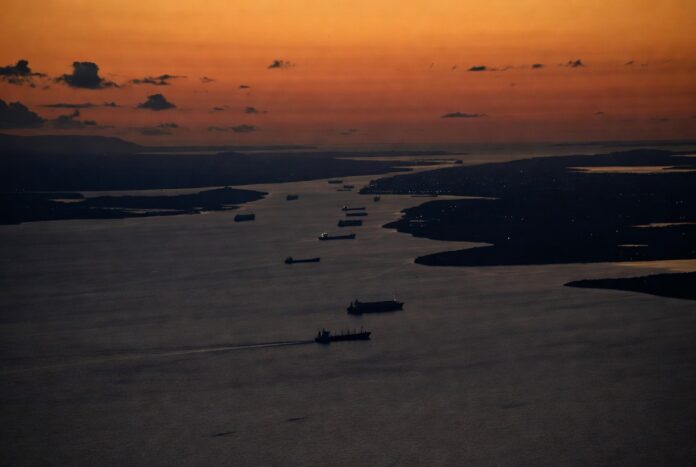
Bloomberg reported on Tuesday that Iran has begun charging commercial vessels transit fees to pass through the Strait of Hormuz. The payments, requested on an ad hoc basis, run as high as $2 million per voyage. There is no published tariff schedule, no formal legal basis, and no enforcement mechanism beyond the implicit threat that ships which refuse to pay may not transit at all. Iran is no longer just closing the strait. It is monetising the closure.
A Toll Road Through the World’s Most Important Chokepoint
The Strait of Hormuz normally handles roughly 20 million barrels of oil per day, about one-fifth of global seaborne crude trade. Since February 28, when the IRGC issued warnings prohibiting vessel passage, tanker traffic has dropped by approximately 70 percent. Commercial shipping that does transit is doing so at extraordinary risk, with 21 confirmed attacks on merchant vessels in the first two weeks of the conflict. Insurance premiums have surged. Most major shipping firms have suspended operations in the area entirely.
Into that vacuum, Iran has inserted itself as gatekeeper. The $2 million fee, according to Bloomberg’s sources, is not applied uniformly. It is sought on an ad hoc basis, which means the price is whatever Iran decides it is on any given day for any given vessel. That is not a tariff. That is a protection racket operating at sovereign scale in international waters.
The legal basis is nonexistent. The UN Convention on the Law of the Sea guarantees the right of transit passage through straits used for international navigation. Iran is a signatory. Charging fees for passage through Hormuz is a direct violation of that framework. But international law requires enforcement, and right now nobody is enforcing it. The US Navy has not escorted a single commercial tanker through the strait. France’s Operation Aspides is still deploying. India and Pakistan sent destroyers to the Gulf of Oman but explicitly not through the strait itself. The coalition of the willing to escort 3 to 4 ships per day with 7 to 8 destroyers has not materialised into a coalition of the doing.
The Pricing Tells You Everything About the Power Dynamic
Two million dollars per voyage sounds like a lot until you calculate what is on the other side. A fully loaded VLCC carrying 2 million barrels of crude at $104 per barrel is moving $208 million worth of oil. The transit fee is less than 1 percent of cargo value. For a shipowner or charterer facing the alternative of rerouting around the Cape of Good Hope, adding 10 to 15 days of sailing time, $300,000 to $500,000 in additional fuel costs, and significantly higher war risk insurance premiums, the $2 million fee is rationally cheaper than the alternative. That is the calculation Iran is banking on.
This also explains why the fee is ad hoc rather than fixed. A fixed tariff could be challenged legally and would create a precedent that other strait states might invoke. An informal, ship-by-ship arrangement gives Iran maximum flexibility: charge more for vessels carrying cargo to countries supporting the US-Israel campaign, charge less for vessels heading to China or India, and charge nothing for vessels carrying Iranian crude under the sanctions waiver that Treasury Secretary Bessent extended on March 20. The US lifted sanctions on 140 million barrels of Iranian oil at sea while bombing Iran. Now Iran is taxing the ships that carry everyone else’s oil through the same waterway.
Citi Says $200 Oil Is on the Table
Citi analysts said on Tuesday that the loss of energy supply to the global economy from the Hormuz closure is larger than the supply shocks of the 1970s as a share of total oil supply. The bank’s base case is that the disruption must be resolved, either militarily or diplomatically, by mid to late April. If it is not, Brent could run to at least $120 within a month. If production constraints extend through June, Citi sees a path to $200.
Brent traded above $104 on Tuesday after rebounding from Monday’s 11 percent plunge to roughly $99. That plunge was driven by President Trump’s claim on Truth Social that the US and Iran had held “very good and productive conversations” about resolving the conflict. Iran’s Foreign Ministry denied any talks had taken place. The speaker of Iran’s parliament, Mohammad Bagher Qalibaf, called the claim “fakenews used to manipulate the financial and oil markets.” On Tuesday, a separate Iranian source told CNN there had been “outreach” and that Iran was willing to listen to “sustainable” proposals. The market could not decide which Iranian statement to believe, so it split the difference. S&P 500 fell as much as 1 percent before recovering to roughly flat on the CNN headline.
The five-day suspension of Trump’s threat to strike Iranian power plants expires on Saturday. If the deadline passes without either a credible diplomatic track or a military escalation, the market will have to price a conflict that has no visible endpoint and a chokepoint that is now operating as a revenue-generating toll booth for the country the US is at war with. That is not a geopolitical risk premium. That is a structural repricing of how global energy moves from producer to consumer.
What This Means for Your Book
If Iran can charge $2 million per ship and nobody stops it, the cost gets passed through. Shipowners pass it to charterers. Charterers pass it to refiners. Refiners pass it to consumers. The fee is small relative to cargo value but it is additive to every other cost that has already spiked: war risk insurance, rerouting fuel costs, demurrage from port delays, and the opportunity cost of tankers sitting idle outside the strait. Stack all of those on top of a $104 barrel of Brent and you get an effective delivered cost of crude that is significantly higher than the headline spot price suggests.
The transit fee also creates a secondary problem that is harder to model. If Iran can selectively price access to the strait, it can effectively create a two-tier market: one price for countries it wants to reward and another for countries it wants to punish. China, which receives roughly a third of its crude through Hormuz, may get preferential treatment. Europe, which the IEA tried to shield with a 400 million barrel strategic release, may not. That is not just a commodity pricing issue. It is a geopolitical realignment of energy trade flows that could outlast the war itself.
The strait is open, technically. You can sail through it. You just have to pay Iran for the privilege. And the price is whatever Iran says it is today. If you are trading energy, shipping, or anything that moves through the Gulf, that sentence is your new baseline. Price accordingly.
For a complete timeline of how the Iran war reshaped global markets, see our reference page.