


Reading time: 6 min
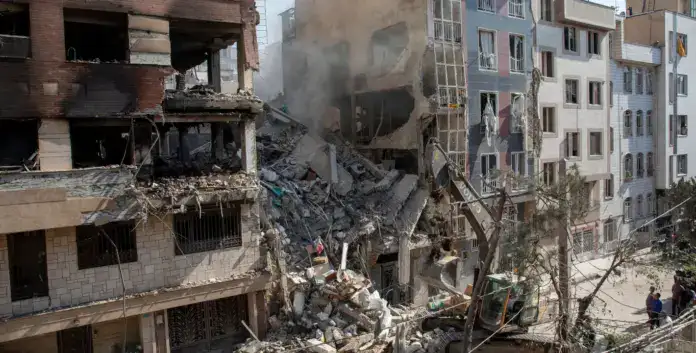
The United States and Israel launched coordinated military strikes across Iran on Saturday, hitting the capital Tehran and multiple other cities in what President Donald Trump described as “major combat operations.” Iran retaliated within hours, firing missiles at Israel and targeting American military bases across the Persian Gulf, according to Al Jazeera, CNN, NBC News and the Washington Post.
Operation Epic Fury
The US Department of Defence confirmed the operation’s codename as “Operation Epic Fury,” according to Al Jazeera, marking the first publicly named American military campaign against Iran. Trump announced the strikes in a video posted to Truth Social, telling Iranians: “The hour of your freedom is at hand. When we are finished, take over your government. It will be yours to take. This will probably be your only chance for generations.” In an interview with the Washington Post, Trump said he wanted Iran to be “a safe nation.” A US official told Reuters the administration was planning a “multiday operation.”
Israeli Prime Minister Benjamin Netanyahu said the joint assault would continue “as long as needed,” the Washington Post reported. A US official told Al Jazeera earlier that the operation was carried out as a joint military campaign, with American forces attacking by air and sea, according to Reuters. The Israeli military said its strikes had been in preparation through “months of close and joint planning,” CNN reported.
Strikes Hit Tehran, Isfahan, Qom
Iranian state media and Al Jazeera correspondents on the ground reported explosions across the capital. Several missiles struck University Street and the Jomhouri area in central Tehran, according to Iran’s Fars news agency. An Associated Press report cited by CBS News said one strike hit near the offices of Supreme Leader Ayatollah Ali Khamenei. CNN confirmed through satellite imagery and triangulated video that several buildings inside Khamenei’s compound were struck. Khamenei was not in Tehran and had been transferred to a secure location, Reuters reported, citing an Iranian official.
Explosions were also reported in Isfahan, Qom, the western province of Ilam and the southern Hormozgan province, according to Iranian media compiled by Al Jazeera. An Israeli strike hit a girls’ elementary school in the city of Minab in Hormozgan, killing at least 40 people and wounding 45 others, according to Iran’s state-run IRNA news agency cited by Al Jazeera and the Associated Press. The Israeli military issued warnings in Farsi urging Iranians near “military industrial factories and military infrastructure” to evacuate immediately, CBS News reported. Cellphone communications were disrupted across several areas of Tehran, according to Al Jazeera’s correspondent Maziar Motamedi.
Iran Retaliates Across the Gulf
Iran struck back within hours, launching missiles at northern Israel and at American military installations across the region. Euronews reported that Iran had fired on targets in every Gulf state except Oman, which has mediated US-Iran nuclear talks. The US Navy’s Fifth Fleet headquarters in Bahrain was targeted, a local source confirmed to CBS News, and explosions were reported in Kuwait, according to multiple media outlets. US bases in Jordan were also targeted, sources told CBS News, though there were no immediate reports of missiles hitting those facilities.
Israel declared a state of emergency and said it had detected missiles launched from Iranian territory, according to NBC News. The Israeli military said it was working to intercept them. Qatar’s transportation ministry called on all maritime vessels to “temporarily suspend maritime navigation” as a precautionary measure, Euronews reported.
Iranian Foreign Minister Abbas Araghchi warned the foreign ministers of Saudi Arabia, the UAE, Qatar, Kuwait, Bahrain and Iraq not to allow the US and Israel to use their territory for attacks, according to Iran’s semi-official Mehr news agency cited by NBC News. He said Iran’s armed forces “will regard the origin and source of aggressive operations” as well as “any action aimed at confronting Iran’s defensive operations, as legitimate targets.”
Market Impact: Strait of Hormuz Now a War Zone
Financial markets were closed when the strikes began on Saturday, but the week ended with prices already reflecting escalation risk. Brent crude surged more than 3% at one point on Friday, according to AFP, closing at $72.87 per barrel — a seven-month high — after Thursday’s last-ditch talks in Geneva failed to produce a deal. Analysts at OilPrice.com said a sharp “war premium” would be priced into crude when markets reopen on Monday, with the Strait of Hormuz — through which roughly 20 million barrels per day flow, equivalent to 20% of global oil consumption, according to the US Energy Information Administration — now effectively “a war zone.”
Bloomberg noted that Iran itself produces 3.3 million barrels per day, making it OPEC’s fourth-largest producer, but its strategic position amplifies the supply risk far beyond its own output. CNBC reported that market watchers expect “far greater market consequences” from the Iran conflict than from recent geopolitical shocks including Trump’s 15% universal tariff and the capture of former Venezuelan President Nicolás Maduro. Gold closed the week near US$5,250 per ounce, already up sharply on safe-haven flows, according to JM Bullion and USAGOLD.
International Reaction
Russia’s foreign ministry said the scale of preparations left “no doubt that this was a pre-planned and unprovoked act of armed aggression” against “an independent UN member state,” according to NBC News. Moscow said the attacks were carried out “under the guise of renewed negotiations,” a criticism echoed by Finland’s President Alexander Stubb, who told broadcaster Yle that the US was “largely operating outside traditional international law,” CNN reported.
Democratic Senator Tim Kaine called the strikes “dangerous, unnecessary, and idiotic” and demanded the Senate reconvene to vote on his War Powers Resolution, according to CNN. The EU’s foreign policy chief Kaja Kallas described the situation as “perilous” and said the bloc was evacuating some staff from the region, Euronews reported. Pakistan’s foreign minister Ishaq Dar called the strikes “unwarranted” during a phone call with his Iranian counterpart, according to Euronews.
Iran’s exiled crown prince Reza Pahlavi addressed the country’s security forces on social media: “Your duty is to defend the people, not a regime that has taken our homeland hostage,” CBS News reported. He also asked Trump to “exercise the utmost caution” to protect civilian lives.
The head of Iran’s parliament national security commission, Ebrahim Azizi, warned on social media: “We warned you! Now you have started down a path whose end is no longer in your control,” according to Al Jazeera. The conflict comes eight months after a 12-day US-Israeli war against Iran last summer that targeted nuclear facilities. This time, Trump’s stated objectives extend beyond the nuclear programme to explicit calls for regime change — a significant escalation that markets and governments across the region are now scrambling to absorb.
For a complete timeline of how the Iran war reshaped global markets, see our reference page.