


Reading time: 6 min
An Iranian Shahed-136 drone struck Saudi Aramco’s Ras Tanura refinery on Monday morning, according to India TV News citing social media footage and Saudi military sources, forcing the shutdown of 550,000 barrels per day of refining capacity and marking the first direct Iranian hit on Gulf energy infrastructure since the conflict began. Brent crude jumped to $79.41 in early trading – up roughly 9 percent from Friday’s close – and the session isn’t over.
What Happened at Ras Tanura
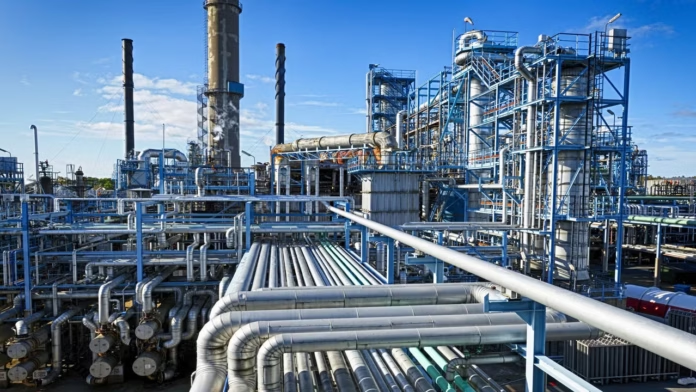
Aramco shut the Ras Tanura complex as a precautionary measure after the drone impact triggered a fire, according to Bloomberg, citing people familiar with the matter. The blaze was brought under control and there are no reported casualties so far. Reuters confirmed the shutdown, quoting an industry source who described the situation as “under control.” The Saudi Defense Ministry said it had intercepted additional drones targeting the facility, as India TV News reported.
That last detail matters more than the one that got through. If multiple drones were launched at a single refinery, this was not a stray projectile from the broader retaliation wave. It was a targeted strike on energy infrastructure. The National reported that the attack marks the first Iranian hit on Gulf energy assets in this conflict – a line Tehran had not previously crossed, even as it launched missiles at airports in Dubai, Abu Dhabi, and Bahrain over the weekend.
Why This Refinery Matters
Ras Tanura is not just a refinery. It is the oldest and largest on the Persian Gulf coast, with 550,000 barrels per day of crude distillation capacity, according to MEED and Offshore Technology. It is also one of the world’s most critical export terminals for Saudi crude, as BusinessToday noted. The complex processes crude from the Abqaiq and Khurais fields, the same upstream sources that were hit in the September 2019 drone and missile attack that temporarily knocked out half of Saudi Arabia’s output. The National added that the Ras Tanura shutdown is the second Aramco disruption in days – the Juaymah liquefied petroleum gas terminal, located nearby, had already seen its exports halted earlier in the week.
That Abqaiq parallel is the one that has crude desks on edge this morning. In 2019, Houthi-claimed drones and cruise missiles struck Abqaiq and Khurais, removing roughly 5.7 million barrels per day from global supply – the largest disruption on record, according to the International Energy Agency – and sending Brent up nearly 20 percent intraday, per Al Jazeera citing Bloomberg. It was the biggest single-session spike since the 1990 invasion of Kuwait. It took Saudi Arabia weeks to fully restore output, partly because Abqaiq contained specialised processing equipment, as Bob McNally of Rapidan Energy Group told CNN, that “you can’t just order from General Electric.” Ras Tanura sources crude from those same fields. If the damage goes beyond what Aramco is publicly stating, the repair timeline could echo 2019.
The Price Picture
Brent crude was already running hot before the Ras Tanura hit. It closed Friday at $72.48 per barrel – a seven-month high, per Reuters – after rising 2.45 percent on war expectations alone. Sunday evening’s open was violent. By early Monday, CNBC reported Brent at $79.41, up roughly 9 percent, or $6.54 on the session. FactSet data showed the benchmark trading at $78.55 earlier in the morning, already up 7.8 percent. WTI tracked it higher, jumping over 8 percent to $72.57. India TV News cited MCX crude futures hitting a lifetime high of Rs 6,700 per barrel, up 9.73 percent on the day.
The range of analyst targets has widened fast. Barclays analyst Amarpreet Singh warned clients on Saturday that Brent could reach $100 per barrel, per CNBC. UBS analysts led by Henri Patricot went further in a Sunday note, flagging a scenario above $120 if there is a material, prolonged disruption. Bloomberg’s Javier Blas took a more measured view, estimating a 10-to-15 percent spike at the open while arguing that a historic oil shock remained unlikely – provided the Strait of Hormuz stays open. Size your positions accordingly. The gap between $80 Brent and $120 Brent is the gap between “contained conflict” and “the strait is closed.”
The Strait Nobody Wants to Talk About
Roughly 13 million barrels per day of crude pass through the Strait of Hormuz – about 20 percent of global seaborne supply, according to Kpler. Iran controls the northern shore. Ship & Bunker reported that Iran appears to be attempting to restrict commercial shipping through the passage, though no formal closure has been declared. Two vessels have already been struck in the area, according to CNBC: a Palau-flagged tanker named Skylight was targeted 5 nautical miles north of the strait, and the Marshall Islands-flagged MKD VYOM was damaged off the coast of Oman. Oman’s Maritime Security Centre confirmed the latter incident.
Dylan Mortimer at broker Marsh told CNBC that marine hull war-risk insurance premiums in the Gulf could spike 25 to 50 percent. That alone raises the delivered cost of every barrel that transits Hormuz, even before accounting for the rerouting costs that have been building since the weekend strikes drove oil toward $73 and gold past $5,300.
Saudi Arabia’s Impossible Position
Here is the part the energy market has not fully priced. Saudi Arabia did not participate in the US-Israeli strikes on Iran. Riyadh explicitly closed its airspace and told Washington it would not allow Saudi territory to be used for operations against Tehran, as Middle East Eye reported, citing two Gulf Arab sources. Crown Prince Mohammed bin Salman called Gulf leaders on Saturday to urge restraint and prevent any one GCC state from provoking an escalation.
Tehran hit them anyway. The Saudi Foreign Ministry, via the state-run Saudi Press Agency, condemned what it called “blatant and cowardly Iranian attacks” on Riyadh and the Eastern Province, as Al Arabiya reported, and said the kingdom would take “all necessary measures” to defend itself, “including the option of responding to the aggression.” A joint statement issued by the US State Department on Sunday, co-signed by Saudi Arabia, the UAE, Bahrain, Kuwait, Qatar, and Jordan, went further, affirming the right to self-defence and calling Iran’s actions “reckless and destabilizing.”
That trajectory matters for your crude book. If Saudi Arabia is drawn into active retaliation against Iran, you are no longer looking at a conflict between the US-Israel axis and Tehran. You are looking at an oil producer actively engaged in a shooting war with a neighbouring oil producer, with the world’s most critical energy chokepoint sitting between them. The repricing scenario that markets were bracing for on Sunday night just got materially worse.
What to Watch
Three things will determine whether Brent settles in the $80s or blows past $100. First: how quickly Aramco restores Ras Tanura. If this is a 48-hour precautionary shutdown, gasoil markets calm down by Wednesday. If there is structural damage to distillation units, you are looking at weeks – and the Abqaiq playbook becomes the reference case. Second: the Strait of Hormuz. Every tanker that transits without incident brings prices down. Every vessel that gets hit pushes them higher. Third: Saudi Arabia’s next move. Riyadh has the language for retaliation on record. Whether it follows through, and against what targets, will define the next leg of this market. Nobody was positioned for this three days ago. Plan accordingly.
For a complete timeline of how the Iran war reshaped global markets, see our reference page.