Reading time: 5 min
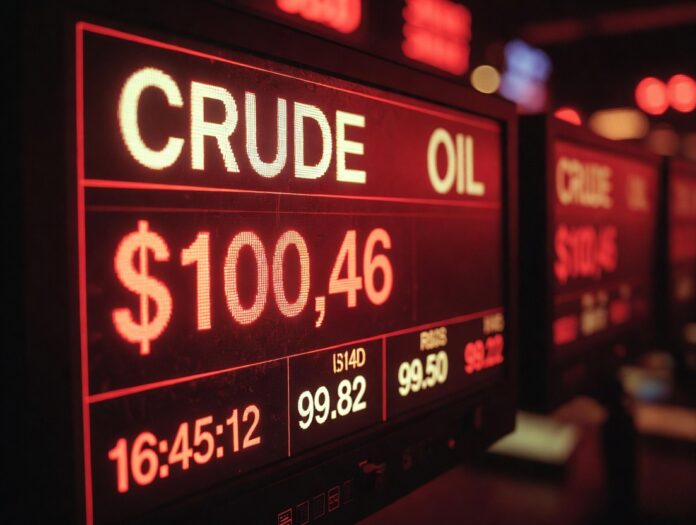
Brent crude settled at $100.46 on Thursday, a 9.22% single-session move and the first close above $100 since August 2022. WTI added 9.72% to $95.73. The IEA’s record 400-million-barrel reserve release, announced the same morning, did nothing. Iran’s new supreme leader told state television the Strait of Hormuz must stay closed as a “tool to pressure the enemy.” Wall Street posted its worst session of the year. The question now isn’t whether oil got to $100. It’s whether anyone has a credible plan to bring it back down.
What Actually Moved the Market on Thursday
The price had already touched $101.59 in overnight trading before Mojtaba Khamenei’s statement hit newswires, per LSEG data. The statement itself – Hormuz as deliberate leverage, not a side effect of the conflict – confirmed what the forward curve had been signalling for days. Contracts for May delivery settled above $100. Further out, per LSEG, the curve declines steadily, falling close to $70 by the end of the decade. That is the market’s answer to Khamenei: it doesn’t believe $100 oil lasts. But it has no idea when it ends, either.
The IEA’s 400 million barrel coordinated release, which the market dismissed almost immediately after the announcement, was never going to move price in a session where the closure was being re-affirmed rather than resolved. Emergency reserves replace barrels in storage. They don’t reopen a strait. The bid held through the close.
The Term Structure Is Telling You Something
At the start of 2026, per LSEG, the Brent curve sat in mild contango: spot around $60, gradually rising into the mid-$60s in the outer years. That structure is gone. The front of the curve has moved roughly $40 in six weeks. The back hasn’t. That divergence is the market pricing a disruption, not a regime change in the energy complex – which is consistent with Goldman Sachs’s base case, published via Reuters on Wednesday, of a March/April average around $98 and a Q4 2026 forecast of $71, predicated on a 21-day disruption window and a 30-day recovery. If that assumption holds, you’re looking at mean reversion through the summer. If the Strait stays closed past that window, Goldman’s model breaks.
Wolfe Research’s Stephanie Roth put the macro arithmetic plainly this week: a $20 sustained increase in oil prices translates to roughly a 0.1% drag on US GDP and a 0.4% uplift to headline inflation. Brent is roughly $40 above where it started the year as of Thursday’s close. You can do the math from there.
Why the Fed Can’t Help You Here
February CPI came in at 2.4% year-on-year, with core holding at 2.5% – sticky but not alarming in isolation, per the Bureau of Labor Statistics. Then the Strait closed. The PCE deflator for January 2026 is due Friday at 8:30 ET, and neither that release nor any near-term data point will yet capture the oil shock’s pass-through into transport, chemicals, and goods prices. BEA is also releasing the second estimate of Q4 2025 GDP today, with the advance print at +1.4% annualised – a significant deceleration from Q3’s 4.4%. The Atlanta Fed’s GDPNow tracker jumped to 2.7% on Thursday’s strong January trade data ($54.5 billion deficit against $66.6 billion consensus, per BEA), but that reading predates the war. The underlying trend it’s tracking doesn’t.
The CME FedWatch tool was showing a 99% probability of a hold at the March 17-18 FOMC meeting as of Thursday’s close, with the federal funds rate expected to remain at 3.5-3.75%. That’s not surprising. What’s more interesting is what the bond market did. The 10-year Treasury yield climbed to 4.26%, a five-week high, and the 30-year auction tailed, signalling weakening demand for long duration amid the inflation repricing. If you’re long duration right now, Thursday’s auction result is the number to watch, not the headline CPI print.
The Session and the Signals Inside It
The S&P 500 fell 1.52% to 6,672.62, its lowest close since November and a 2026 year-to-date low, according to CNBC. The Dow shed 739 points to 46,677.85. The Nasdaq lost 1.78% to 22,311.98. Eight of the eleven S&P sectors closed lower, with industrials, consumer discretionary, and technology leading the declines. Energy and utilities were the only sectors in the green – a textbook risk-off rotation. The index is still just 4.4% below its all-time high set in January, per AP, which suggests the market is treating this as a disruption, not a structural repricing. That confidence could prove well-founded or badly wrong depending on a single variable: how long the strait stays closed.
There was one additional development Thursday that received less attention than oil but matters for the credit picture. Reports emerged Thursday of withdrawal caps at private credit funds including Morgan Stanley and Cliffwater, per session recaps. Private credit has been one of the fastest-growing corners of US finance for a decade. Withdrawal caps at this stage of an oil shock, with the rate outlook deteriorating, raise questions about underlying loan quality that deserve more scrutiny than they got in Thursday’s tape. The supply-side math was already broken before this new credit signal appeared.
What Breaks the Move
Energy Secretary Chris Wright told CNBC on Thursday that the US Navy is “not ready” to begin escorting tankers through the Strait. He added it would be able to do so “relatively soon” and potentially by month-end, as military assets remain focused on destroying Iran’s offensive capabilities. That’s the single most important variable in the oil price right now. Brent touched $120 earlier in the conflict before collapsing to $86 in a single session – a move that showed just how violently the market will reprice the moment a credible resolution mechanism appears. The same logic runs in reverse on the upside: if tanker escorts begin and the first convoy transits successfully, the front-month contract could give back $15 in hours.
Until then, the market is pricing duration uncertainty into a front-loaded curve, the Fed is frozen between an energy inflation it can’t cut through and a labour market it can’t ignore, and Wall Street is sitting 4.4% off its highs hoping Wright’s “relatively soon” means what it sounds like. The positioning trade is not whether $100 holds. It’s whether the Strait re-opens in days, weeks, or months. Every piece of data between now and that answer is noise.