Reading time: 8 min
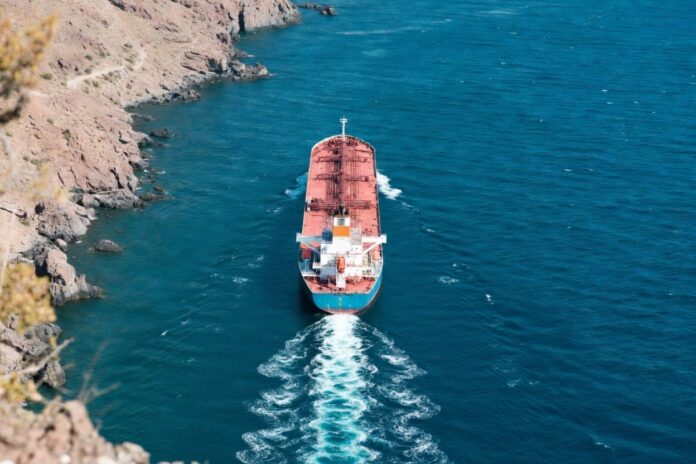
On April 2, three tankers managed by Oman Ship Management Company transited the Strait of Hormuz by hugging the Omani coastline instead of using the standard northern shipping lanes that pass through Iranian territorial waters. Bloomberg identified them as the supertankers Dhalkut and Habrut and the LNG carrier Sohar LNG, all broadcasting AIS signals on the southern route. Hours later, Iran’s deputy foreign minister Kazem Gharibabadi announced that Tehran and Muscat are drafting a joint protocol to “monitor transit” through the strait. The implication was immediate: Iran is trying to claim authority over a waterway it cannot fully control, while the market just discovered a route that bypasses Iranian waters entirely. Brent pared a 10 percent intraday surge after the protocol news hit, dropping from $111 to $106 before settling near $109. The question is no longer whether oil can move through Hormuz. The question is who decides.
The Route That Changed the Calculation
The Strait of Hormuz is 33 kilometers wide at its narrowest point. Under international maritime law, both Iran and Oman can claim up to 12 nautical miles of territorial waters from their respective coastlines. The entire width of the strait consists of overlapping territorial seas. There is no high sea passage in between. For decades, commercial shipping used northern lanes that passed between Iran’s islands and required de facto Iranian cooperation. That route is now controlled by the IRGC, which has operated what Al Jazeera and Lloyd’s List have described as a “toll booth” system since approximately March 15, requiring vessels to submit to a vetting scheme before transit.
What the three Omani-managed tankers demonstrated on April 2 is that the southern route, hugging Oman’s coastline, is physically passable. Brent crude reacted immediately, dropping on the implication that the blockade has a structural weakness. Professor Jason Chuah of City University of London told Al Jazeera that Iran has no jurisdiction beyond 12 nautical miles from its coast: “It cannot charge a toll if your ship uses the Omani coastline.” But he added the critical caveat: Iran retains the capability to strike any vessel on either side of the strait with missiles, mines, or drones, regardless of whose territorial waters the ship occupies. The route exists. The safety guarantee does not.
What the Data Actually Shows
The optimism around the Omani route needs to be measured against what has actually happened in the strait since February 28. Windward, the maritime intelligence firm tracking every transit, reported that daily throughput remains 93 percent below pre-war averages. In the week from March 15 to March 23, only 16 AIS-transmitting crossings were observed. By March 31, the daily count had risen to 11 vessels, including some operating with AIS dark. Oil prices have swung violently on each incremental change in transit numbers, but the cumulative picture remains one of near-total disruption.
March oil loadings at ports west of Hormuz tell the fuller story. According to Windward data, exports of crude, condensate, and petroleum products totaled 5.28 million barrels per day in March, compared with 22.2 million barrels per day in February. That is a 76 percent decline in one month. Crude and condensate loadings specifically fell from 16.6 million bpd to 4.3 million bpd. Nearly 2,000 vessels remain stranded on both sides of the strait, according to International Maritime Organization Secretary-General Arsenio Dominguez. The three Omani tankers that took the southern route are a proof of concept, not a solution to a crisis of this magnitude.
Iran’s Two-Track Strategy
Tehran is running a parallel game. On one track, it selectively allows vessels linked to friendly nations to transit via the northern route past Larak Island. On March 26, Iran’s foreign minister Abbas Araghchi announced that ships owned by China, Russia, India, Iraq, and Pakistan would be permitted passage. Malaysian and Thai vessels were added after bilateral negotiations. By late March, 36 percent of observed transits were on US-sanctioned vessels, and 27 percent were Greek-owned bulk carriers carrying agricultural commodities, according to Windward analysis. The selective blockade is a geopolitical instrument, not a commercial one.
On the second track, Iran is trying to institutionalize its control. The protocol being drafted with Oman would establish joint monitoring of transit, which in practice means Iranian vetting of every ship that passes through. Iranian lawmaker Alaeddin Boroujerdi told Iran International that the country has been charging some vessels $2 million per transit. “Because war has costs, naturally, we must do this,” he said. Iran has listed international recognition of its authority over the strait as one of five conditions for ending the war. Gregory Brew, senior Iran and oil analyst at Eurasia Group, told MS NOW that if Iran manages to take permanent control, it would be “a colossal win” for Tehran. Central banks from Washington to Frankfurt are watching this negotiation as closely as any military operation because the outcome determines whether the energy price shock is temporary or structural.
Why Oman Is the Pivot
Oman occupies a unique position in this crisis. It borders the strait on the south side, has deep-water ports at Duqm, Salalah, and Sohar in the Arabian Sea that allow tankers to bypass the chokepoint entirely, and has maintained diplomatic relationships with both Iran and the West for decades. Muscat has historically played the role of quiet mediator in Gulf conflicts. The fact that Omani-managed vessels were the first to demonstrate the southern route is not coincidental.
But the bypass is not without risk. In March, Iranian drones struck Duqm and Salalah, damaging at least one fuel storage tank at Duqm. Sohar falls within the Joint War Committee’s designated war risk area, meaning insurance costs for vessels calling there have increased sharply. India and Pakistan sent destroyers to escort tankers in the Gulf of Oman, though not in the strait itself. Analysts estimate that 3 to 4 commercial ships per day could be escorted with 7 to 8 destroyers providing air cover, but sustaining that for months would require resources that no single navy has committed. The coordinated policy freeze across central banks reflects the reality that nobody knows whether the Omani route scales or whether Iran escalates to shut it down.
The Insurance Problem Nobody Is Solving
Even if the physical route through Omani waters works, the commercial route remains blocked by insurance. The Lloyd’s of London Joint War Committee added waters around Oman to its list of high-risk maritime areas in March. War risk premiums for vessels transiting the region have increased by multiples, not percentages. A tanker owner considering the Omani route faces hull insurance premiums that can exceed the value of the cargo on short routes, plus crew war risk bonuses, plus the possibility that a single Iranian drone or mine makes the vessel uninsurable for future voyages.
This is the mechanism that keeps the blockade effective even when the physical passage is open. Brent’s 55 percent gain in March was not driven by a shortage of oil in the ground. It was driven by a shortage of oil that could be moved at a price that made commercial sense. The UKMTO has logged 24 maritime incidents since February 28, including 16 confirmed attacks and 8 suspicious events. CNN reported that Iran has attacked at least 19 vessels near the strait, in the Persian Gulf, and in the Gulf of Oman. A single attack on a tanker using the Omani route would likely shut down the southern bypass for weeks, regardless of whether the physical passage remains open. Gold remains elevated in part because the insurance market is pricing exactly this scenario.
What April 6 Means
Trump’s deadline for Iran’s energy infrastructure is April 6. The US military struck facilities on Kharg Island on March 28, which handles roughly 90 percent of Iran’s crude exports, but did not target oil trade infrastructure directly. Trump has warned that those sites could be next. If the US escalates to hitting Kharg Island’s oil terminals, Iran’s incentive to maintain even selective transit through Hormuz disappears. If a deal materializes before April 6, transit could resume within days and Brent would fall sharply.
The Omani route exists between these two extremes. It offers a physical alternative that could, over weeks, restore a fraction of the 22.2 million bpd that flowed through Hormuz before the war. But fraction is the operative word. Three tankers on a single day do not replace a system that moved roughly two dozen vessels per day before February 28. The market understood this immediately: Brent gave back five dollars on the Bloomberg report before recovering to settle near $109 as traders realized that three ships do not equal an open strait.
For oil traders, the next 96 hours are binary. Either Trump’s deadline produces a diplomatic breakthrough and the strait reopens under international norms, or it produces an escalation and the Omani route becomes the only viable path for Gulf oil. In the first scenario, Brent retests $90. In the second, the Omani route’s capacity constraints, insurance costs, and vulnerability to Iranian interdiction mean Brent stays above $100 for the foreseeable future. Asian markets are already positioning for both outcomes. The strait is no longer closed or open. It is negotiated, ship by ship, route by route, day by day. That is the new normal, and it is priced accordingly.