

Reading time: 7 min
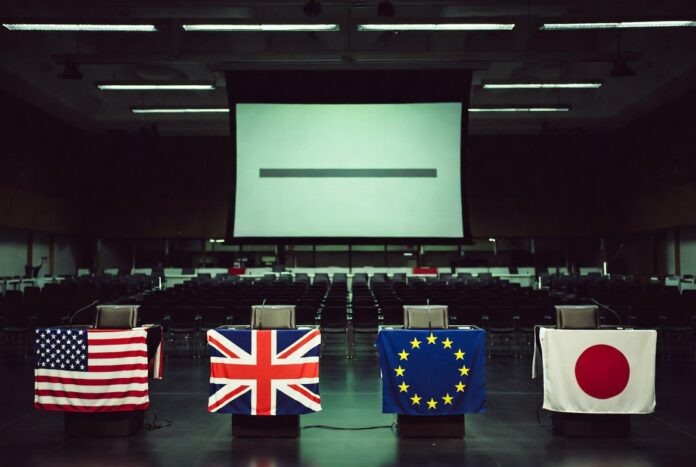
The Federal Reserve, the Bank of England, the European Central Bank, and the Bank of Japan all held interest rates between Wednesday afternoon and Thursday afternoon, a span of barely 24 hours. The combined message was unambiguous: the monetary easing that markets had spent eighteen months pricing is over, and several of the world’s most important central banks are now openly discussing whether the next move is up, not down.
It is worth stating the sequence plainly, because nothing like it has happened since the coordinated response to the pandemic in 2020. The Federal Reserve held at 3.50 to 3.75 percent on Wednesday afternoon. The Bank of Japan held at 0.75 percent on Thursday morning Tokyo time. The European Central Bank held at 2.00 percent on Thursday afternoon in Frankfurt. The Bank of England held at 3.75 percent on Thursday afternoon in London. Four institutions responsible for setting borrowing costs across more than half the global economy arrived at the same conclusion within the span of a single day: the Iran war has made it impossible to cut, and the data is beginning to suggest it may become necessary to raise.
The Bank of England
The BoE delivered the most consequential surprise. The Monetary Policy Committee voted 9-0 to hold, the first unanimous decision since September 2021. Reuters had polled economists who mostly expected a 7-2 split, with at least two members voting for a cut. None did. The minutes revealed that BoE staff now forecast CPI rising to 3.5 percent over the next two calendar quarters, up from 2.1 percent just weeks earlier. Governor Andrew Bailey warned that petrol prices were already higher and that household energy bills would increase later this year if the conflict persists.
The individual statements from MPC members told a sharper story. Catherine Mann, who had been considering a vote for a cut as recently as February, explicitly shifted her stance to a “longer hold, or even a hike at some point.” Swati Dhingra, the committee’s most consistent dove, acknowledged that rates might need to stay on hold or rise in the event of a severe and prolonged energy disruption. Chief Economist Huw Pill, who had voted against the BoE’s most recent cuts, said he was “ready to act” if the shock raised longer-term inflation risks. Only Alan Taylor, one of the most vocal supporters of easing, pushed back, saying he saw “a high bar to hiking” given the uncertainty around energy prices.
Markets responded immediately. Two-year gilt yields spiked 33 basis points to 4.43 percent, their highest level since January 2025, per Reuters. Investors moved to price two quarter-point hikes by year-end, a scenario that would have been considered absurd three weeks ago. Bailey later cautioned broadcasters against “reaching any strong conclusions about us raising interest rates,” adding that “the right place to be is on hold.” Rob Wood, former BoE economist now at Pantheon Macroeconomics, noted that the surge in natural gas prices on Thursday, which came after the MPC’s vote on Wednesday, tilted risks further toward hikes.
The Federal Reserve
The Fed held at 3.50 to 3.75 percent on Wednesday as universally expected, but the updated Summary of Economic Projections and Chair Jerome Powell’s press conference shifted the market’s rate path decisively. The dot plot continued to show a median of one 25 basis point cut in 2026, but the distribution around that median has shifted hawkish. Two members, Stephen Miran and Christopher Waller, dissented in favour of a cut, repeating their January stance, but they are now further from the consensus than they were three months ago.
Powell’s remarks were interpreted as hawkish. He acknowledged that the Iran conflict had injected “elevated uncertainty” into the outlook and that energy prices could complicate both sides of the Fed’s dual mandate. Markets reacted by pricing out nearly all remaining rate cuts for 2026. CME FedWatch data showed a 73 percent probability that the fed funds rate would remain unchanged through the end of the year, up from 26 percent one month earlier. A 4 percent probability of a rate hike by December appeared for the first time since the tightening cycle ended. The two-year Treasury yield rose to 4.27 percent, its highest since the summer, while the ten-year settled at 4.27 percent.
The political dimension added a layer that no other central bank faces. President Trump, speaking to reporters on Monday, criticised Powell directly: “What’s a better time to cut interest rates than now? A third-grade student would know that.” The administration signalled support for a Department of Justice investigation into Powell over a headquarters renovation project, a move Powell addressed in a video statement, calling it “a consequence of the Federal Reserve setting interest rates based on our best assessment of what will serve the public, rather than following the preferences of the President.” Powell’s term expires on May 15. His nominated successor, Kevin Warsh, remains unconfirmed.
The European Central Bank
The ECB held its deposit facility rate at 2.00 percent on Thursday, as expected, but the updated staff projections carried the real weight. The 2026 headline inflation forecast was raised to 2.6 percent from 1.9 percent in the December round, driven entirely by higher energy prices from the war. The growth forecast was cut to 0.9 percent from 1.2 percent, per the ECB’s official projection tables. President Christine Lagarde dropped her previous characterisation that policy was in “a good place,” telling CNBC that the ECB was “well-positioned and well-equipped to deal with the development of a major shock that is unfolding.”
The shift in tone was significant. Eurozone industrial production had already contracted 1.2 percent year-on-year in January, before the worst of the energy shock. The ECB is now navigating a familiar bind: inflation driven by supply-side energy costs that rate increases cannot address, combined with a growth trajectory (0.9 percent) that rate increases would weaken further. The eurozone’s only consolation is that wage growth has been cooling, but energy costs, if sustained, will overpower that signal within months. Markets are now pricing rate hikes for the ECB as well, though the probability remains lower than for the BoE.
The Bank of Japan
The BOJ held at 0.75 percent by an 8-1 vote, with Hajime Takata dissenting in favour of a hike to 1.0 percent. It was Takata’s second consecutive dissent. Governor Kazuo Ueda made what several analysts described as a remarkably candid admission during the post-meeting press conference, acknowledging difficulty in judging whether to prioritise fighting inflation or supporting growth. For a central bank that has spent decades signalling through layers of indirection, Ueda’s candour was itself a policy signal.
The BOJ’s statement cited the Iran conflict directly, noting that “in the wake of increased tension in the Middle East, global financial and capital markets have been volatile and crude oil prices have risen significantly.” Japanese industrial production surged 4.3 percent month-on-month in January, far above the 2.2 percent consensus, but that data predates the energy shock. Spring wage negotiations, meanwhile, continued to exceed expectations, with many large firms fully accepting union demands for a third consecutive year of 5 percent-plus increases. The combination of strong wages and rising import costs creates precisely the kind of inflation that the BOJ has spent decades trying to generate, arriving at the worst possible moment.
The Implication
The synchronised hold across four major central banks is not, in itself, unprecedented. What is unprecedented is the direction of the discussion within each institution. Three weeks ago, markets were pricing rate cuts from all four. Today, the BoE’s own committee members are discussing hikes. The ECB has raised its inflation forecast by 70 basis points in a single revision. The Fed has effectively priced out its entire 2026 easing path. The BOJ has a dissenter calling for a return to 1.0 percent.
The Iran war has, in effect, ended the post-pandemic monetary easing cycle. It has done so not through a demand shock, which central banks know how to address, but through a supply shock that raises prices and weakens growth simultaneously. The last time the global economy faced a comparable configuration was 1973. The policy toolkit has not fundamentally changed since then. Central banks cannot print oil. They cannot reopen the Strait of Hormuz. They cannot rebuild Ras Laffan. What they can do is hold rates and wait. As of this week, that is exactly what all four have chosen to do. The question is how long that posture survives if Brent stays above $110 and the infrastructure damage in the Gulf proves as durable as QatarEnergy’s CEO suggests. The answer to that question will define the global macroeconomic environment for the rest of 2026.
For a complete timeline of how the Iran war reshaped global markets, see our reference page.