


Reading time: 10 min
South Korea’s benchmark index touched an all-time intraday high of 8,046.78 on Friday and closed at 7,493.18, a single-session loss of 488 points or 6.12%. It was the worst day for the KOSPI since March 23. Samsung fell 8.61%. SK Hynix dropped 7.66%. Foreign investors pulled 1.8 trillion won from the market in one day. Three things caused this. All three are still live risks.
From 7,000 to 8,000 in Seven Sessions
To understand Friday you need to understand the week that preceded it. The KOSPI first crossed 7,000 on May 6. Seven trading sessions later it crossed 8,000 for the first time in its history. That is a 1,000-point move in seven days on a major national index, per DigitalToday’s coverage published the same day. The index was up roughly 21 percent in May alone. In the year to date, the KOSPI had gained approximately 80 percent, positioning South Korea as one of the best-performing major equity markets in the world by a significant margin.
The engine of that rally was almost entirely two stocks. Samsung Electronics and SK Hynix together account for approximately 42.2 percent of the entire KOSPI weighting, per Manulife Investment Management data cited by both CNBC and Benzinga on Friday. Both companies produce high-bandwidth memory chips that sit at the centre of the global AI infrastructure buildout. Over the past year, Samsung shares had surged more than 375 percent and SK Hynix approximately 790 percent, per Business Today’s analysis. By the time KOSPI crossed 8,000 on Friday morning, Samsung had printed an intraday high of 299,500 Korean won and SK Hynix had touched 1,995,000 won, per the same source.
The concentration risk in Korean equities had been building for weeks. When 42.2 percent of an index’s weight is in two semiconductor names responding to the same demand cycle, the index has effectively become a leveraged bet on AI infrastructure spending. That is fine in one direction. It is not fine when all three catalysts that triggered Friday’s selloff hit simultaneously.
Catalyst One: Samsung Strike Confirmed
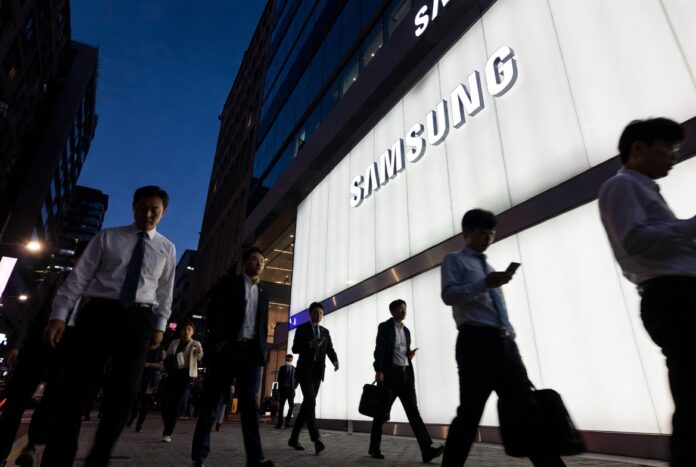
Samsung’s largest labour union confirmed on Friday that it will proceed with an 18-day strike beginning May 21, after government-mediated negotiations collapsed. More than 41,000 workers are expected to join, per CNBC’s May 13 reporting on the formal announcement made at a union rally on April 23. South Korean media estimates put potential participation at over 50,000, with TradingKey citing a figure of 61,000 following a 93.1 percent approval vote. The union is demanding abolition of the 50 percent performance bonus cap, allocation of 15 percent of annual operating profit to a bonus pool, and a 7 percent base salary increase. Management offered a 6.2 percent raise with stock and special bonuses but refused to permanently remove the bonus cap. That gap proved unbridgeable. Union representative Choi Seung-ho told Korea JoongAng Daily that the union declared negotiations over because “management kept extending the mediation without making any meaningful changes to its proposal, which appeared to be an attempt to weaken momentum for a general strike.” Choi added: “We spent 16 out of the 17 hours of mediation simply waiting around,” per Tom’s Hardware’s reporting on the breakdown.
The financial consequences of an 18-day work stoppage are material. JPMorgan estimates the strike could reduce Samsung’s 2026 operating profit by between 7 and 12 percent if union demands are fully met, per TradingKey’s analysis. A direct revenue loss from the 18-day work stoppage is estimated at over 4 trillion won, approximately 1 percent of the semiconductor division’s annual sales, per the same source. The union’s own estimate of potential losses runs as high as 30 trillion won, which most analysts consider an extreme scenario, per TradingKey.
The deeper issue is what the strike reflects about Samsung’s competitive position. More than 200 core engineers have left Samsung for SK Hynix in the last four months, per TradingKey’s reporting. The catalyst for that exodus is straightforward: SK Hynix agreed in 2025 to distribute 10 percent of annual operating profit to an employee performance bonus pool, following its record-breaking earnings. Samsung workers watched their counterparts at SK Hynix set to receive per-capita bonuses potentially reaching 700 million won in 2026, against Samsung bonuses running at less than half that amount, per TradingKey’s strike analysis. Jefferies has stated the Samsung strike could affect approximately 3 percent of global memory chip capacity and accelerate the migration of customer orders to Micron, per the same source.
Catalyst Two: The Trump-Xi Summit Produced Nothing Concrete
The second catalyst was geopolitical. Asian markets opened Friday with residual optimism from the Trump-Xi summit in Beijing, which began on May 14. That optimism dissipated quickly. Tom Ross, head of high yield at Janus Henderson Investors, told CNBC on Friday that “there was no meaningful agreement from the Trump-Xi summit after two days of talks, which weighed on sentiment.” Xi had warned Trump on Thursday that Washington and Beijing could face “clashes and even conflicts” if the sensitive issue of Taiwan independence is mishandled, adding that failure to handle Taiwan “properly” could place “the entire relationship in great jeopardy,” per CNBC’s Asia markets coverage.
For Korean semiconductor stocks specifically, the summit’s outcome on export controls matters as much as the Taiwan framing. The final language from the meeting on semiconductor export restrictions will directly affect both Samsung and SK Hynix’s revenue outlooks, particularly regarding sales to Chinese customers, per Benzinga’s analysis. Goldman Sachs analysts had flagged before the summit that they expected discussions to focus on tariffs and export controls. The absence of a clear positive outcome on either front removed the catalyst that had partially supported the market’s opening move above 8,000.
The contrast with earlier Asian market behaviour this year is stark. For months, Asian equities, including a KOSPI that had already broken multiple records, had largely priced in faster resolution of geopolitical risks than materialised. Friday suggested that tolerance has limits, particularly when the underlying index valuation has moved into territory that leaves little room for disappointment.
Catalyst Three: The Valuation Was Simply Unsustainable
The third catalyst is the one that the other two triggered but did not create. At a forward price-to-earnings ratio of approximately 30 at its intraday peak, the KOSPI had surpassed the S&P 500’s valuation of roughly 22, making it one of the most expensive major global indices in the world at that moment, per Benzinga. For a market that has historically traded at a significant discount to global peers due to the so-called “Korea discount” from governance and geopolitical risk factors, a P/E of 30 is an extraordinary number.
The KOSPI’s run to 8,000 was accompanied by significant structural warning signs. The Korea Exchange had issued 250 investment warning designations on KOSPI and KOSDAQ stocks from January to May 11, a rate that is on track for a 10-year high, per Asia Business Daily’s reporting. Margin balances had grown 12 percent since the end of February, reaching 35.99 trillion won by May 11, per the Korea Financial Investment Association data in the same report. Investor deposits at brokerages had reached 134 trillion won, a record level, per AI PRISM’s May 13 coverage. The index was running on domestic retail fuel: as recently as May 13, retail investors were net buyers of 1.88 trillion won against 3.76 trillion won of foreign selling, per AI PRISM.
Foreign investors had in fact been net sellers for five consecutive sessions before Friday, per AI PRISM’s reporting. Data from DigitalToday shows foreign investors posted net selling of approximately 20.2 trillion won over the eight sessions from the start of May, the third-largest selling on record after February and March 2026. On Friday alone, net foreign outflows from the Korea Exchange reached approximately 1.8 trillion won, roughly $1.21 billion, per Benzinga. The iShares MSCI South Korea ETF (EWY) recorded outflows in three consecutive weeks, shedding over $1.2 billion in assets, per Invezz’s May 15 analysis.
The Broader Asian Session on Friday
The KOSPI’s drop was not an isolated Korean story. The session was broadly negative across Asia-Pacific with one notable exception. Japan’s Nikkei 225 dropped more than 2 percent as the country’s bond yields continued to rise, per Invezz. Australia’s ASX 200 fell 0.30 percent. Hong Kong’s Hang Seng fell 1.6 percent in its final hour of trading, while mainland China’s CSI 300 lost 1.12 percent to 4,859.59, per CNBC’s live markets coverage.
Precious metals were sold aggressively. Spot gold fell 1.43 percent to $4,583.02 per ounce. Silver fell more than 5 percent to $79.07 per ounce, with CNBC’s global markets coverage reporting silver down 7 percent at one point on the day. The US 10-year Treasury yield spiked approximately 9 basis points to 4.544 percent, its highest level in almost a year, driven by the combination of no meaningful Trump-Xi agreement and the resumption of tariff escalation rhetoric, per CNBC’s global markets report. The dollar’s continued strength and the upward pressure on US yields are compressing the monetary policy options for every central bank in Asia that is trying to manage currency depreciation while supporting growth.
India’s Nifty 50 was the only major Asian index to close in positive territory on the day, per Invezz, boosted by Adani Group companies after the Trump administration moved to end lawsuits against the conglomerate. That single-country exception underscored how idiosyncratic the session’s drivers were: Korea was selling on AI concentration and Samsung strike risk, Japan on bond yields, China and Hong Kong on Trump-Xi disappointment, and India was catching a political tailwind from Washington.
What Comes Next for the KOSPI
Three variables will determine whether Friday was a profit-taking correction or the beginning of a more sustained de-rating. The first is the Samsung strike. If the company and union reach an agreement before May 21, sentiment could stabilise quickly. If the 18-day stoppage proceeds as announced, the next question is whether it extends beyond its initial duration, which the union’s stated willingness to return to talks only after June 7 makes structurally likely. The union has not provided an opening for a quick resolution.
The second variable is the final communication from the Trump-Xi summit regarding semiconductor export controls. The absence of clarity on this point left the AI chip rally without the policy tailwind it had partially been pricing in. Any positive signal on export restrictions for Korean memory chips into China could restore some of the lost ground quickly. Any escalation would compound Friday’s move.
The third variable is global bond yields. Tom Ross at Janus Henderson attributed the global bond selloff on Friday to a combination of idiosyncratic factors and shifting macro expectations, with the UK’s gilt market also selling off sharply amid domestic political uncertainty around Keir Starmer’s grip on power and speculation that Andy Burnham could replace him with a looser fiscal stance. A KOSPI that has re-rated to a P/E of 30 on AI earnings expectations is highly sensitive to any increase in the global discount rate.
The structural tension between China’s role as a deflationary force in manufactured goods and an inflationary force in commodity markets is also relevant to the Korean semiconductor story in a way that has not yet been fully priced. The Trump administration’s pressure on export controls and the Trump-Xi summit’s inconclusive outcome leave Samsung and SK Hynix navigating a market in which their largest potential growth market, China, remains structurally constrained by US policy.
Morgan Stanley, JPMorgan and Goldman Sachs have all published bull-case KOSPI targets of 10,000, per AI PRISM’s May 13 coverage. That is 33 percent above Friday’s close. The path to 10,000 runs through a Samsung strike resolution, a positive export control outcome from the Trump-Xi meeting’s aftermath, and a stabilisation in global bond yields. On Friday, all three moved in the wrong direction simultaneously. That is what a 6.12 percent single-day drop looks like.