


Reading time: 8 min
On Monday May 11, SK Hynix surged over 15% intraday on the Seoul exchange, briefly pushing its market capitalisation above $900 billion and hitting an all-time high of 1,949,000 won. On the same day, Nintendo fell nearly 8% in Tokyo to its lowest price in almost two years, after disclosing that Switch 2 prices are going up $50 in the US and that console sales are expected to decline this fiscal year. The same chip shortage caused both.
What SK Hynix Just Reported
The context for Monday’s move is SK Hynix’s Q1 2026 earnings, reported on April 22. The numbers were not just good. They were historically unprecedented for any memory company in any quarter. Revenue came in at 52.58 trillion won, roughly $37.9 billion, up 198 percent year on year and crossing the 50 trillion won threshold for the first time in the company’s history. Operating profit reached 37.61 trillion won at a 72 percent margin. Net profit was 40.35 trillion won at a 77 percent net margin. Every one of those numbers was a company all-time record. And the season in which these results were posted was Q1, which is traditionally the weakest quarter of the year for memory chip demand.
What overrode the seasonal headwind entirely was AI. SK Hynix is the world’s leading supplier of High Bandwidth Memory, the chip architecture that sits inside every Nvidia GPU powering AI data centres globally. HBM revenue more than doubled year on year in 2025, and the Q1 2026 results show that acceleration continuing. The company’s vice president for HBM sales and marketing, Kim Ki-tae, said in earnings communications that HBM demand required over the next three years far exceeds SK Hynix’s supply capacity, according to South Korean financial media reporting on the earnings call. The company added in its earnings release that DRAM, NAND, and HBM are completely sold out and that it cannot satisfy all customer orders. SK Group Chairman Chey Tae-won went further in March, warning investors that the global chip wafer shortage is likely to persist until 2030, with a projected shortfall exceeding 20 percent as expanding capacity takes four to five years.
Goldman Sachs in April raised its 2026 DRAM supply-demand gap forecast from 3.3 percent to 4.9 percent, calling it the most severe shortage in 15 years. TrendForce data showed DRAM contract prices surging 90 to 95 percent quarter on quarter in Q1 2026, with NAND Flash up 55 to 60 percent. UBS on Monday raised its SK Hynix price target from 1.55 million won to 1.7 million won and upgraded its EPS forecasts for 2026 and 2027 by 22 and 29 percent respectively, citing a memory supercycle “unseen in nearly 30 years.” SK Securities went further with a street-high target of 3 million won, arguing that SK Hynix’s 12-month forward P/E of roughly 5.2 times should not be valued using traditional cyclical frameworks. At Q1’s run-rate, annualised 2026 revenue would exceed 200 trillion won, more than double the full year 2025. As the KOSPI has been demonstrating throughout 2026, when SK Hynix runs, Seoul runs with it.
What Nintendo Just Disclosed
Nintendo’s situation runs in exactly the opposite direction. The company reported full-year FY2026 results on May 8 and disclosed that the Switch 2, which launched last June and sold 19.86 million units in its first year, will see its US price rise from $449.99 to $499.99 effective September 1. Japan gets the increase first, on May 25, with a 10,000 yen hike from 49,980 to 59,980 yen, the largest relative adjustment of any market. Europe and Canada follow on September 1 alongside the US. Nintendo’s official language cited “changes in market conditions expected to extend over the medium to long term.” Nintendo president Shuntaro Furukawa confirmed in investor communications that memory shortages and tariffs are the primary profitability pressures driving the increase.
The guidance that spooked the market was not the price hike itself. It was the sales forecast that accompanied it. Nintendo projected 16.5 million Switch 2 units for FY2027, a 17 percent decline from the 19.86 million sold in the year just concluded. Software sales across both Switch and Switch 2 were guided to 165 million units, an 11 percent year on year decline. Net sales for the full year were guided at 2.05 trillion yen, an 11.4 percent decline missing LSEG analyst expectations of 2.46 trillion yen by nearly 400 billion yen. Net profit guidance of 310 billion yen was 26 percent below the analyst consensus of 418.5 billion yen. Nintendo also said it expects a 100 billion yen hit from memory prices and tariffs combined. GameSpot reported the stock fell to its lowest level in almost two years on Monday, with some sources citing an intraday peak decline of close to 12 percent before settling at roughly 8 percent.
The analysts were divided on whether the guidance reflects reality or Nintendo’s famously conservative forecasting culture. Serkan Toto, CEO of Kantan Games, told CNBC: “The clock was ticking for Nintendo for months now. The impact is quite dramatic, as console sales usually go up in the second year, and not down as Nintendo predicts this time.” Morningstar analyst Kazunori Ito took the opposite view, calling the projections “overly conservative” and forecasting 19 million hardware units and 205 million software units against Nintendo’s own 16.5 million and 165 million. Bernstein’s Robin Zhu told Bloomberg that Nintendo’s first-party software pipeline remains the key variable. A Nintendo Direct event laying out the full 2026 software slate could arrive within weeks, per Toto, which would be the fastest way to reset investor expectations.
The Same Chip, Two Completely Different Positions
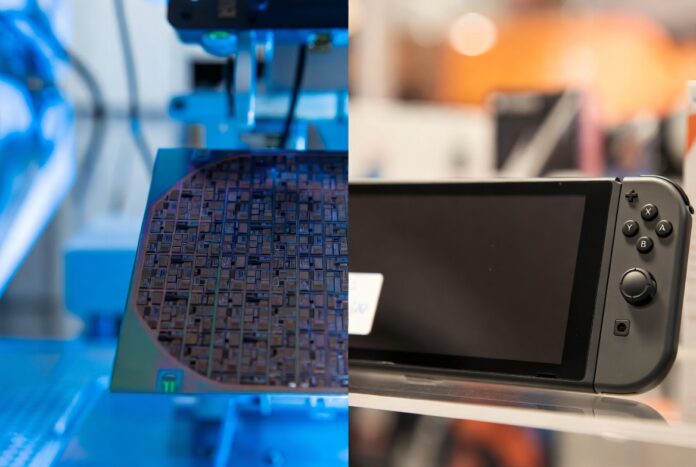
DRAM, the dynamic random-access memory that powers the Switch 2’s processing, is the exact same chip category that is generating SK Hynix’s record margins. BitsFromBytes put the mechanism plainly on Sunday: cloud computing companies (Microsoft, Google, Amazon) are buying DRAM at data-centre scale to build AI infrastructure. Their procurement volume outbids gaming hardware manufacturers for the same fabrication capacity at the same foundries. Nintendo cannot compete with hyperscaler budgets for the same wafer time that SK Hynix sells to Nvidia. The result is that SK Hynix captures the margin upside of the shortage and Nintendo absorbs the cost downside of it simultaneously, on the same trading day, on adjacent exchanges in the same time zone.
Sony sits in an interesting position between them. PlayStation 5 prices were raised by as much as $150 in March, per CNBC, for the same memory cost reasons. But Sony reported on Monday that while hardware sales fell, profit rose, driven by strong digital software sales carrying the gaming segment. Sony was up 10 percent on Monday against Nintendo’s 8 percent decline. The consumer electronics analogy for this trade is straightforward: companies that sell memory win when the shortage bites; companies that buy memory lose. The ratio of AI infrastructure capex to consumer electronics capex in 2026 determines which side of that divide you are on. As institutional capital accelerates into AI-adjacent positions, the companies buying memory for non-AI applications are structurally disadvantaged in this cycle.
What KOSPI Did With All of This
South Korea’s KOSPI closed 4.32 percent higher at 7,822.24 on Monday, opening to a fresh all-time record. SK Hynix’s intraday surge of over 15 percent was the primary driver, with Samsung Electronics adding to the move as investors positioned for further HBM demand. The index has now run approximately 48 percent from its war-driven trough near 5,277 in late March. Samsung and SK Hynix together represent roughly 45 percent of KOSPI’s weighting, which means the index has effectively become one of the most concentrated AI memory trades available in global equity markets. When US chip stocks surge on a Friday, driven by AMD beats, Nvidia guidance upgrades, or hyperscaler capex announcements, Seoul opens higher on Monday with a reliability that has become mechanical in 2026.
The KOSPI move came despite Trump posting on Truth Social that Iran’s latest peace proposal was “TOTALLY UNACCEPTABLE” and that the ceasefire was “on life support.” Oil jumped $4 on the news. The prediction markets tracking the Iran conflict moved sharply on the statement, but KOSPI barely reacted to the geopolitical noise. The index has made its calculation: AI memory demand is a multi-year structural trade, the ceasefire is a day-to-day variable, and the two operate on different timescales. Monday’s session confirmed that calculation is holding.
Japan’s Nikkei 225 was a different story, choppy and closing marginally lower at 62,417.88 after its record session on Thursday. Nintendo’s 8 percent decline was a significant drag on the index’s consumer electronics component, partially offset by continued strength in semiconductor supply chain names. The divergence within a single national index between the commodity and materials winners of the supply chain disruption and the consumer electronics losers of the memory crunch is one of the cleaner expressions of how the 2026 AI trade is distributing gains and losses across the region. SK Hynix is having the best year of any major company in Asia. Nintendo is having one of its harder quarters. The chip connecting them is the same chip, at the same fabs, under the same shortage. Nobody is adding meaningful wafer capacity this year. The imbalance runs until at least 2027.