


Reading time: 10 min
The eurozone recorded its weakest quarterly growth since the pandemic’s aftermath in Q1 2026, expanding by just 0.1% as the Iran war drives energy costs to levels not seen in three years and forces a monetary policy standoff that few central bankers envisioned at the start of the year.
The Numbers Tell a Bleak Story
On April 30, Eurostat’s flash estimate confirmed what the survey data had been signalling for weeks: the euro area economy grew by just 0.1% in the first quarter of 2026, falling below the 0.2% median forecast in a Bloomberg poll of economists. The headline masks pronounced divergence at the country level. Spain, as has become something of a structural pattern, led the bloc with 0.6% growth, driven by resilient domestic consumption and a services sector that remains relatively insulated from energy-intensive production. Germany managed 0.3%, a figure that looks reasonable on paper but sits against the backdrop of a government that has already halved its full-year growth forecast to 0.5%. France, the eurozone’s second-largest economy, recorded zero growth, precisely the stagnation that policymakers had hoped to avoid.
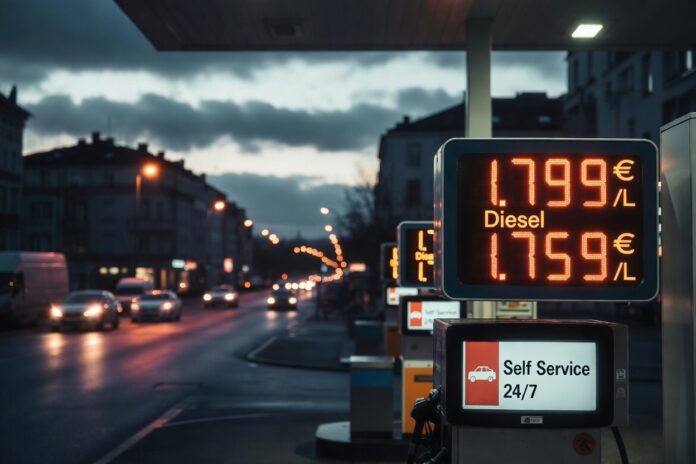
The same day brought equally uncomfortable news on prices. Euro area annual inflation climbed to 3.0% in April 2026, the highest reading since September 2023, up from 2.6% in March and from 1.9% in February. The acceleration is almost entirely energy-driven. Per Eurostat’s April flash estimate, energy costs surged 10.9% year-on-year, the sharpest increase since February 2023, directly reflecting disruptions to oil and gas flows through the Strait of Hormuz. Oil prices have risen by approximately 70% since the war in the Middle East began, while European gas prices remain roughly 45% above their pre-war levels, according to IMF data published in April. The one piece of genuine relief is that core inflation, which strips out energy and food, eased to 2.2% from 2.3% the month prior. Second-round effects, the wage-price feedback loops that proved so corrosive in 2022, have not yet materialized. That may be the ECB’s most important data point right now.
The ECB’s Impossible Balancing Act
At its April 30 meeting, the ECB Governing Council voted to hold all three key interest rates unchanged, with the deposit facility rate remaining at 2.0%. The decision was widely anticipated, with CNBC reporting that markets had broadly priced a hold ahead of the announcement, but the statement accompanying it was notably more cautious than the tone taken in early 2026. The ECB acknowledged that upside risks to inflation and downside risks to growth have simultaneously intensified, a combination that makes the conventional policy toolkit considerably less useful. President Lagarde, in the March press conference following the previous hold decision, had already described the outlook as “significantly more uncertain,” and the April meeting’s communication did nothing to walk that back.
The dilemma is structural. The primary driver of current eurozone inflation is a supply-side energy shock originating outside European borders, specifically the closure and partial blockage of the Strait of Hormuz, which, per ECB Economic Bulletin data, accounts for roughly 20% of global oil supply flows. No interest rate decision in Frankfurt can reopen that passage or rebuild the damaged energy infrastructure in the region. Hiking rates to suppress inflation caused by a supply shock risks compounding the growth problem by raising borrowing costs for firms and households already squeezed by energy bills. Not hiking, however, risks allowing elevated near-term inflation to drift into expectations and eventually into wages. Berenberg economists, in analysis circulated late in April, put the case plainly: if the ECB were to raise rates in response to this temporary spike, the eurozone may first fall into an unnecessary mini-recession before recovering, which would constitute a policy mistake.
The Conference Board, in its updated euro area forecast, placed the ECB in the “single rate hike” camp for 2026 as a precautionary measure to contain spillovers into core inflation, but explicitly noted that absent clear second-round effects, the case for aggressive tightening of two to four hikes, as priced at one point by futures markets, remains weak. The June meeting, when the ECB will have significantly more data, is now broadly viewed as the more consequential decision point.
Germany and France: Two Versions of the Same Problem
The country-level divergence within the eurozone reflects not just cyclical exposure to energy prices but also structural vulnerabilities that predate the current conflict. Germany’s position is the more acute. The seasonally adjusted unemployment rate held at 6.4% in April 2026, its highest level since July 2020, while the number of unemployed persons rose to 3.006 million, the highest count since March 2011, per the Federal Employment Agency’s April 30 release. Andrea Nahles, head of the Bundesagentur für Arbeit, stated there is still “no sign of a turnaround” in the labour market, with the typical spring hiring rebound failing to materialise. Inflation in April accelerated to 2.9% year-on-year, driven in part by energy costs feeding into an industrial base that remains among the most energy-intensive in the developed world. The Merz government’s fiscal package, which had raised some hopes of a structural demand boost, is contributing only modestly to near-term activity. Coface, in its 2026 outlook, estimated German growth could reach 1.0% for the full year assuming the Merz plan’s pass-through, a figure that now looks optimistic given Q1 data and the persistence of the energy shock.
France’s position is different in character. French inflation in April jumped to 2.5%, up from 2.0% in March, a sharper monthly acceleration than most analysts anticipated. The economy’s zero growth in Q1 reflects not just energy costs but the persistent fiscal and political uncertainties that Coface and others have flagged as structurally constraining investment. France ended 2025 with roughly 69,000 business failures, exceeding the previous record set in 2009, per Coface data. European Commission President Ursula von der Leyen warned publicly at the end of April that the economic damage from the current energy shock could be felt for “years.” That is not an assessment the Commission deploys lightly.
Storage, Supply and the Summer Problem
One dimension of the current shock that deserves more attention than it typically receives in the headline GDP and CPI figures is European gas storage. As Rebecca Christie, Elina Ribakova and colleagues at Bruegel noted in analysis published in early March, Europe entered 2026 with materially lower gas storage levels than in recent years: approximately 46 billion cubic metres at the end of February 2026, compared with 60 billion cubic metres in 2025 and 77 billion cubic metres in 2024. The refill season, typically running from spring through early autumn, is therefore more critical than usual. If flows through the Strait of Hormuz remain constrained into summer, storage refill operations will face significant pressure, with direct consequences for industrial energy costs in the fourth quarter and beyond. The International Energy Agency, in mid-April, noted that Europe had roughly six weeks of remaining jet fuel supplies as of that date. On April 30, the European Commission confirmed there are no current fuel shortages in the EU, while stating that the bloc should begin preparing for possible consequences if the situation extends beyond the end of May.
This storage dynamic is one reason why the ECB’s analysis has taken on a distinctly scenario-based quality. The March projections, published by ECB staff on March 19, foresaw annual real GDP growth of 0.9% for 2026 under a baseline assumption that oil prices average around $90 per barrel and gas prices around €50 per MWh through Q2, before declining. That baseline now looks contingent on a resolution timeline that remains far from certain. The ECB’s own Survey of Professional Forecasters, in its Q2 2026 round published in early May, revised 2026 GDP growth expectations down to 1.0%, a downward revision of 0.2 percentage points from the previous round, while revising 2026 headline HICP inflation up to 2.7%. The longer-term expectation for 2030 remained anchored at 2.0%, which is the data point ECB policymakers will be watching most closely.
Renewables, Defence, and the Structural Offset
The current shock is not without offsetting factors, though the offsets are partial. Renewables now account for more than half of European electricity generation, per Eurostat’s 2026 edition of its energy statistics, which has meaningfully reduced the continent’s exposure to gas price spikes relative to where it stood in 2022. Defence spending commitments, following NATO target increases, represent a genuine demand stimulus: the ECB’s Q1 2026 Survey of Professional Forecasters estimated the average annual impact of defence and fiscal spending on real GDP growth at 0.12 percentage points across the 2026-2030 horizon. The EU-India free trade agreement, which will reduce tariffs on over 95% of product groups per KPMG’s European Economic Outlook, adds a longer-term trade diversification option, though India currently represents under 2% of extra-EU exports, making its near-term macro impact modest at best.
The broader trade picture is also complicated by China. As Finonity has covered in detail, China is simultaneously exporting deflation through manufactured goods and importing inflationary pressure through energy and commodity markets, a dynamic that creates competing cross-currents for European manufacturers trying to read their cost and pricing outlook. Supply chain pressures from the Strait of Hormuz disruption are hitting sectors that were already navigating Chinese competition in their core export markets. The contrast with Asia is stark: while European PMIs slumped toward stagnation territory in the spring, Asian equity markets, including a Nikkei that cleared 62,000, largely priced in a faster resolution and proved more insulated from the energy shock given the region’s different fuel mix and geographic distance from the Strait.
On the commodity side, the Iran conflict’s effect is not confined to oil and gas. Copper, which hit $14,527 per tonne on the LME in January, reflects the broader scramble for industrial inputs that characterises a supply shock of this duration, a scramble that European manufacturers are participating in at elevated cost. And the wider trade realignment, including the context examined in Finonity’s coverage of how Trump tariffs have reshaped the transatlantic trade calculus for Britain, is adding friction to European export routes at precisely the moment when the domestic demand picture is weakest.
What the June Decision Will Determine
The ECB’s June meeting is now the focal point for European macro. By then, the Governing Council will have two more months of inflation data, an updated read on whether second-round effects are emerging in wage negotiations, and a clearer picture of whether the Strait of Hormuz situation is moving toward resolution or entrenchment. Vanguard’s scenario analysis, published in April, modelled a baseline in which oil prices average $90-$100 per barrel and gas prices average €60 per MWh for one to two quarters; under that assumption, 2026 GDP growth falls to 0.8% and headline inflation rises to 2.5%. That scenario assumes the conflict eases before summer. If it does not, the downside scenarios in the ECB’s own projections come into focus, scenarios the bank has published but not yet been compelled to confront as base cases.
The eurozone entered this period in a materially better position than it did the 2022 energy shock: inflation was near target, longer-term expectations were anchored, labour markets were resilient, and the banking system was adequately capitalised. Those are genuine advantages. Whether they are sufficient to navigate a supply shock of this scale without a policy mistake on rates, a meaningful growth miss, or both will be determined in the months ahead, not in the data that is already in.