


Reading time: 10 min
The eurozone composite PMI collapsed to 48.6 in April, the first contraction in sixteen months, while consumer inflation expectations doubled to 4.0 percent in a single month. Christine Lagarde walks into Thursday’s rate decision facing a textbook stagflation trap, and the data arriving alongside her verdict will only make it worse.
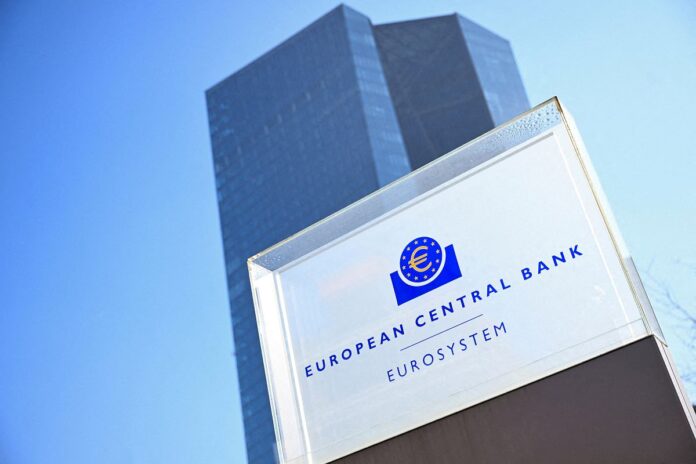
Three numbers define the week. On Wednesday, Eurostat will publish its flash estimate for eurozone inflation in April, with the consensus sitting at 2.9 percent, the highest since late 2023. On Thursday morning, the agency releases its preliminary reading of first-quarter GDP, the first hard growth figure to capture the opening weeks of the Iran conflict. And at 14:15 CET the same day, the European Central Bank announces its rate decision, followed by what promises to be one of the most consequential Lagarde press conferences since the post-pandemic tightening cycle began. The Governing Council started deliberating in Frankfurt on Tuesday. It is not a comfortable room.
The Contraction Nobody Can Ignore
The flash PMI data published by S&P Global on April 23 caught even the pessimists off guard. The HCOB composite output index fell from 50.7 in March to 48.6, breaching the contraction threshold for the first time since November 2024. The damage was concentrated in services, where the business activity index plunged to 47.4, a sixty-two-month low that takes the sector back to the depths of early 2021 lockdown territory. Dr Cyrus de la Rubia, chief economist at Hamburg Commercial Bank, noted in the accompanying release that the war is “hitting the service sector hardest.” ING’s rates team described the report as evidence of “deepening stagflationary pressures,” a phrase central bankers do not enjoy hearing forty-eight hours before a policy meeting.
Manufacturing, paradoxically, painted a brighter picture on the surface. The factory PMI climbed to 52.2, the strongest reading since May 2022, with new orders expanding at their fastest pace in four years. That number, however, comes with a critical asterisk. S&P Global noted explicitly that a significant portion of the upturn reflected customers stockpiling inventory ahead of anticipated price hikes and supply disruptions linked to the Middle East conflict. This is not organic demand. It is fear buying, the same pattern that briefly inflated manufacturing readings in the early months of the Russia-Ukraine war before demand collapsed. Business confidence, accordingly, fell to a seventeen-month low.
The services collapse is the more consequential signal. Services account for roughly two-thirds of eurozone GDP and employ the vast majority of workers. When the sector contracts at this pace, it typically shows up in consumer spending within a quarter. Household budgets are already under pressure from surging commodity prices across the metals and energy complex, and the European Commission’s consumer confidence indicator has fallen for two consecutive months.
The Inflation Problem Is Accelerating
Eurozone inflation was confirmed at 2.6 percent in March, up sharply from 1.9 percent in February, according to Eurostat’s final HICP release on April 16. The composition of that jump tells the real story. Energy prices swung from a 3.1 percent annual decline to a 5.1 percent increase in a single month, per Eurostat, the sharpest reversal since the energy shock of early 2022. The cause is not subtle. Iran’s near-total closure of the Strait of Hormuz, through which roughly a fifth of the world’s oil and liquefied natural gas trade passes, has sent Brent crude up approximately 73 percent year-to-date, according to Trading Economics data.
Core inflation, which strips out energy and food, actually edged lower in March, falling to 2.3 percent from 2.4 percent. That is the number the ECB’s doves will lean on. But the data published by the ECB itself on April 28 undercuts that argument considerably. The March Consumer Expectations Survey showed median twelve-month inflation expectations jumping to 4.0 percent, up from 2.5 percent in February. Three-year expectations rose to 3.0 percent. Expected nominal spending growth climbed to 4.1 percent, the highest since May 2023. If these figures do not constitute a de-anchoring of inflation expectations, they are closer to one than anything the Governing Council has seen since the 2022 crisis.
The pass-through across member states is uneven, which complicates any unified policy response. Goldman Sachs economists Garnadt and Pierdomenico modelled the transmission speed, as cited by Euronews on March 31: Italy, heavily dependent on natural gas, sees the deepest impact; Spain’s flexible tariffs transmit wholesale spikes to households almost immediately; France’s regulated structure provides the most insulation. In March, Spain’s harmonised inflation stood at 3.4 percent while Italy’s remained at 1.6 percent, a gap that makes a single interest rate inherently imprecise.
The ECB’s Impossible Calculus
The deposit facility rate has been on hold at 2.0 percent since June 2025, when the ECB delivered its last twenty-five basis point cut, according to the central bank’s own rate history. Six consecutive holds followed. The March meeting, the first after the outbreak of hostilities in the Middle East, produced a unanimous decision to wait. Lagarde told reporters on March 19 that the war had made the outlook “significantly more uncertain, creating upside risks for inflation and downside risks for growth.” Staff projections, incorporating data through the unusually late cut-off of March 11, forecast headline inflation at 2.6 percent and GDP growth at just 0.9 percent for 2026.
Those projections are already stale. The PMI data, the inflation expectations survey, and the deterioration in German business sentiment, where the Ifo index fell to 84.4 in April (the lowest since May 2020, per the Ifo Institute’s release on April 25) and the ZEW economic sentiment indicator slumped to minus 17.2, all post-date the March staff exercise. The IMF’s Regional Economic Outlook for Europe, released on April 17 alongside the World Economic Outlook titled “Global Economy in the Shadow of War,” cut the eurozone growth forecast to 1.1 percent from 1.4 percent and warned that in its adverse scenario, a persistent supply shock combined with tightening financial conditions, the bloc could approach recession with inflation nearing 5 percent.
Market pricing, per LSEG data cited by CNBC on April 16, assigns only a 10 percent probability to a rate hike on Thursday. The base case is a hold, with language that implicitly opens the door to June. ING’s rates strategy team, in a note titled “Ready, Aim, Hold” published on April 23, framed the meeting as a placeholder while the real battle begins six weeks later. Markets currently price between 20 and 40 basis points of tightening by the June meeting and roughly 50 basis points by year-end, which would take the deposit rate to approximately 2.5 percent.
The Governing Council is not unified. Bundesbank President Joachim Nagel told CNBC in Washington on April 16 that he was “really cautious to give a proper indication” of the next move, adding that “in two weeks, we can see a lot of new things coming.” Latvian central banker Martins Kazaks, asked whether April was too soon for a hike, replied simply: “we will see.” At the other end, Lagarde herself, speaking at the ECB Watchers conference in late March, stated that “some measured adjustment of policy could be warranted” even if the inflation surge proves temporary. That is as close to pre-commitment as this particular president gets.
Germany: The Recovery That Never Arrived
The Federal Ministry for Economic Affairs and Energy slashed Germany’s 2026 growth forecast from 1.0 percent to 0.5 percent, as CNBC reported on April 24. Inflation is now projected at 2.7 percent for the year, up from earlier estimates. The energy shock, compounded by the broader oil-driven crisis confronting central banks globally, has pushed Europe’s largest economy back into defensive mode barely months after the coalition government’s fiscal stimulus package was supposed to reignite growth.
The damage runs deeper than headline numbers. Lufthansa Group announced it would cut 20,000 flights from its schedule through October because jet fuel prices had doubled since the outbreak of the Iran conflict that continues to roil energy markets. BASF has hiked prices by more than 30 percent on products ranging from formic acid to homecare goods, per CNN’s April 22 report. The German Chemical Industry Association warned of further production shutdowns. According to the European Commission, the bloc has spent an additional 24 billion euros on energy imports since the start of the war, more than $587 million per day, while industrial energy prices remain roughly double their pre-2022 levels and substantially higher than those in the United States.
What Thursday’s Data Will Show
The preliminary flash GDP estimate for the first quarter is the most uncertain of the three releases. The fourth quarter of 2025 delivered a modest 0.2 percent expansion, per Eurostat’s April 20 update. The PMI composite for Q1 averaged above 50, suggesting marginal growth, but the March deterioration raises questions about how much of the figure reflects genuine momentum versus statistical carryover. Vanguard’s forecast puts full-year growth at just 0.8 percent, below even the ECB’s 0.9 percent baseline.
The April inflation flash will carry more immediate weight for the rate decision. If headline inflation prints at or above the 2.9 percent consensus, it will mark the highest reading since December 2023 and the third consecutive month above the ECB’s target. The Conference Board, in its latest eurozone outlook, projects inflation peaking above 3 percent in the coming months, with the possibility of briefly exceeding 4 percent if the conflict escalates. Prediction markets on Polymarket price an 85 percent probability that inflation ends 2026 above 2.8 percent.
The parallel with other major central banks facing fiscal and monetary trade-offs is instructive. The Bank of Japan is managing a record bond issuance programme while navigating its own inflationary pressures. The Bank of England, dealing with a deteriorating labour market and above-target inflation simultaneously, has kept rates on hold while markets debate whether its next move is up or down. The ECB faces the same dilemma in a more acute form: the eurozone entered this shock with weaker growth than either the United States or the United Kingdom, and its energy import dependency is structurally higher.
The Policy Trap
Pepperstone’s macro research team, in a preview published on April 21, argued that hiking rates in response to what remains predominantly a supply-side shock would “amplify the negative demand shock” already visible in the PMI data. Their model suggests that even if the ECB fails to deliver the tightening embedded in its March projections, the impact on peak inflation this year would be negligible.
That is the dovish case. The hawkish case rests on the Consumer Expectations Survey. When twelve-month inflation expectations double in a single month, from 2.5 percent to 4.0 percent, the risk of second-round effects, wage demands, margin protection through price hikes, anticipatory purchasing, moves from theoretical to operational. The 5Y5Y inflation forward swap, the ECB’s preferred market gauge of long-term expectations, has so far risen only modestly, from 2.08 percent in February to 2.14 percent. That stability is what gives the Governing Council room to wait. If it breaks, the room disappears.
The most likely outcome on Thursday is a hold accompanied by language measurably more hawkish than March. Lagarde will probably reference the inflation expectations data without calling it de-anchoring, note that the economy is evolving “between the baseline and the adverse” scenarios (the formulation she used in her Bloomberg interview on April 14), and reiterate the meeting-by-meeting framework without pre-committing to June. The euro, trading at $1.1698 on Tuesday, is unlikely to move materially unless the press conference delivers a genuine surprise.
The deeper question is whether any of this matters if the war continues. Deutsche Bank’s base case, outlined in February, was for the ECB to hold at 2.0 percent through all of 2026, with the first hike not arriving until mid-2027. That scenario assumed a benign inflation trajectory that no longer exists. The ECB’s own adverse scenario modelled oil prices 80 percent above baseline. Brent is already up 73 percent. The adverse scenario is no longer a tail risk. It is the central tendency. And the ECB, for all its institutional credibility, cannot set a price for oil. It can only decide how much economic pain to layer on top of an energy shock that it did not cause and cannot control. That is the only set of options available.