


Reading time: 7 min
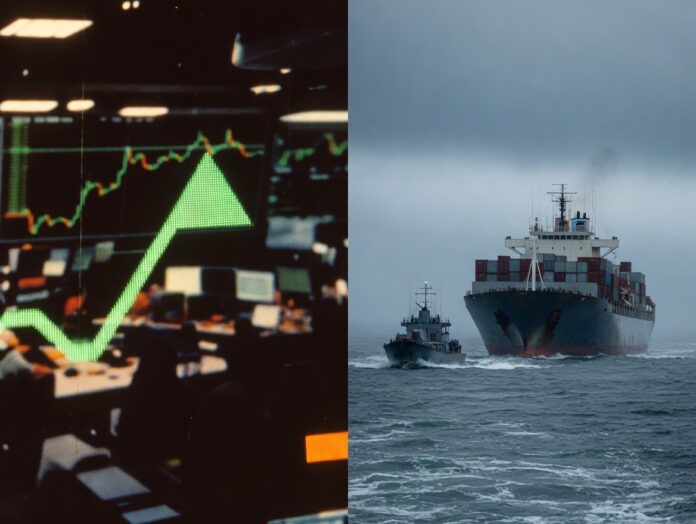
The S&P 500 closed at 7,137.90 on April 22, a fresh all-time high, up 1.05 percent on the session. The Nasdaq Composite finished at 24,657.57, also a record, up 1.64 percent. The Dow Jones Industrial Average gained 340.65 points to 49,490.03. The VIX dropped to 19. And while all of that was happening, Iran’s Revolutionary Guard attacked three vessels in the Strait of Hormuz, seizing two of them and firing rocket-propelled grenades into the bridge of a Greek-owned cargo ship called the Epaminondas, per CNBC, NBC News and UKMTO reporting.
Both of those things happened on the same Wednesday. The market that is supposed to price risk just made a new high while the chokepoint that carries a quarter of the world’s seaborne oil trade was, by any military definition, under active attack.
What the Market Bought
The catalyst for the rally was a decision President Trump made shortly after Tuesday’s close. He extended the US ceasefire with Iran indefinitely, saying Tehran’s government was “seriously fractured” and needed time to “come up with a unified proposal” to end the war. The truce had been set to expire on Wednesday. Trump had previously vowed not to extend it. He extended it anyway, and the S&P 500 futures opened 0.5 percent higher on the news, per Bloomberg.
The ceasefire extension came with a critical qualifier that the market chose to treat as background noise: the US naval blockade of Iranian ports remains in place. The blockade that shut Hormuz to most commercial traffic in late February has not been lifted. Vice President JD Vance cancelled a planned trip to Islamabad for a second round of peace talks after Iran refused to attend, per the Associated Press. The White House is offering more time without offering any change in the military posture that provoked the crisis in the first place.
Put that in context. The S&P 500 has now erased the entirety of its Iran war losses, rallied past its pre-war peak, and added another 2 percent on top. It did so while Brent crude was still trading near $98 per barrel, per CNBC data, well above the $68 average that the IMF used in its October 2025 baseline forecast. The disconnect is not subtle.
What Happened in the Strait
The sequence in the Strait of Hormuz on Wednesday morning tells a different story from the one the equity market was trading.
At approximately 5:47 a.m. London time, the UKMTO reported that an IRGC gunboat approached a cargo ship roughly 15 miles northeast of Oman and opened fire without warning, causing “heavy damage” to the bridge, per CNBC. All crew were reported safe. Iran’s semiofficial Tasnim News Agency said the vessel had “ignored repeated warnings.” A British maritime security firm, Vanguard Tech, said the ship had been informed it had permission to transit the strait. Wikipedia and Greek media identified the vessel as the Epaminondas, a Liberian-flagged, Greek-owned cargo ship attacked with gunfire and rocket-propelled grenades.
The IRGC then announced it had seized the Epaminondas along with a second vessel, the MSC Francesca (Panamanian-flagged), transferring both to Iranian waters, per NBC News and Al Jazeera. Ship tracking data showed both vessels had stopped transmitting AIS signals on April 18 before reappearing off the Iranian coast on Wednesday morning. A third ship, the Greek-linked Euphoria, was separately attacked and reported disabled between Oman and Iran, per NBC’s tracking analysis. Iran’s Fars News Agency said the Euphoria was now “stranded on Iranian shores.”
Greece’s Foreign Minister Giorgos Gerapetritis told reporters that the Epaminondas was “trying to get out of the Strait of Hormuz” when it was seized, and issued a notice to all Greek-owned ships to avoid the waterway. The White House response, delivered by press secretary Karoline Leavitt on Fox News, was that the seizures did not constitute a ceasefire violation because “these were not US ships” and “these were not Israeli ships.” She described Iran’s actions as “piracy.”
A multinational planning conference is now underway at a Royal Air Force base north of London, per NPR, with military planners from more than 30 countries working on a convoy escort mission for the strait. The plan would only take effect after what the organisers call “a sustained ceasefire,” a condition that does not currently exist.
The Earnings Layer
The market rally was not built entirely on ceasefire hope. It was also built on earnings that, so far, have been difficult to argue with.
More than 80 percent of S&P 500 companies that have reported first-quarter results have beaten expectations, per FactSet. Boeing reported an adjusted loss of 20 cents per share against an expected loss of 83 cents, with revenue of $22.22 billion beating the $21.78 billion consensus, per LSEG data. The stock rose more than 3 percent in premarket trading. GE Vernova jumped 12 percent after revenue of $9.34 billion topped estimates and the company raised its full-year outlook. The S&P 500 had its worst session of the year in March, but the index has now cleared 7,000 and added another 2 percent, and the earnings tape is keeping it there.
Tesla reports after Wednesday’s close. BofA reiterated a buy rating ahead of the print, arguing that first-quarter focus would be on “robotaxi deployments” and what the firm described as a “$1 trillion-plus market opportunity,” per CNBC. The result will land in a market that is priced for optimism and positioned for continuation. If it disappoints, the reaction will test whether the ceasefire premium is enough to hold the index at these levels without a tech bid underneath it.
The Pricing Contradiction
The equity market and the energy market are telling incompatible stories. Brent crashed 16 percent on April 8 when the ceasefire was first announced, then recovered half the move when talks collapsed, and is now hovering near $98 as traders try to figure out whether an indefinite extension of a truce that includes a continuing blockade is bullish or bearish for crude. WTI settled around $89.
The answer depends on which market you trust. Equities are pricing a war that is winding down. Oil is pricing a strait that is still closed. Both cannot be right at the same time, and the resolution of the contradiction will determine whether the S&P 500 at 7,137 is a new floor or a ceiling.
The structural case for the rally is real. Japan’s Nikkei, which lost 3.4 percent in a single session during the worst of the war, hit its own record last week on the same peace optimism. South Korea’s Kospi is up more than 47 percent year-to-date on semiconductor exports. The AI capex cycle is feeding through to earnings across the tech stack, with BMO projecting Google Cloud Platform revenue of $84.8 billion for 2026, a 44 percent year-on-year increase. The earnings are real. The multiples are justifiable at these growth rates. The problem is not the fundamentals. The problem is that the fundamentals are being discounted against a geopolitical backdrop that, as of Wednesday morning in the Strait of Hormuz, is still producing rocket-propelled grenades and seized cargo ships.
Consumer confidence has already dropped below the level that preceded every recession since 1978. March CPI came in at 3.3 percent, driven by a 19 percent year-on-year spike in gasoline. Lufthansa cut 20,000 flights through October because jet fuel costs have doubled since the war began. United Airlines lowered its full-year profit forecast. The consumer is paying the energy premium even as the equity market celebrates the ceasefire that has not ended the energy crisis.
What the Record Is Actually Pricing
The S&P 500 at 7,137.90 is not pricing peace. It is pricing the expectation that peace is close enough that the war premium in energy will unwind before it shows up in second-quarter earnings. That is a bet on timing, not on fundamentals, and timing bets against geopolitical events have a specific track record: they work until they don’t, and when they stop working, they stop all at once.
Iran’s senior negotiator told state media on Wednesday that Trump’s ceasefire extension “means nothing,” per NPR. The Revolutionary Guard is seizing ships in a waterway that 30 countries are now planning to escort with naval convoys. The White House says the seizures don’t violate the ceasefire because the ships weren’t American. That is the backdrop against which the S&P 500 just made a record high. The market is not wrong to rally on earnings, on AI capex, on the probability that the war eventually ends. It may be wrong about eventually meaning soon.