


Reading time: 5 min
The national average for a gallon of regular gasoline hit $3.41 on Saturday, up 14% in a single week, per AAA. That’s the sharpest weekly surge since March 2022. A week ago, the average was below $3. Thirteen consecutive weeks under that level, the longest stretch since 2021, ended on Monday. Diesel climbed even harder – up 15.3% to $4.33, per Benzinga. If your book has any exposure to freight, agriculture or consumer discretionary, that diesel number is the one to watch.
The trigger is mechanical and by now familiar. WTI broke above $90 on Friday for the first time since October 2023. Brent is holding above $90. The Strait of Hormuz, which carries roughly 20% of the world’s seaborne crude, is functionally closed. Iran has been hitting ships, energy facilities and Gulf infrastructure since the US-Israeli strikes began on February 28. QatarEnergy halted production at Ras Laffan. Storage tanks across the Gulf are filling up because tankers can’t get out, which means producers are cutting output even as demand hasn’t dropped.
That’s the supply side. The demand side hasn’t adjusted yet.
What the Pump Numbers Show
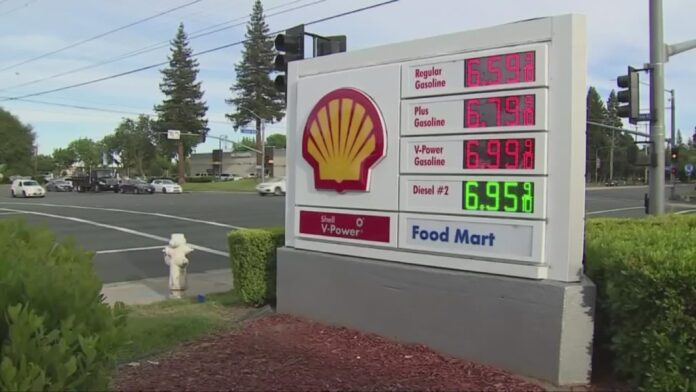
AAA reported the national average at $3.25 on Wednesday March 5, already up 27 cents from the prior week. By Saturday it was $3.41. TIME, reporting on the AAA data, noted the average was under $3 just seven days earlier. Bloomberg confirmed gasoline futures rallied 27% on the week, the biggest weekly advance since March 2022 when Russia’s invasion of Ukraine sent energy markets into chaos. The parallel matters. In 2022, the spike peaked around $5 nationally in June. This time the starting point is lower, but the crude move underneath is faster – WTI went from the low $70s to above $90 in five trading sessions.
The state-level dispersion is extreme. Per Benzinga, Kansas is at $2.87. California is at $4.91 – nearly $5. That’s a $2.04 spread between the cheapest and most expensive state. Oregon, Washington and Hawaii are all above $4. Some Northern California stations have already crossed back above $5, a level historically associated with demand destruction. If you’re positioned in refining margins, the West Coast crack spread is where the action is.
Diesel is where the real damage sits. The 15.3% weekly jump to $4.33 per gallon, the steepest of any fuel category per Benzinga, feeds directly into freight costs, agricultural input costs and manufacturing logistics. Diesel inflation doesn’t show up in CPI for weeks, but it shows up in corporate margins immediately. Every trucking company, every rail operator, every farmer running equipment into spring planting is repricing right now.
Why the US Can’t Insulate Itself
The instinct is to say America is energy independent. That’s half right. US crude production hit record levels in 2025, up 167% from 2008, per CNN citing federal data. But as CNN’s analysis this week made clear, America produces light sweet crude – good for gasoline, poor for diesel, kerosene and fuel oils. The country still needs to import heavier crudes or refined products to meet diesel and jet fuel demand. When the Gulf supply chain seizes up, those imports get more expensive or stop arriving entirely.
Bob McNally at Rapidan Energy Group, a former energy adviser to President George W. Bush, told CNN that if Hormuz doesn’t reopen “soon,” oil is heading to $100 and gasoline nationally is heading above $4. That’s not a fringe call. The strait is in its second week of effective closure. Traffic has slowed to a crawl. Even when it reopens, damaged infrastructure in the UAE, Qatar and potentially Saudi Arabia will take time to restore. The fire at a key storage hub in Fujairah, UAE underscored that point on Tuesday.
Treasury Secretary Scott Bessent responded this week by issuing a 30-day waiver on US sanctions on Russian oil sales to India, per TIME, specifically targeting barrels already stranded at sea. Bessent described it as a “deliberately short-term measure” that would not significantly benefit Moscow. It’s a signal of how thin the policy options are. The administration is releasing Russian barrels to cool a market that its own military operation created.
The Political Price
Trump made energy affordability a centrepiece of his 2024 campaign. In his State of the Union address last month, he boasted of gasoline below $2.30 in most states and $1.85 in Iowa. TIME reported that in an interview with Reuters this week, Trump dismissed rising prices: “I don’t have any concern about it. They’ll drop very rapidly when this is over.” That’s a bet on a short war. The White House said this week it needs four to six weeks to meet war objectives. If crude stays above $90 for that duration, the gasoline math gets unpleasant fast.
Bloomberg reported on Thursday that the $3.32 level that day was the highest pump price at any point under the Trump presidency and the highest since May 2024. By Saturday, at $3.41, it had already been surpassed. The political sensitivity is obvious. Midterm elections are in November. Every 10-cent increase in gasoline costs American households roughly $13 to $14 billion annually in additional spending, based on EIA volume estimates of around 130 to 140 billion gallons consumed per year. At current trajectories, the total hit by summer could rival the 2022 energy shock that contributed to the worst consumer sentiment readings in decades.
The Positioning
Here’s what the market is pricing. Gasoline futures are front-running a sustained Hormuz closure. Diesel futures are pricing in a freight inflation impulse that hasn’t yet reached consumer goods. Crude is pricing in a war that the White House says will last at least another month. The base case is $90+ WTI through March, with $100 as the tail risk if the strait stays shut or Saudi infrastructure gets hit again – Riyadh intercepted 16 drones targeting its Shaybah field last weekend.
If you’re long energy equities, the trade is working but getting crowded. If you’re short consumer discretionary on the thesis that pump prices crush spending, the diesel number is your confirmation signal. If you’re watching the Fed, this is the nightmare scenario: a labour market that just printed -92,000 jobs alongside an energy shock that pushes headline inflation higher. Rate cuts get pushed back. Growth gets weaker. The dollar stays bid on haven flows but the economy underneath is deteriorating.
The market is pricing a stagflation impulse. Whether it gets one depends on how long those tankers sit idle in the Gulf.
Size your positions accordingly.
For a complete timeline of how the Iran war reshaped global markets, see our reference page.